Denmark Shows How Biogas Can Be Carbon-Negative
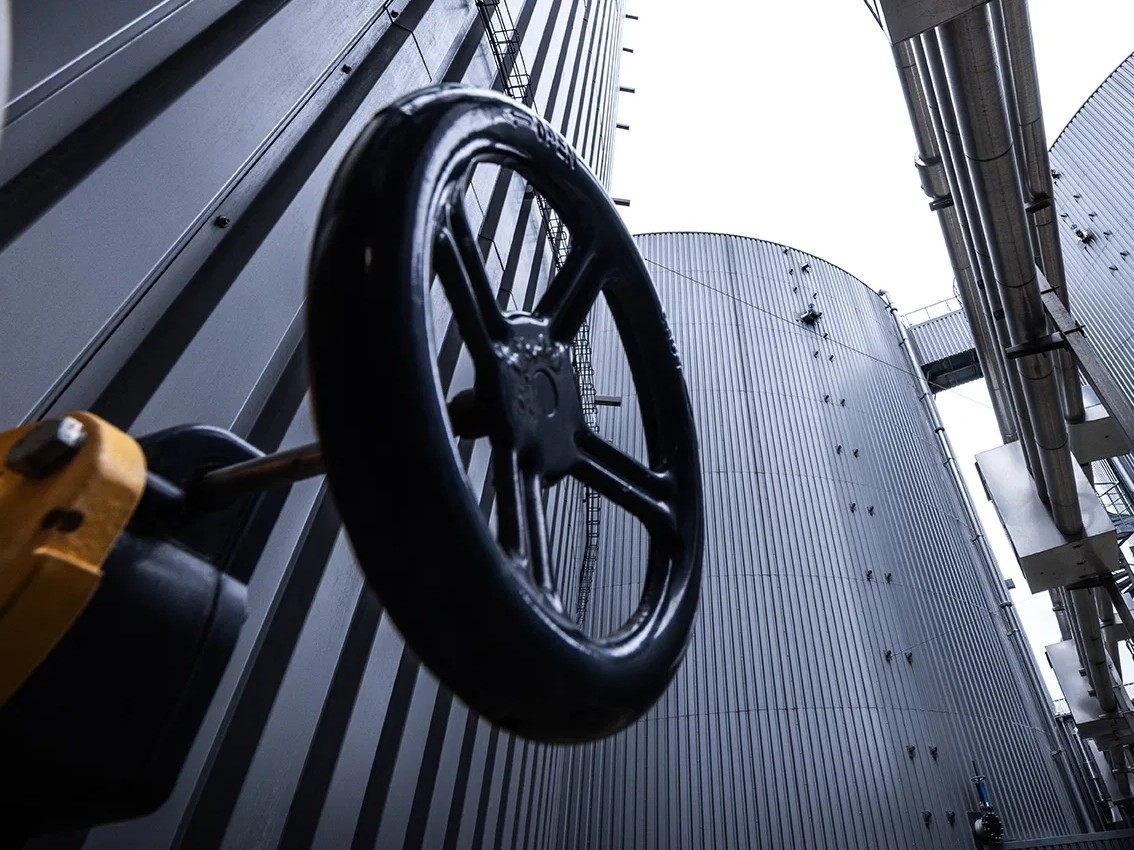
On 20 May Bigadan inaugurated a new CO₂ facility at the Kalundborg Bioenergy site, reaching a milestone the biogas industry had so far only referred to in theory. The Danish company has now shown in practice, for the first time, that biogenic carbon dioxide recovered from biogas can be used commercially, stored permanently and handled as part of a complete, closed value chain.
What is being built in Kalundborg – and why it matters
For years, Bigadan's biogas plant in Kalundborg has processed organic by-products from pharmaceutical and fermentation production at the Novo Nordisk and Novonesis plants. This amounts to around 300,000 tonnes of biomass a year, which is turned into biogas and liquid fertiliser. The plant's annual biogas production is about 30 million Nm³, a suitable basis for CO₂ capture.
The new facility builds on this base: the carbon dioxide produced during biogas production – previously simply released into the air – is now captured, purified, liquefied and transported to permanent geological storage. The captured CO₂ goes to the port of Esbjerg, where after temporary storage it is loaded onto ships and placed in permanent geological storage in the Nini field deep beneath the North Sea – under Project Greensand, led by INEOS Energy.
The Kalundborg site's initial capacity is 27,000 tonnes of CO₂ a year, but this could grow to 200,000 tonnes by 2030 as Bigadan introduces CO₂ capture at its other Danish plants. The company currently operates nine such facilities and produces 1.3 TWh of renewable energy a year.
BECCS: the carbon-negative technology that has so far existed only on paper
BECCS (bioenergy with carbon capture and storage) is not a new concept in climate policy. IPCC and European Commission documents have for years counted on it as a tool needed to reach net-zero targets, but the number of commercial projects actually built has so far been negligible.
The logic of BECCS is remarkable. The plants and organisms that make up biomass took carbon dioxide from the atmosphere during their lives, so the carbon stored in agricultural by-products, industrial fermentation residues and sewage sludge is considered biogenic. If the CO₂ released when the resulting biogas is burned or processed is captured and stored permanently, the whole process ends with a net negative carbon balance: more carbon dioxide goes underground than the chain emits.
This means Bigadan's Kalundborg plant is not just carbon-neutral but, in principle, carbon-negative. That is the threshold beyond which the biogas industry actively helps reduce atmospheric CO₂, rather than merely replacing fossil energy.
The NECCS (Negative Emission Carbon Capture and Storage) tender programme launched by the Danish Energy Agency, which provides a state support framework for negative-emission projects of this kind, played a key role in financing the project.
The value chain: what does "integrated" mean in practice?
In Bigadan's own words, the project delivers "one of the world's first fully integrated commercial value chains". The claim becomes clear when we follow each step.
The first step is biogas production from organic feedstock by anaerobic digestion. The second is capturing and purifying the CO₂: the methane and carbon dioxide fractions of the biogas are separated and the CO₂ purified. The third is liquefaction: the gaseous carbon dioxide is turned into a liquid, which makes it transportable. In the fourth step the liquid CO₂ travels by tanker truck to the port of Esbjerg. In the fifth step it is placed in a depleted oil field beneath the North Sea floor, where geological formations will lock it away for millennia.
Project Greensand: the North Sea as a store
Project Greensand, which serves as the storage site, was set up under the leadership of INEOS Energy and uses the Danish sector of the North Sea for the permanent geological storage of carbon dioxide. The project aims to be able to take in 250 million tonnes of CO₂ a year by 2040 – an outstanding capacity even by European standards.
The Bigadan–INEOS partnership is also remarkable because it links a biogas plant – which essentially processes agricultural and industrial waste – directly with offshore storage infrastructure. Such integration was previously unthinkable; the project is new not only technologically but also as a business model.
What does this mean for Europe?
All this is both symbolic and practical. Symbolic, because it proves that BECCS is not just a theoretical component of climate policy scenarios but a feasible, financeable and operable technology. The demonstration effect is invaluable – especially at a time when EU climate policy is under growing pressure to find ways of staying on a 1.5 °C path.
Practical, because it sets a template: Bigadan's model can be adapted to other European biogas plants.
According to Bioenergy Europe's latest BECCS report, more and more projects are starting in this direction in Europe, but Kalundborg is the first to be built as a full commercial value chain rather than a pilot plant.
Bigadan's expansion plan
Bigadan plans to extend CO₂ capture gradually to all its Danish plants. The Horsens site already has a CO₂ facility, and one is also being built in Herning. If all nine plants join, a decisive share of the company's CO₂ emissions could go into geological storage.
Against this background, the 2030 capacity target of 200,000 tonnes looks realistic – provided that storage infrastructure (Greensand) and logistics capacity (Esbjerg) can keep pace. The company has also declared the goal of exceeding 2 TWh of renewable energy production a year by 2027.
On 20 May, Denmark's Bigadan inaugurated its CO₂ facility in Kalundborg, creating one of the world's first fully integrated, commercial-scale value chains for the permanent geological storage of biogenic carbon dioxide captured from biogas. Initial capacity is 27,000 tonnes of CO₂ a year, with plans to expand to 200,000 tonnes by 2030. The captured carbon dioxide is liquefied, transported to the port of Esbjerg and then stored permanently deep beneath the North Sea under Project Greensand, operated by INEOS Energy. The BECCS approach – supported by the Danish state's NECCS tender – enables a carbon-negative balance: the process captures more CO₂ than it emits. The Kalundborg project is not a pilot plant but a full commercial system – the first of its kind in Europe's biogas sector.
On 20 May, Denmark's Bigadan inaugurated its CO₂ facility in Kalundborg, becoming the first to create a fully integrated, commercial-scale value chain for the permanent geological storage of biogenic carbon dioxide captured from biogas. The event is a milestone not only for the Danish biogas industry but also for European climate policy.
Kalundborg Bioenergy processes around 300,000 tonnes of biomass a year – mainly fermentation by-products from Novo Nordisk and Novonesis – producing 30 million Nm³ of biogas. The new facility captures, purifies and liquefies the carbon dioxide released during biogas production. The liquid CO₂ goes to the port of Esbjerg, from where it is shipped to the Nini field on the North Sea floor – under Project Greensand, operated by INEOS Energy. The project plans storage capacity of 250 million tonnes a year by 2040.
The facility's initial CO₂ capture capacity is 27,000 tonnes a year, to be expanded to 200,000 tonnes by 2030, while CO₂ capture is also being built at other Bigadan plants in Denmark, including Horsens and Herning. The development is supported by the Danish Energy Agency's NECCS tender.
The BECCS-based system enables a carbon-negative balance: the process results in net removal of carbon dioxide from the atmosphere. It has turned a technology that existed only at pilot level in Europe's biogas sector into a commercial reality – that is the real significance of the Kalundborg inauguration.



From 4 November, companies that want to buy biomethane can post their demand on the European Commission's platform and producers can bid from January. Here is what to do now and what the scheme will not give you.

Berlin wants gas and heating oil suppliers to sell a rising share of renewable fuels to households from 2028, but biomethane producers say the draft design favours hydrogen.
W4 relaunches with a new website, an English edition, dedicated series pages and a separate professional hub – the same coverage, with far better tools for reading and finding it.
A new analysis finds that global biomethane production could in theory cover much of international shipping's early decarbonisation energy demand, but regulatory details may decide whether it actually reaches the seas.