Ukraine's Largest Biomethane Plant Comes Online
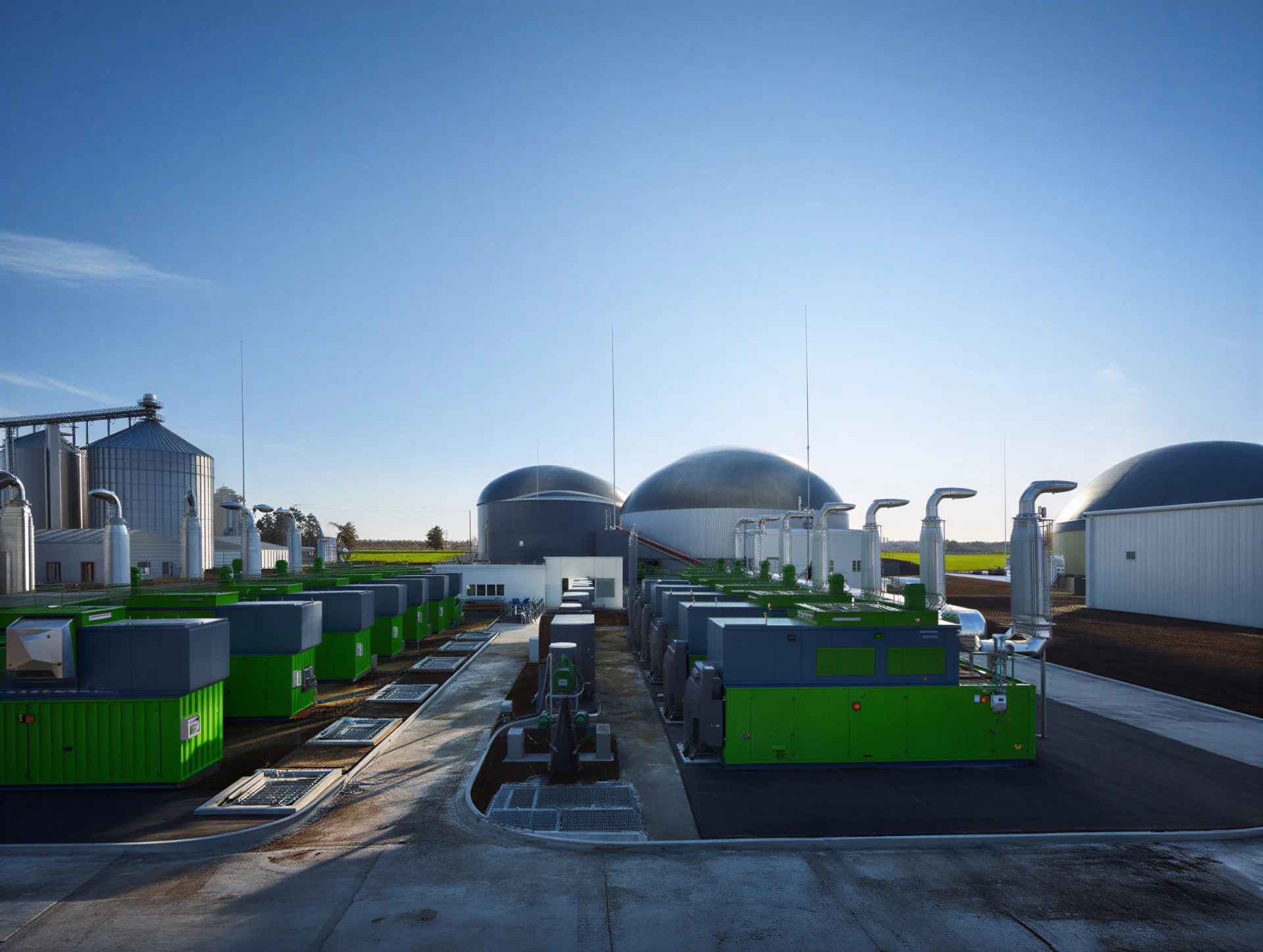
Ukraine's biomethane sector has a short but dynamic history. The relevant legislation was adopted in 2021, and the country first exported biomethane to the international market in 2025. The latest development: in March 2026 the largest Ukrainian biomethane plant to date was commissioned.
A record-sized plant with a direct grid connection
With an annual capacity of 56 million m³, Teofipol Energy Company's facility has become a major player in the country's biomethane sector. It stands out not only for its size: unlike most Ukrainian producers, it is connected directly to the gas transmission system, allowing the biomethane it produces to be fed straight into the main pipelines. This brings major logistical and economic advantages and points towards scalable industrial biomethane production.
With the plant's commissioning, Ukraine's total biomethane capacity has risen to 106 million m³ – compared with a combined 50 million m³ for the previous five plants.
Six producers, with a seventh on the horizon
According to Georgii Geletukha, head of the Bioenergy Association of Ukraine, six producers are currently active on the Ukrainian market. Four of them supply biomethane through pipelines, while two deliver it as bio-LNG – liquefied biomethane – in cryogenic tanks. A seventh plant is expected to start operating during 2026.
All Ukrainian biomethane producers hold ISCC EU certification – a scheme recognised by the European Commission that certifies production in line with the EU Renewable Energy Directive (RED II/III). The certificate is critical for export potential.
ISCC EU certification means that Ukrainian biomethane can be used directly as renewable energy on the EU internal market – a strategic bridge between Europe's green energy balance and an agricultural biogas sector that keeps developing in a war zone.
From first exports to a consolidating market
Ukraine first exported biomethane to the EU in 2025: MKP, VITAGRO and Hals Agro sold a total of 11.2 million m³ of biomethane via the gas grid, and UM Liquid Gas shipped around 900 tonnes of bio-LNG abroad. These are modest numbers – but the breakthrough itself matters.
Exporting biomethane makes economic sense, as producers can sell it in the EU for twice the price they get on the domestic market, where it sells at the price of natural gas. This price gap is the result of the demand for biomethane created by the EU through strict decarbonisation policies and high CO₂ allowance prices. EU measures raise the price of natural gas, encouraging the switch to green gas. On Ukraine's domestic market, this incentive is still missing – and wartime conditions and investor uncertainty make domestic sales even harder.
“The war knocked us off schedule somewhat, because in wartime very few people are willing to invest in new projects.”
That makes it all the more remarkable that the sector is still growing. Some investors are clearly betting on post-war recovery and the stability of the export market.
Biomethane could fully replace Ukraine's gas consumption
So how big is Ukraine's biomethane potential really? According to the Bioenergy Association of Ukraine, the country consumes around 20 billion m³ of natural gas a year. Current capacity of 0.1 billion m³ is negligible by comparison – but the long-term potential is much larger.
Under pre-war plans, Ukraine could produce 1 billion m³ of biomethane a year by 2030, 4.5 billion by 2040 and 20 billion m³ by 2050 – the last of which could, in theory, fully replace current gas consumption. That would require around 4,000 plants and some €40 billion of investment.
Ukraine's biomethane potential under pre-war plans
billion m³ per year
| 2030 | 1.0 |
|---|---|
| 2040 | 4.5 |
| 2050 | 20.0 |
A full transition would cut emissions by 50 million tonnes of CO₂ a year and create 250,000 jobs in the sector.
The feedstock: agricultural waste
A frequently raised concern about scaling up biomethane production is that feedstock production competes with the food industry. Ukrainian experts counter this by pointing to European rules: biomethane sold on the EU market can only be produced from approved waste-category biomass – chicken manure, slurry, straw, crop residues and industrial by-products. Gas produced from feedstocks suitable as food or feed – such as silage or sugar beet pulp – falls into a different category and does not count as waste-based biomethane under EU classification.
That is exactly why Ukraine's agricultural conditions are so favourable: the country is one of Europe's largest agricultural producers, with huge quantities of agricultural by-products, most of which still go unused.
What does this mean for Europe?
The growth of Ukraine's biomethane sector has direct geopolitical and energy implications for the EU as well. With the EU planning 35 billion m³ of biomethane production and 10 billion m³ of annual imports by 2030 under its REPowerEU strategy, Ukraine – with ISCC EU certification and direct grid connections – is becoming a logical and obvious import source.
Germany has already signalled interest in importing Ukrainian biomethane for heating. If the European price advantage for biomethane persists and Ukraine's political situation stabilises, the country could even become the EU's strategic green gas partner.
Ukraine's biomethane potential of 20 billion m³ is four times the EU's entire current biomethane production – and the country's agricultural resources make this capacity realistically achievable.
Conclusion: small capacity, big promise
On its own, the capacity of the Teofipol plant commissioned in March 2026 is a modest number – 56 million m³ in a 20 billion m³ market. But the logic behind it is strong: ISCC EU certification, a direct grid connection and an export-oriented business model. Ukraine's biomethane sector started almost from zero six years ago; today it has six producers, 106 million m³ of capacity and successful exports to the EU.
If financing conditions and the political situation allow what pre-war plans envisaged – 1 billion m³ a year by 2030 – Ukraine could become a key player in the EU's biomethane import strategy.
In March 2026 Ukraine commissioned its largest biomethane plant to date: Teofipol Energy Company's facility, with an annual capacity of 56 million cubic metres, connects directly to the country's gas transmission system. This raises Ukraine's total biomethane capacity to 106 million cubic metres, with six producers now operating. All Ukrainian biomethane is ISCC EU certified and can therefore be sold directly on the EU market. Ukraine's long-term potential could reach 20 billion cubic metres a year – enough to replace its current natural gas consumption entirely – but that would require building 4,000 plants, or around €40 billion of investment.
Ukraine's biomethane sector reached a milestone in March 2026: Teofipol Energy Company commissioned the country's largest biomethane plant to date, with a design capacity of 56 million cubic metres a year. The plant stands out because it connects directly to the gas transmission system, unlike other Ukrainian producers, which work through distribution networks. This raised Ukraine's total biomethane capacity to 106 million cubic metres and the number of producers to six. A seventh plant is expected to start operating later this year.
All of the country's biomethane producers are ISCC EU certified, meaning the exported gas fully complies with EU renewable energy rules. The first exports took place in 2025: MKP, VITAGRO and Hals Agro sold a total of 11.2 million cubic metres of gas in the EU, while UM Liquid Gas delivered around 900 tonnes of bio-LNG.
Although Ukraine's current capacity of 0.1 billion cubic metres is dwarfed by its estimated annual gas consumption of 20 billion cubic metres, the Bioenergy Association of Ukraine estimates the country's potential at 20 billion cubic metres a year – enough to replace current natural gas use entirely. That would require 4,000 plants and around €40 billion of investment, cutting CO₂ emissions by 50 million tonnes a year and creating 250,000 jobs. The war has slowed progress, but the direction is clear: Ukraine could become one of Europe's most important future sources of biomethane.


From 4 November, companies that want to buy biomethane can post their demand on the European Commission's platform and producers can bid from January. Here is what to do now and what the scheme will not give you.
Berlin wants gas and heating oil suppliers to sell a rising share of renewable fuels to households from 2028, but biomethane producers say the draft design favours hydrogen.

W4 relaunches with a new website, an English edition, dedicated series pages and a separate professional hub – the same coverage, with far better tools for reading and finding it.
A new analysis finds that global biomethane production could in theory cover much of international shipping's early decarbonisation energy demand, but regulatory details may decide whether it actually reaches the seas.