When the Cooling Water and the Power Run Out
This article is the second part of our four-part series Europe at Risk. In the first part, Europe Is Drying Up, we showed that by summer 2026 the continent was facing record-low river levels and a structural water shortage that has been building up for years: in August, 50% of the territory of the EU and the UK was struggling with some level of drought, flows on the Rhine, the Danube and the Garonne fell in places to a fraction of normal, and estimated economic damage reached €180 billion, close to 1% of EU GDP. In this part, we show how this water crisis is spilling over into Europe's energy system – and why what happened this year cannot be regarded as a one-off accident.
When a river provides a nuclear power plant's cooling water, and the stability of a power grid depends on the momentary balance of that same energy system, water and electricity are in fact two sides of a single, tightly interwoven system. Without rain there is no hydropower, without cooling water there is no nuclear power, and without a stable grid millions can be left without electricity within minutes – even if generation itself would be sufficient. The extreme summers of recent years have shown that this is not a theoretical risk: Europe's energy system faces problems of grid stability and cooling water supply at the same time.
In April 2025 the Iberian Peninsula, and in summer 2026 the Danube region, provided two examples that arose independently of each other yet revealed the same systemic fragility.
Paralysis in five minutes
On 28 April 2025, the grids of Spain and Portugal collapsed within five minutes, affecting 47–60 million people, because Iberia's international interconnection of just 3.62% and 25 MW of energy storage fell far short of EU targets (SEPA, n.d.). In summer 2026, record-low water levels on the Danube pushed Hungary's Paks nuclear power plant to the brink of a complete shutdown for the first time in 44 years, and Romania's Cernavodă plant actually shut down completely – for the first time in its history – with both of its 700 MW units offline. Nuclear plants in France, Switzerland and Bulgaria were also hit by cooling water shortages. According to experts and the European Commission alike, this is not a one-off accident: according to the think tank Ember, 55% of the EU grid is at elevated risk, and in Hungary and Romania a live, legally codified rolling disconnection protocol is ready for the next crisis.
According to the 440-page final investigation report published in March 2026 by the European Network of Transmission System Operators for Electricity (ENTSO-E, 2026), the root cause was not a single event but the combined effect of systemic deficiencies in voltage control and reactive power management and differing national regulatory practices, which led to cascading generator disconnections due to overvoltage (Rouco et al., 2026). The report explicitly rules out that renewable energy sources – wind or solar – played a role in causing the situation. According to WindEurope (2026), the president of ENTSO-E put it this way at the press conference:
“It's not about renewables, it's about voltage control.”
The blackout was made considerably worse by the systemic isolation of the Iberian Peninsula. According to official European Commission data, Spain's electricity interconnection ratio in 2025 was just 3.62%, far from the EU target of 15% for 2030 and even from the earlier 10% target for 2020 (European Commission, n.d.). This means that in an emergency the peninsula can import hardly any electricity from neighbouring countries. On top of this, Spain had only 25 MW of installed battery storage capacity against a target of 500 MW for 2025 – meaning energy storage lagged an order of magnitude behind plan, precisely when it was needed most.
In five minutes, as much generating capacity vanished from the grid as the entire consumption of a medium-sized country.
The blackout's impact on daily life also shows how fundamental this infrastructure is. Spanish rail operator Renfe halted all its trains, and some 35,000 passengers had to be evacuated from stranded trains.
Meanwhile, Madrid's Barajas and Lisbon airports operated at reduced capacity or were temporarily shut down. During restoration, international interconnections – including lines with France – played a key role in restarting the grid, which in itself highlights that the currently missing capacity expansion could be one of the most important tools for averting future crises.
Paks came within millimetres
In summer 2026, a different crisis with the same roots unfolded in Hungary. Because of record-low water levels on the Danube, the Paks nuclear power plant – which on its own provides half of Hungary's electricity generation, with a rated capacity of 2,000 MW – was forced into a gradual shutdown. At the end of July and the beginning of August, three units had already been shut down, and in the early hours of 4 August only a single 240 MW turbine of unit 2 was still generating – just a tenth of total capacity.
This had never happened before in the 44-year history of the Paks plant: since December 1982, when the first unit started up, the plant had been continuously generating at least some electricity, right up until that night.
According to the operator MVM, the problem was not the volume of water itself but the position of the pumps used for cooling water intake, as the intakes sit higher than the Danube's current, drastically reduced level requires. According to Attila Aszódi, formerly the state secretary responsible for the Paks II project, the river was more than 1 metre below the minimum level considered in the design during those days.
Ferenc Adorján, an independent nuclear safety expert who previously oversaw the plant's safety at Hungary's national atomic energy authority, stressed that the low Danube level does not in itself pose a nuclear safety risk, since the safety cooling of shut-down reactors needs orders of magnitude less water than normal power generation, and mobile pumps for this purpose are available on site. The critical night ended well: by Tuesday morning the water level had risen by 2 cm, the pumps' performance recovered, and the operating turbine continued to generate more than 220 MW.
“We have got through the hardest and most critical night.”
The story also brought regional solidarity: Slovak Prime Minister Robert Fico announced that Slovakia was ready to help Hungary with electricity supplies until the Danube's level, and with it the cooling water supply at Paks, stabilised. The plant could also rely on backup solutions: working with the national water authority, the authorities installed mobile pumps on site, with 12 to run continuously, 4 as immediate reserves and a further 13 on standby if needed, to ensure cooling of the shut-down units even at extremely low water levels. For the duration of the crisis, businesses were also asked to limit their consumption: several large companies, including Samsung SDI, Audi Hungaria, Mercedes, BMW and Bosch, voluntarily reduced their electricity use during the critical evening peak – this kind of voluntary, company-level demand reduction will also be one of the central topics of the next part of our series.
For the first time in forty-four years, Paks was pushed to the brink of a complete shutdown.
Romania shut down completely
While Paks avoided a complete shutdown at the last minute, neighbouring Romania was not so lucky – there, the worst-case scenario came to pass. Danube flow measured at Baziaș was just 1,590 m³/s against a long-term average of around 4,700 m³/s, and according to an analysis by the Copernicus climate monitoring service, such low July flows had not been measured along nearly two-thirds of the river's length for 34 years.
The Cernavodă plant – Romania's only nuclear power plant, whose two 700 MW units provide around a fifth of the country's electricity – began a gradual shutdown at the end of July. The authorities did everything they could to avoid this: Romanian navy personnel used explosives to remove a sandbank from the Bala branch of the Danube, then sank four barges loaded with stone to divert water into the Old Danube branch leading to Cernavodă. The government in Bucharest set aside around 12.1 million lei from its emergency reserve fund for the operation, and it initially worked: the water level rose by 4 cm, giving the plant at least 9 days of breathing space.
The effect did not prove lasting, however. On 13 August, Nuclearelectrica announced the controlled shutdown of unit 2 – the last reactor still operating – after unit 1 had already been shut down. This left Romania without any nuclear generation for the first time in its history. Romanian energy state secretary Cristian Bușoi admitted that although, as the government promised, households would not be directly affected, large consumers would have to expect demand restrictions at peak times. Bușoi also added that in a regional comparison only Hungary was in a worse position than Romania – Bulgaria is considered stable for now, although at the Kozloduy nuclear plant the Danube's level is just 30 cm above the critical threshold.
For the first time in Romania's history, the country's only nuclear power plant shut down completely.
A fragile continent
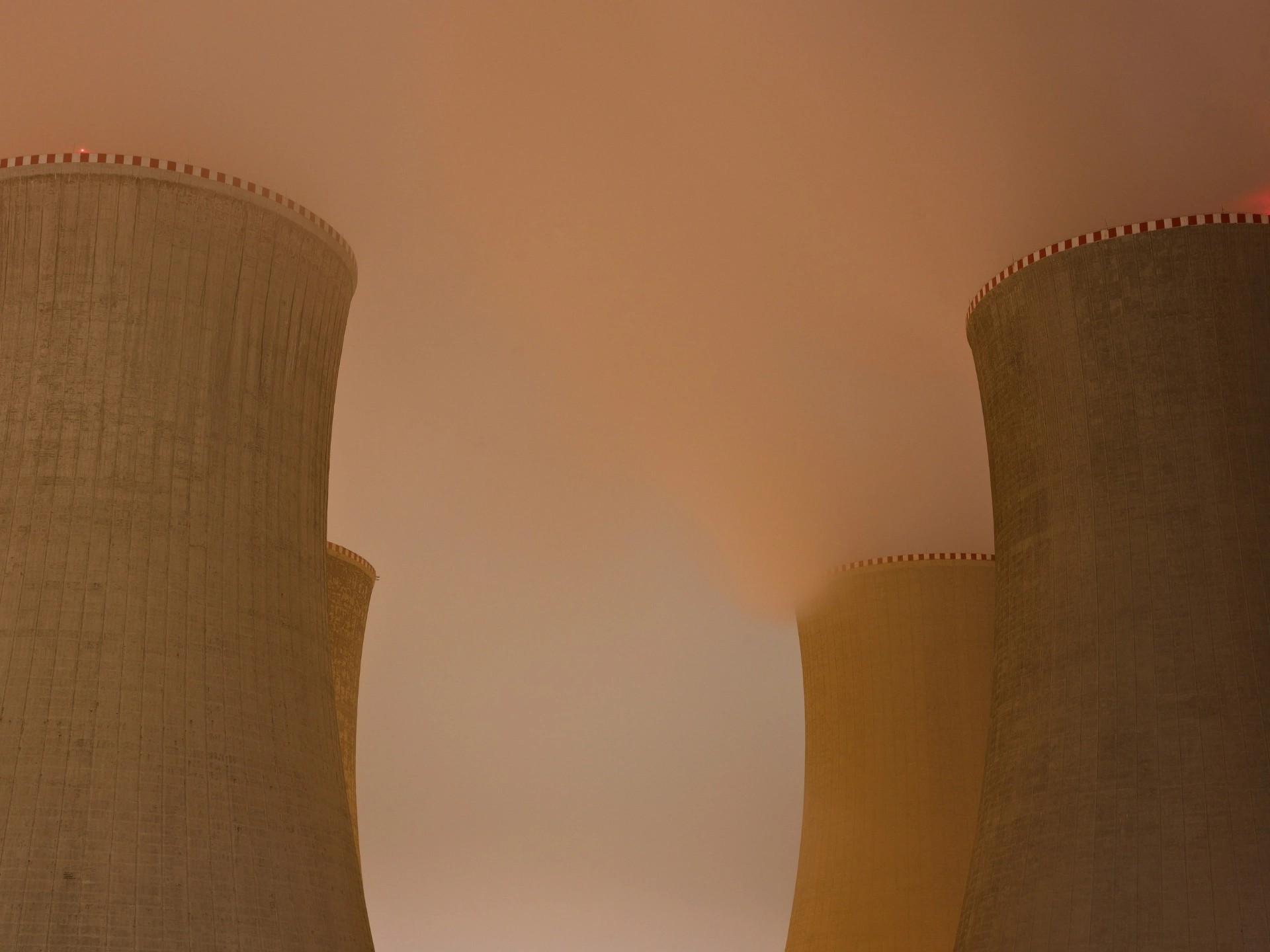
The Iberian blackout and the near-shutdown at Paks are two manifestations of a broader, continental phenomenon. At the end of summer 2026, six nuclear power plants – around 15 reactors in total – were operating at reduced output or shut down across Europe because of extreme drought. In France, unit 2 of the Golfech plant was shut down completely on 30 July because the temperature of the Garonne exceeded the permitted limit. In Switzerland, output at the Beznau plant was reduced and then stopped after the temperature of the Aare reached 25 °C. In Romania, at Cernavodă, the authorities used explosives to remove a rock obstruction from a side branch of the Danube to secure the cooling water supply, while in Bulgaria the Kozloduy plant worked with the Serbian authorities to regulate releases from the Iron Gates hydropower plant and keep the Danube above the critical threshold.
Drought-related nuclear power plant restrictions in Europe, summer 2026
| Country | Plant | Problem | Action |
|---|---|---|---|
| Hungary | Paks | record-low Danube water level | 3 units shut down, 1 turbine at minimum output, on the brink of complete shutdown |
| Romania | Cernavodă | Danube flow of 1,590 m³/s instead of the 4,700 m³/s average | both reactors (2 × 700 MW) shut down – Romania's first complete nuclear outage |
| France | Golfech | cooling water too warm (Garonne) | complete shutdown of unit 2 |
| Switzerland | Beznau | the Aare warmed above 25 °C | output reduced, then shut down |
| Bulgaria | Kozloduy | low Danube level, just 30 cm above the critical level | cooperation with the Serbian hydropower plant to maintain the water level |
Meanwhile, hydropower generation also fell: according to the energy think tank Ember, EU hydropower generation fell by 12% in 2025 because of weather conditions, offset by an 8% increase in gas-fired generation – meaning water scarcity led directly to greater use of fossil fuels. The shortage also fed into prices: in July 2026, the average daily wholesale electricity price rose to €122/MWh in Hungary, €120/MWh in Romania, €117/MWh in both Austria and Switzerland, and €95/MWh in France – in every case well above the previous year's level. This phenomenon is not new: cooling problems at French nuclear plants have been known since the 2003 heatwave and were on the agenda again in 2019, 2022 and 2023. What sets 2026 apart from previous years is its continental scale: record-low water levels occurred simultaneously from the Rhine in Germany all the way to the Danube Delta in Romania.
Wholesale electricity prices in July 2026
€/MWh, daily average
| Hungary | 122 |
|---|---|
| Romania | 120 |
| Austria | 117 |
| Switzerland | 117 |
| France | 95 |
The system's other structural weakness is the decline in grid “inertia”. The mechanical inertia of conventional power plants with rotating generators – coal, gas and nuclear – used to automatically dampen sudden frequency fluctuations. Solar panels and wind turbines, however, connect to the grid through power electronics and do not provide such inertia. According to a study on the subject (Mehigan et al., 2020), tightening minimum inertia requirements significantly increases generation costs and the amount of renewable curtailment needed – meaning there is a real tension between grid stability and the pace of decarbonisation.
According to Ralf Petri, head of the energy division of Germany's VDE engineering association, the energy transition creates fundamental challenges for grid stability, as frequency fluctuations previously dampened by the inertia of conventional power plants now affect the system more directly (VDE, n.d.).
Lagging grid development is also a structural problem: according to expert estimates, Europe will need around €1 trillion of new grid infrastructure and reinforcement over the next 25 years to support the energy transition, but the pace of investment is currently falling behind the growth of renewable generation. After the Iberian blackout, the European Commission announced the EU Grids Package, aimed precisely at accelerating grid investment and expanding interconnections between member states. According to Ember, by the end of 2024, 14 EU member states had already met or exceeded the 2030 interconnection target, while 8 countries – including Spain, which is in the most critical position – had not even reached the earlier 2020 target. This picture shows that the continent's energy security is extremely uneven, and that the countries falling behind on development are precisely those that need it most.
Six nuclear power plants, fifteen reactors – all forced to cut back by drought in a single summer.
Not an accident, but a recurring condition
On the basis of the available data, it is becoming increasingly difficult to treat the Iberian blackout and the Danube shutdowns as one-off, isolated accidents. An analysis by the Stockholm Environment Institute (2026), citing the International Energy Agency's (IEA) 2026 assessment, put it clearly: the Iberian blackout was not the first and will not be the last, because grid investment is not yet keeping pace with renewables and electrification. According to a September 2025 study by the energy think tank Ember, as much as 55% of Europe's electricity system can be considered at elevated risk: countries with import options from at most three directions and import capacity below 25% of their peak demand are particularly exposed to a repeat of a similar event.
Meanwhile, the European Commission's own communication of 19 August 2026 also acknowledged that although there is currently no short-term risk to security of supply, the situation will remain tight in the coming weeks (European Commission, 2026) – official confirmation that the summer energy crisis is not a one-off event but a prolonged, recurring condition, which the Commission is monitoring continuously with member states and ENTSO-E.
Several countries are now preparing for the worst-case scenario with legally codified tools – meaning rolling blackouts are not a theoretical possibility but a live protocol ready for deployment. In Hungary, the rotational disconnection scheme (RKR) was designed for exactly this purpose: as a last resort, the country would be divided into 18 load groups of roughly equal size, which would be disconnected in turn for periods of up to 3 hours to avoid a complete nationwide blackout. The rules expressly state that if the energy shortage persists, the disconnection cycles can start again and again – meaning a rolling blackout is not a single event lasting a few hours, but can become a condition repeating for days or even weeks until water levels or generating capacity recover. In Romania, for similar reasons, demand restrictions for large consumers at peak times have already come into force, and after the Iberian blackout Portugal announced it would invest €137 million in grid development to be better prepared for a possible future emergency.
The legal framework for rolling blackouts is ready in both Hungary and Romania – the question is not whether it will be needed, but when and how often.
Power shortages
The Iberian blackout, the near-shutdown at Paks and Romania's complete nuclear outage carry the same message: Europe's energy system is far more sensitive to water and weather extremes than previously assumed, and this sensitivity is not a one-off accident but a recurring condition that reappears every summer. Weak international interconnections, lagging energy storage, declining grid inertia and a power plant fleet that depends on cooling water are interwoven into a single system – and in both 2025 and 2026 this system was pushed to the edge of the abyss, while in several countries the legal frameworks for rolling disconnections stand ready for live deployment. From here on, the question is not whether Europe will see power outages or even longer, protracted supply disruptions in the future, but what investments member states and the EU can make to reduce their frequency and severity.
The third part of our series examines what national and EU-level investments – desalination plants, energy storage, grid development and conscious shifting of consumption within the day – can mitigate the water and energy risks described in our articles.
Editorial opinion
Europe's energy infrastructure is not prepared for persistent water scarcity and extreme weather. In the near future, we must prepare for restrictions on electricity use and rolling blackouts. We must also prepare for the possibility of having no electricity supply for longer periods – weeks, months or even years. Clean water and energy have always been resources to be cherished, but now and in the period ahead it is especially important to manage them prudently and avoid wasting them.
On 28 April 2025, the electricity grid of Spain and Portugal collapsed in five minutes, affecting 47–60 million people, because Iberia's international interconnection of just 3.62% and 25 MW of energy storage fell far short of EU targets. In summer 2026, record-low water levels on the Danube pushed Hungary's Paks nuclear power plant to the brink of a complete shutdown for the first time in 44 years, and Romania's Cernavodă plant actually shut down completely – for the first time in its history – with both of its 700 MW units. Nuclear plants in France, Switzerland and Bulgaria were also hit by cooling water shortages. According to experts and the European Commission alike, this is not a one-off accident: according to the think tank Ember, 55% of the EU grid is at elevated risk, and in Hungary and Romania a live, legally codified rolling disconnection protocol awaits the next crisis.
Two cases that arose independently show how closely water and energy security are intertwined in Europe – and how likely it is that this will happen again. On 28 April 2025, the grids of Spain and Portugal collapsed within minutes, affecting 47–60 million people; according to ENTSO-E's final report, shortcomings in voltage control, Iberia's international interconnection of just 3.62% and Spain's energy storage capacity of only 25 MW (instead of the 500 MW target) caused the cascading shutdown.
In summer 2026, record-low water levels on the Danube pushed Hungary's Paks nuclear power plant to the brink of a complete shutdown for the first time in its 44-year history, while neighbouring Romania's Cernavodă plant actually shut down completely for the first time: both of its 700 MW units went offline after Danube flow at Baziaș fell to just 1,590 m³/s instead of the 4,700 m³/s average. Nuclear plants in France, Switzerland and Bulgaria also struggled with cooling water shortages.
According to experts, this pattern is not a one-off accident. Citing an IEA analysis, the Stockholm Environment Institute stated that the Iberian blackout would not be the last; according to the think tank Ember, 55% of the EU grid is at elevated risk because of weak interconnections. The European Commission's communication of 19 August 2026 also acknowledged that the situation would remain tight in the coming weeks. In Hungary and Romania, legally codified rolling disconnection protocols are ready for the worst-case scenario – the question now is not whether they will be needed, but when and how often.


The IEA expects the first annual fall in renewable additions in 21 years, the biggest six-year expansion on record, and a grid that is now the main thing standing in the way.


A new report projects data centres' water footprint reaching 9.32 trillion litres by 2030, but the number is only meaningful once you know what it counts, and who is making the case.
From 4 November, companies that want to buy biomethane can post their demand on the European Commission's platform and producers can bid from January. Here is what to do now and what the scheme will not give you.

The Dutch Authority for Digital Infrastructure warns that the shared cloud back ends behind home batteries, inverters and heat pumps could threaten grid stability, a risk EU rules only partly address.