Record Renewables Growth Runs Into a Full Grid
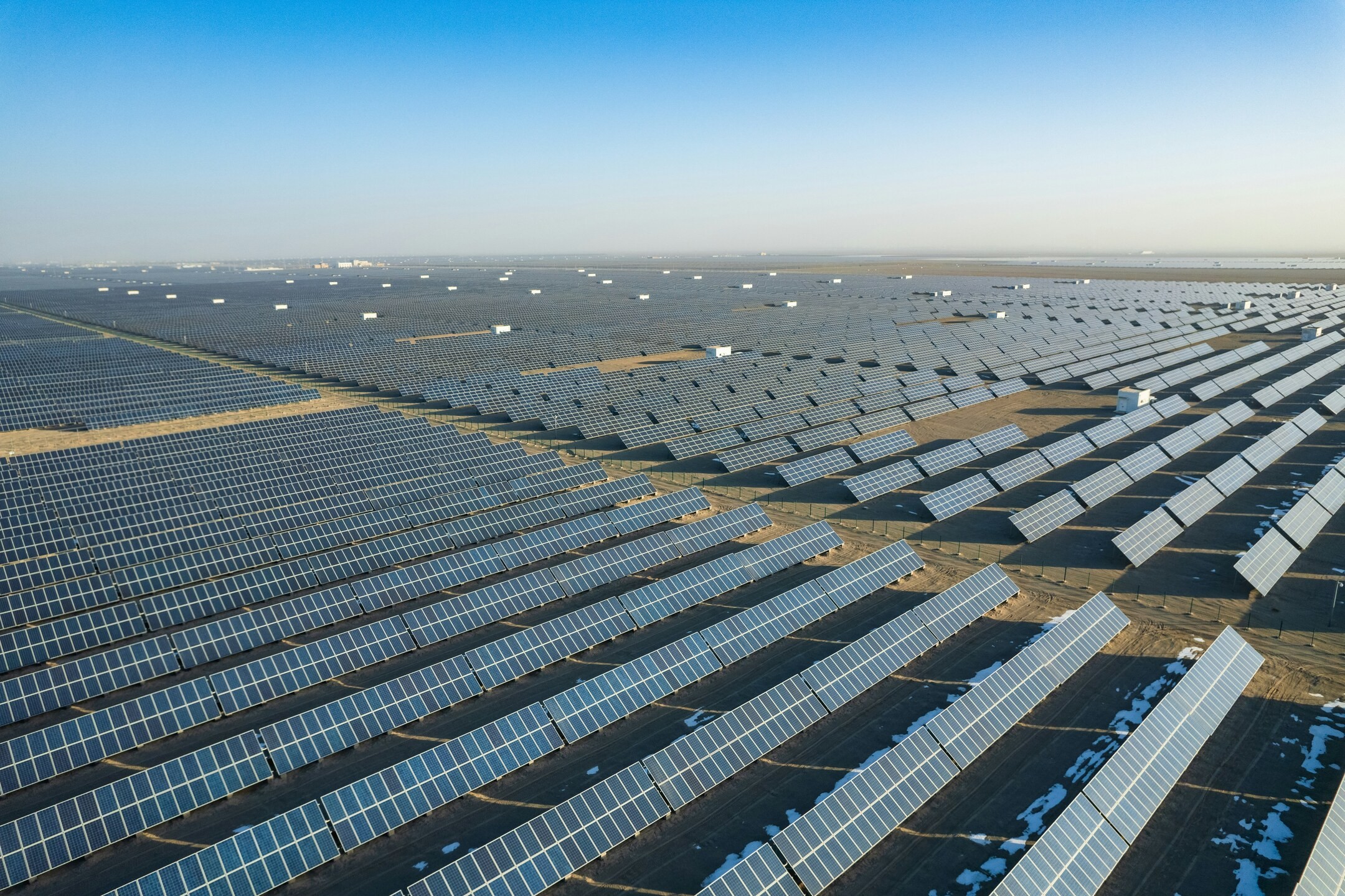
For 21 years in a row, the world added more renewable power capacity than the year before. That run ends in 2026. The International Energy Agency's latest forecast sees global additions falling 11% this year to 733 GW, even as it predicts the largest six-year expansion on record (IEA, 2026a).
The two do not contradict each other, and the report's third message shows why: what limits the spread of renewables today is less money or political will than the capacity of electricity grids to take them.
The first dip in 21 years
This year's fall comes down to one country. In June 2025 China replaced fixed remuneration for new renewable plants with auctions, and the effect on construction was swift: Chinese solar PV additions in the first nine months of 2026 were almost 55% lower than a year earlier (IEA, 2026b). Even so, 733 GW is the second-highest annual figure ever recorded.
The agency has cut its China forecast by 5% from last year, almost 116 GW, though expected growth still exceeds the targets of the country's 15th Five-Year Plan. China remains by far the largest market, but its weight is falling: it accounted for more than 60% of global renewable capacity growth in 2025 and will average 53% over 2026–2031 (IEA, 2026a).
Manufacturers are feeling it. More than 90% of major Chinese PV makers reported losses in 2026, and there have been more than 70 bankruptcies in the sector since 2024 (IEA, 2026b).
Source: IEA (2026), Renewables 2026, CC BY 4.0
Who picks up the slack
Look further ahead and the picture is stronger than ever. The IEA expects almost 4,800 GW of renewable capacity to be added between 2026 and 2031, 57% more than in 2020–2025, and total installed renewable capacity to grow by around 85% between 2025 and 2031. Solar PV makes up more than three-quarters of the growth, followed by onshore wind (IEA, 2026a). Solar overtakes wind in generation this year and hydropower in 2029.
Other countries are filling the gap China leaves. India becomes the second-largest growth market, adding 2.6 times as much capacity in 2026–2031 as in the previous six years and almost doubling its share of global growth to about 8.5%. The US forecast is 40% higher than last year's, driven largely by solar and battery projects serving data-centre demand. Across Southeast Asia, the Middle East and North Africa, and sub-Saharan Africa, additions almost triple, and capacity in the Middle East and North Africa more than doubles. In Latin America, solar overtakes hydropower by the end of the decade, as hydro's share of generation falls from 40% to 35% (IEA, 2026b).
India is also moving up the supply chain. By 2031 it will be the only country besides China able to make every major PV component at scale, and its share of global module manufacturing is set to almost double to 17%, diversifying a market that remains highly concentrated (IEA, 2026a, 2026c).
For the first time, emerging and developing economies outside China will add as much renewable capacity as the advanced economies.
Where renewable capacity is built in 2026–2031
IEA main-case forecast for the key markets
| Market | What the IEA expects | Change |
|---|---|---|
| China | 53% of global growth on average (over 60% in 2025) | −5% vs last year's forecast |
| India | 2.6 times the 2020–2025 build | about 8.5% of global growth |
| United States | about 314 GW, 30% more than 2020–2025 | +40% vs last year's forecast |
| Europe | 617 GW, about 40% more than 2020–2025 | −6% vs last year's forecast |
| Asia-Pacific excluding China | over 840 GW, more than double the previous period | led by emerging markets |
| Sub-Saharan Africa | solar PV over 80% of new capacity | +54% vs last year's forecast |
Source: IEA (2026), Renewables 2026, CC BY 4.0
The United States is one of the report's surprises. After about 49 GW in 2025, the agency expects an average of around 52 GW a year, almost 90% of it solar PV. The outlook for emerging economies outside China has been raised by almost 20% overall. Rooftops matter too: small solar systems have improved electricity supply for around 70 million households since 2022, and off-grid solar could grow 2.5 times to about 80 GW by 2031 (IEA, 2026a).
Why security took over
The agency argues that the reason renewables get built has changed. The turning point was the Iran war, which broke out at the end of February 2026 and, through disruption in the Strait of Hormuz, pushed oil and gas prices higher and made them more volatile (IEA, 2026c).
“Previously, environmental concerns were the policy priority behind the growth of renewables, whose falling costs have made them a competitive option in many markets – but today, it's mainly energy security that is driving renewables' expansion as more and more countries seek to reduce their exposure to imported fuels.”
The report puts numbers on what renewables already deliver. Without their growth since 2010, global fossil fuel demand in 2025 would have been around 8% higher, roughly India's entire energy use. Gas demand alone would have been 515 bcm higher. In the European Union, fossil fuel demand would have been 12% higher (IEA, 2026b).
The EU analysis also covers prices. Based on data from 11 member states, wholesale electricity would have cost almost €55/MWh more in 2026 without the wind and solar built since 2021, and supply costs over 2021–2026 would have been more than €280 billion higher.
The renewable share of global electricity could rise from 33% in 2025 to almost 45% in 2031, with wind and solar together going from 17% to 28%. The main case still falls short of the COP28 pledge to triple capacity: installed capacity reaches about 9,710 GW in 2030, 2.6 times the 2022 level. Only in the agency's accelerated case is tripling reached, in 2031 (IEA, 2026a).
The grid is full
The report's sharpest warning concerns the grid. Advanced-stage renewable and storage projects waiting for connection rose 60% in a year to 3,000 GW, four times the wind and solar capacity connected last year. Batteries and hybrid projects account for the entire increase (IEA, 2026c).
The make-up of the queues is shifting fast. Battery storage applications rose by 900 GW in a year to more than 1,500 GW, and hybrid projects now exceed 600 GW, more than half of them pairing solar with batteries. Standalone renewable projects in the queues fell by about a fifth, from roughly 3,000 GW to 2,300 GW. Meanwhile, reforms in several countries removed around 430 GW of speculative solar and wind projects, most of them in the UK, the US and India (IEA, 2026b).
What holds renewables back now is less the money than the wires.
The strain already shows in output. By 2031, wind and solar will supply more than half of all electricity in 17 countries. Curtailed wind and solar generation nearly doubled in both 2024 and 2025, to about 200 TWh, and could exceed 800 TWh by 2031, around 8% of variable renewable output. Germany, the Netherlands and Belgium each recorded more than 500 hours of negative wholesale prices in 2025, and low prices in sunny hours are eating into the revenues of merchant plants and power purchase agreements (IEA, 2026a).
Part of the answer is already being built. Behind-the-meter batteries in homes and businesses could grow five- to sixfold to around 670–700 GWh by 2031, and in many regions a hybrid plant combining solar, wind and batteries can deliver power for under $75/MWh (IEA, 2026b). Battery deployment is accelerating, the agency says, but not fast enough. Its priorities are grid investment, faster connections, batteries, flexible demand and digital tools, including artificial intelligence (IEA, 2026c).
Europe plateaus
Europe is set to add 617 GW of renewable capacity in 2026–2031, almost 40% more than in the previous six years, but annual additions level off at around 103 GW. The EU accounts for more than 480 GW of that. It reaches its solar PV target but misses its wind ambition by more than 30%, and in 2030 only 60% of its electricity comes from renewables, against the 72% in Commission modelling consistent with REPowerEU. The reasons the IEA gives are national ambitions set too low, delays to offshore wind and rising curtailment (IEA, 2026b).
The variable share climbs fastest at Europe's edges. Lithuania's wind and solar share is forecast to reach 84% in 2031, overtaking Denmark at about 80%, while Germany approaches 70%. These countries will meet the problem of surplus hours earlier than most, and Lithuania is already among those where negative-price hours rose sharply in 2025 (IEA, 2026b).
For generators, grid operators and large consumers, the report carries the same lesson. Renewable capacity will be cheap and plentiful; the question is who can connect it, store it and use it at the right hour. Over the next few years, a grid connection, a battery and a load that can move may be what makes a project, or a plant, competitive.
The International Energy Agency's new forecast sees almost 4,800 GW of renewable power capacity added worldwide between 2026 and 2031, 57% more than in the previous six years. Yet 2026 itself breaks a 21-year run of records: additions fall 11% to 733 GW, because China switched from fixed tariffs to auctions and its solar build slumped. Growth is spreading to India, the United States, Southeast Asia, the Middle East and Africa, and the agency says energy security, not climate policy, is now the main driver. The constraint has moved to the grid. Advanced-stage projects waiting for connection rose 60% in a year to 3,000 GW, almost all of the increase from batteries and hybrids, and curtailed wind and solar output could pass 800 TWh by 2031. The EU meets its solar target but falls well short on wind.
The International Energy Agency's Renewables 2026 report, published on 6 November, makes three claims that look contradictory at first sight. The first is that 2026 ends a run of 21 consecutive record years: global renewable additions fall 11% to 733 GW. That is still the second-highest total ever, and the fall is China's. In June 2025 it replaced fixed remuneration with auctions, and its solar additions in the first nine months of 2026 were almost 55% lower than a year earlier.
The second is that the coming six years will still be the biggest yet. The agency expects almost 4,800 GW of new capacity in 2026–2031, 57% more than in 2020–2025, with solar PV accounting for more than three-quarters. China's share of growth falls from over 60% to 53%, India becomes the second-largest market, the US forecast is raised by 40%, and additions in Southeast Asia, the Middle East and Africa almost triple. Executive Director Fatih Birol says energy security has replaced environmental concerns as the main reason countries build renewables. Their share of global electricity could rise from 33% in 2025 to almost 45% in 2031, and EU analysis suggests wind and solar built since 2021 kept wholesale power nearly €55/MWh cheaper this year.
The third is that the grid is now the limit. Advanced-stage renewable and storage projects waiting for connection rose 60% in a year to 3,000 GW, with batteries and hybrids accounting for the entire increase. Curtailment could exceed 800 TWh by 2031. The EU reaches its solar target but misses its wind ambition by more than 30%.



A new report projects data centres' water footprint reaching 9.32 trillion litres by 2030, but the number is only meaningful once you know what it counts, and who is making the case.

From 4 November, companies that want to buy biomethane can post their demand on the European Commission's platform and producers can bid from January. Here is what to do now and what the scheme will not give you.

The Dutch Authority for Digital Infrastructure warns that the shared cloud back ends behind home batteries, inverters and heat pumps could threaten grid stability, a risk EU rules only partly address.

The Joint Research Centre mapped 1,300 hydrogen plants against local water resources and found the EU's targets reachable without a water crisis, though southern Europe and parts of central Europe will need careful planning.