Hydrogen-Iron Battery at Europe's Largest Wind Farm
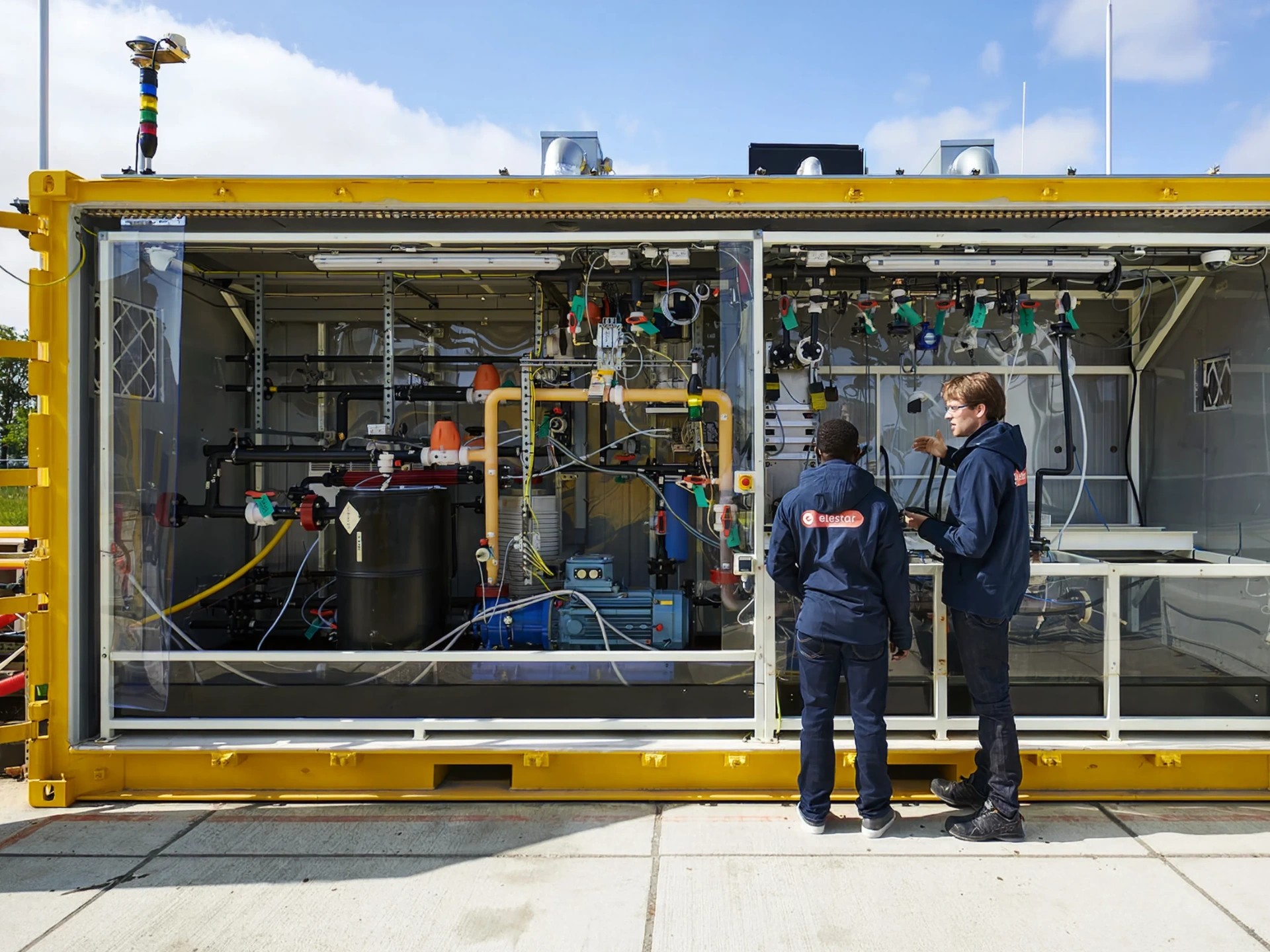
On 8 July 2026, Dutch energy storage company Elestor announced a partnership with Windpark Zeewolde, a 322 MW facility in the province of Flevoland made up of 222 turbines. A hydrogen-iron flow battery with a capacity of 20 MW (200–800 MWh) will be installed at Zeewolde, considered Europe's largest onshore wind farm. The project shows both where the flow battery market stands today and how much renewable grid congestion affects the Netherlands. While lithium-ion technology dominates short-duration storage, alternative chemistries – including Elestor's system – are increasingly gaining ground for discharge durations longer than 8 hours.
The Zeewolde project: phased expansion on a congested grid
Windpark Zeewolde was developed by a cooperative of local farmers and landowners, and its 222 turbines deliver 322 MW of power – making it Europe's largest onshore wind farm. Despite its considerable output, the park also faces one of the Netherlands' most typical problems: because of grid congestion, it cannot export all the energy it generates at peak times.
The agreement with Elestor will be implemented as a phased deployment: the system will expand from an initial configuration to the full 800 MWh capacity as the project proves its performance and commercial viability. This stepwise approach is typical of the early stage of the LDES market, where developers manage risk through the timing of expansion.
The partnership follows a €30 million Series A funding round led by Equinor Ventures, with participation from Vopak Ventures, Invest-NL, Somerset Capital Partners, EIT InnoEnergy and Enfuro Ventures. Elestor has also received €22 million in support through the SLDBatt (Sustainable Long Duration Battery) consortium of the Dutch National Growth Fund, which aims to scale up long-duration energy storage technologies to commercial size.
How does a hydrogen-iron flow battery work?
The basic principle of flow batteries differs from familiar lithium-ion cells: energy is stored not in a solid electrode but in liquid electrolyte held in external tanks. As a result, power (the flow cells, pumps and control systems) and capacity (the size of the electrolyte tanks) can be scaled independently – increasing capacity simply requires adding more, relatively cheap electrolyte, without having to expand the more expensive power infrastructure.
This design makes the technology particularly well suited to long-duration energy storage.
According to Elestor, the system can provide discharge durations of 8–150 hours, far exceeding the 8-hour limits of lithium-ion systems.
The Zeewolde installation will operate in a range of 10–40 hours, depending on dispatch requirements.
Because energy is carried by the electrolyte rather than the electrode, the cells do not degrade at the rate of lithium-ion batteries: the electrolyte can simply be replaced if necessary, so the system is capable of a virtually unlimited number of cycles. Flow systems available on the market typically operate for more than 20,000 cycles, with guaranteed lifetimes of over 25 years and minimal performance loss.
The technology also has safety advantages: thanks to the water-based, non-flammable electrolyte, there is no thermal runaway, which can reduce insurance and installation costs compared with lithium-ion systems. At the end of their life, the electrolyte and many components can be recycled – making flow technology one of the promising directions for circular energy storage.
The flow battery market: promise and mixed results
According to the LDES Council, the long-duration energy storage (LDES) market could reach 85–140 TWh of capacity, or 15–25 TW of installed power, globally by 2040. Lithium-ion technology remains the best choice in the 4–8-hour range, but above 8 hours flow systems are becoming increasingly cost-competitive – this is where the cost advantage of decoupling power and capacity starts to take effect.
Despite the technology's potential, the industry's path so far has been rocky: several flow battery developers have entered bankruptcy protection or been forced to restructure in recent years, while others – including Elestor, Invinity Energy Systems and Sumitomo Electric – continue to expand their commercial projects.
Vanadium redox flow battery (VRFB) technology is the market leader: China's Rongke Power has more than 3.5 GWh of installed capacity and operates the world's largest VRFB system, the CTG Jimusaer installation (200 MW/1,000 MWh). Invinity Energy Systems is also a major VRFB player: its 20.7 MWh system at Copwood in the UK is Europe's largest VRFB project, and the company is present in a total of 90 projects in 17 countries on 5 continents, achieving a 36% cost reduction since launching its Endurium product line.
Other chemistries are also in the race: US-based ESS Tech Inc manufactures iron-based flow systems with discharge times of 8–22 hours, but its future is uncertain because of persistently weak financial performance. Germany's CMBlu works with an electrolyte based on organic molecules, scaling up to GWh-size systems – a conditional 5 GWh supply agreement with Uniper, among others, shows industrial interest in the technology.
Dutch grid congestion and the TenneT case
Windpark Zeewolde is not an isolated case: in the Netherlands, the growth of wind and solar capacity has been outpacing transmission grid development for years, leading to regular congestion and curtailment of renewable generation. The Dutch transmission system operator TenneT is therefore actively seeking commercial energy storage solutions to ease the problem.
In April 2026, TenneT signed its first contract with a so-called “controllable congestion mitigator”: an agreement with developer Green Energy Storage (GES) for a 200 MW/800 MWh battery energy storage system (BESS) called Sequoia in the province of North Brabant. The arrangement has two elements: a time-duration transmission right (TDTR), which gives access to the grid's spare off-peak capacity, and a capacity steering contract (CSC), which obliges a large user to actively adjust its consumption or feed-in at peak times in exchange for a fee.
The agreement was made possible by an earlier decision of the Netherlands Authority for Consumers and Markets (ACM), which allowed grid operators to offer special contracts for residual off-peak capacity. The Sequoia project therefore takes priority in the connection queue and could come online in 2027.
“This first capacity control contract with a congestion mitigator marks an important step in the development of a flexible energy system. With Sequoia, we are demonstrating how large-scale battery storage can already make a tangible contribution to alleviating grid congestion today.”
Together, the Zeewolde and Sequoia projects indicate that in the Netherlands energy storage is increasingly becoming not just a commercial tool but a grid management tool – and in this role flow technologies can also find a place alongside lithium-ion systems.
Summary
On its own, the partnership between Elestor and Windpark Zeewolde is the announcement of a 20 MW/200–800 MWh project – but it sheds light on three broader trends. First, it shows that hydrogen-iron and other flow technologies are beginning to move beyond the demonstration phase, even if the sector as a whole continues to struggle with mixed financial and market results. Second, it shows that storage needs longer than 8 hours are increasingly forming a technology category of their own alongside lithium-ion. Third, it highlights the severity of grid congestion in the Netherlands, which makes both solutions like the Zeewolde project and regulatory innovations like TenneT's Sequoia contract necessary. The coming years will decide whether the phased, risk-averse expansion model will be enough for hydrogen-iron technology to move beyond a narrow experimental role and secure a lasting place alongside lithium-ion in the long-duration energy storage market.
On 8 July 2026, Dutch LDES developer Elestor announced that it will install a 20 MW/200–800 MWh hydrogen-iron flow battery at Windpark Zeewolde, Europe's largest onshore wind farm. Because of grid congestion, the 322 MW, 222-turbine park cannot export all its output; the system will be expanded gradually to 800 MWh. The key to the technology is that power and capacity can be scaled independently, which could make the system more competitive than lithium-ion in the long term: it allows discharge durations of 8–150 hours, and the Zeewolde installation will operate in the 10–40-hour range. The flow battery market – where Rongke Power, Invinity and CMBlu compete alongside Elestor – shows mixed results. Meanwhile in the Netherlands, TenneT is also signing new congestion mitigation contracts, such as with the 200 MW/800 MWh Sequoia project.
On 8 July 2026, Dutch long-duration energy storage (LDES) developer Elestor announced a partnership with Windpark Zeewolde: a 20 MW/200–800 MWh hydrogen-iron flow battery will be installed at the 322 MW, 222-turbine facility, considered Europe's largest onshore wind farm. Because of grid congestion, the park cannot export all its output at peak times, and the system will be expanded gradually to its final capacity of 800 MWh. The project follows a €30 million Series A funding round led by Equinor Ventures and a further €22 million in support through the Dutch National Growth Fund. The key to the technology is that power and capacity can be scaled independently: expanding storage only requires more cheap electrolyte, allowing discharge times of 8–150 hours – the Zeewolde system will operate in the 10–40-hour range.
According to the LDES Council, the flow battery market could reach 85–140 TWh of capacity globally by 2040, but its development so far has been mixed: several developers have entered bankruptcy protection, while others – including vanadium redox players Rongke Power and Invinity Energy Systems and organic electrolyte developer CMBlu – continue to expand their projects. In the Netherlands, grid congestion is a systemic problem: in April 2026, transmission system operator TenneT signed its first “controllable congestion mitigator” contract with developer Green Energy Storage for the 200 MW/800 MWh Sequoia project, which could come online in 2027. Together, the two developments indicate that long-duration energy storage in the Netherlands is becoming both a technology and a grid management issue.


The IEA expects the first annual fall in renewable additions in 21 years, the biggest six-year expansion on record, and a grid that is now the main thing standing in the way.

A new report projects data centres' water footprint reaching 9.32 trillion litres by 2030, but the number is only meaningful once you know what it counts, and who is making the case.
From 4 November, companies that want to buy biomethane can post their demand on the European Commission's platform and producers can bid from January. Here is what to do now and what the scheme will not give you.
The Dutch Authority for Digital Infrastructure warns that the shared cloud back ends behind home batteries, inverters and heat pumps could threaten grid stability, a risk EU rules only partly address.