Wind at Sea – the Decade of Offshore Energy
Until now our magazine has paid little attention to energy, one of our four main categories (water, wastewater, biogas, energy). The sector is developing rapidly to meet humanity's fast-growing energy demand: according to the IEA, global electricity consumption was 28,200 TWh in 2025 and is expected to rise to 33,600 TWh by 2030. From now on we will give the sector more attention and publish energy-related content regularly.
Enjoy the first such article, which is about wind farms built at sea!
The physics of wind: why location matters
Wind energy is essentially about converting the kinetic energy of wind into electricity. The relationship is not linear: power is proportional to the cube of wind speed, which means that wind just 25% stronger delivers almost twice as much energy. This explains why it matters where a turbine stands.
At an inland European site – central Germany, for example – the average wind speed at hub height is around 5–6 m/s, which translates into a capacity factor of 25–33%. In Patagonia, at the southern tip of South America, where weather systems from the west sweep across almost unhindered, it can reach 60% – an exceptional onshore situation.
Offshore sites, however, systematically approach this range: the absence of terrain obstacles, the lower surface roughness of water and a more stable pressure gradient together make the wind resource at sea broader and steadier for energy generation.
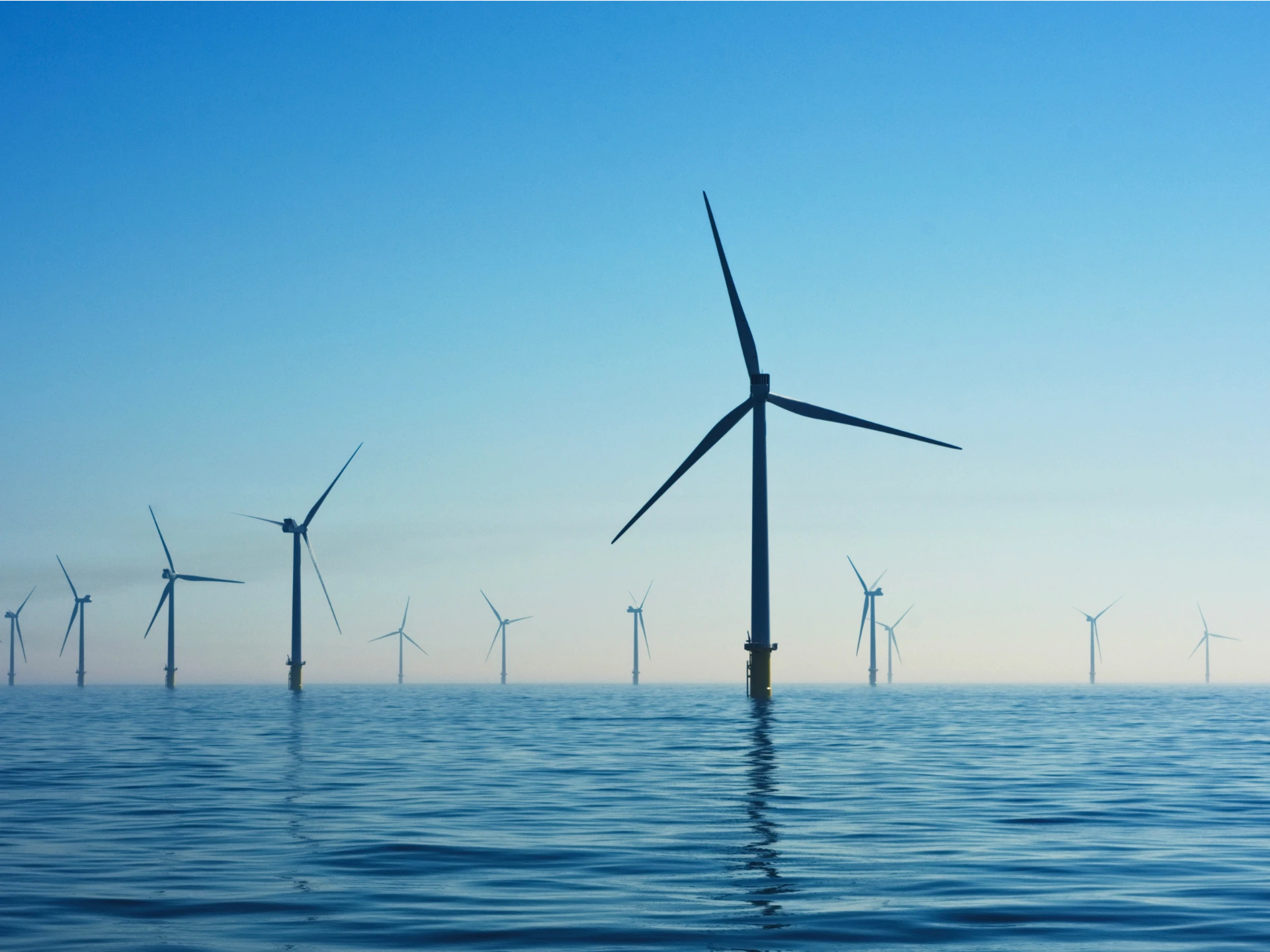
Offshore turbines are wind turbines installed at sea, usually anywhere from a few hundred metres to more than 100 km from the coast.
According to a comparative analysis by Tanvir and Etminan (2025), offshore turbines see an average hub-height wind speed of ~9 m/s and achieve capacity factors above 50%, compared with 30–40% onshore.
Unit capacities are in another league too: the latest offshore turbines – such as the GE Haliade-X used at the Dogger Bank wind farm – are rated at 13–15 MW, while an average onshore machine tops out at around 3–5 MW.
When transported by sea, blade size is no limit: the Haliade-X's 107-metre blades could not be moved by road.
Fixed or floating?
Today the offshore wind industry works with two fundamentally different installation approaches, which complement rather than replace each other.
In fixed-bottom systems, steel monopiles or gravity foundations anchor the turbine tower directly to the seabed. This technology is commercially mature and economical in water depths of up to about 60 metres. Across much of the North Sea – where depths are typically 20–40 metres – it is the optimal solution. The numbers confirm its effectiveness: the Danish Horns Rev 2 wind farm achieved an average capacity factor close to 50% over 11 years, according to the operator's own measurements.
With floating platforms (floating offshore wind, FOW), the turbine is not fixed to the seabed: the structure is held up by a floating platform moored to the seabed with anchor lines. This approach opens up installation in waters deeper than 60 metres – and with it the huge potential of the world's windy deep-water areas. According to Robertson et al. (2025), floating turbines have already achieved generation efficiency comparable to fixed systems; the challenge is not technical but industrial: each FOW turbine contains some 8,000 electrical and mechanical components that require industrial-scale standardisation and supply chain integration.
Hywind Scotland – Equinor's pioneering 5-turbine, 30 MW project off the Scottish coast – was the first commercial-scale floating offshore wind farm. Operating data show it achieved a capacity factor of 54% over its first five years and 57% in its best year – making it the best-performing wind farm in the United Kingdom.
Since becoming fully operational in 2023, Hywind Tampen (Norway, 88 MW) has been the world's largest floating offshore wind farm – and it is unusual in supplying electricity directly to oil platforms.
The market today: numbers, projects, trends
2024 was a year of contrasts for offshore wind. According to GWEC (2025), 8 GW of new capacity was connected to the grid during the year – a 26% drop on 2023, mainly due to scheduling delays in China and Europe. Yet the long-term outlook has never been stronger: 56 GW of new capacity was awarded in auctions worldwide in 2024, and 48 GW is currently under construction around the world.
Five countries dominate the market, accounting for 94% of new capacity in 2024: China, the United Kingdom, Taiwan, Germany and France. China accounts for nearly half of cumulative offshore capacity (41.8 GW), but Europe has retained its leading role in innovation and technology. Global offshore wind capacity has grown by an average of 10% a year over the past decade.
The stakes for floating offshore wind are even bigger: total global capacity was just 278 MW at the end of 2024, but it is expected to grow exponentially by the end of the next decade. Norway leads with 101 MW, followed by the United Kingdom (78 MW), China (40 MW) and France (27 MW).
Floating offshore wind capacity by country, end of 2024
MW
Total: 278 MW
| Norway | 101 |
|---|---|
| United Kingdom | 78 |
| China | 40 |
| France | 27 |
| Other | 32 |
Flagship projects
The Dogger Bank Wind Farm (United Kingdom, North Sea) is currently the world's largest offshore wind farm under construction. The three-phase, 3.6 GW project is a joint venture of SSE Renewables, Equinor and Vårgrønn, with an estimated total cost of £7.8 billion. Equipped with GE Haliade-X 13–14 MW turbines, the farm is expected to meet the electricity needs of 6 million British households. The first phase (Dogger Bank A) was connected to the grid in 2025, full completion is expected in 2026 – and the developers are already preparing a fourth, 1.5 GW phase, Dogger Bank D.
RWE's Nordseecluster (Germany, 1.6 GW), Baltica 2 (Poland, 1.5 GW) and the Thor project (Denmark) mark the next wave of European expansion. Poland's entry is particularly noteworthy for Central Europe: the country sees Baltic Sea offshore wind as a strategic tool for energy independence.
IRENA says 2,000 GW of offshore wind capacity is needed by 2050 to meet climate goals. That is more than 24 times today's 83 GW – and although the figure looks ambitious, IRENA's analysis finds it technologically feasible (IRENA, 2025).
Challenges, costs and obstacles
Offshore wind is a real opportunity, but the economics are not equally favourable for every technological branch.
The levelised cost of energy (LCOE) of fixed-bottom offshore wind was around €40/MWh in mature markets in 2024 – competitive with conventional power plants. Between 2010 and 2024, offshore wind installation costs fell by 48% and LCOE by 62%. That is an extraordinary industrial learning curve.
The situation for floating offshore wind is completely different: its current LCOE is around €123/MWh, three times that of fixed systems. According to a scientific analysis (Santhakumar et al., 2023), this could fall to €33/MWh at 100 GW of cumulative capacity as the industry matures, which would make it competitive. But that will take a decade of investment and industrial development.
The cost of offshore wind power (LCOE)
€/MWh
| Fixed-bottom (2024) | 40 |
|---|---|
| Floating (today) | 123 |
| Floating at 100 GW (estimate) | 33 |
The key challenges, according to analyses by NREL and the EU's MARINEWIND project
Supply chain and installation capacity. Installing turbines above 10 MW requires specialised vessels, whose scarcity is a structural bottleneck (NREL, 2024; MARINEWIND, 2024). Orders are growing more slowly than the fleet is ageing – which could cause delivery delays in the second half of the decade.
Cable and grid infrastructure. Integrating a gigawatt-scale system from the sea into the onshore grid requires billions in investment on its own. Some of Europe's delays in 2024 were caused precisely by protracted onshore grid connections.
Permitting and planning uncertainty. Auctions failed in the United Kingdom and Denmark in 2024 – developers withdrew because, with rising material and financing costs, the regulated price was not sustainable. In the US, offshore wind permitting froze in 2025 under the Trump administration.
Carbon footprint and ecological impact. Assessing the impact on marine ecosystems is an increasingly serious regulatory expectation, especially in the mooring zones of floating systems.
It is worth noting that other forms of marine renewable energy are also under development – wave energy converters and tidal stream turbines – which likewise aim to harness the resources of the sea, but are still far less mature commercially than offshore wind.
A real path, with factual limits
Offshore wind is not just a promising technology – industry data show it is already a commercially proven, rapidly scaling system. Fixed offshore wind is competitive, and floating offshore wind is on the threshold of industrial-scale development.
The question is whether the regulatory and investment environment can keep up with the physical and technological possibilities. The auction failures of the past two years – in the United Kingdom, Denmark and the US – showed that industrial-scale growth requires stable, long-term contractual frameworks. Where these exist – in Norway, the Netherlands and Poland – projects are moving forward.
The LCOE of fixed offshore wind fell below €40/MWh by 2024 – down 62% since 2010 – making the technology competitive with other types of power plant.
IRENA's target of 2,000 GW by 2050, GWEC's forecast of 441 GW by 2034 and the 48 GW currently under construction worldwide all suggest that offshore wind is one of the "most real paths" in the alternative energy sector – especially for regions without enough onshore wind potential but with coastal or sea access.
Global offshore wind capacity reached 83 GW by the end of 2024, and forecasts suggest it will exceed 441 GW by 2034. Building at sea means more than just more space – capacity factors above 50% can be achieved over water, compared with 30–40% on land. The technology's two branches – fixed-bottom and floating – complement each other, opening up both shallow and deep waters. Dogger Bank, Hywind and Hornsea prove it can be done, but for floating offshore wind to spread at commercial scale, its LCOE must fall by at least a third.
Over the past decade offshore wind has become one of the fastest-growing branches of wind energy. According to GWEC's Global Offshore Wind Report 2025, the industry reached a cumulative capacity of 83 GW by the end of 2024 – enough to supply 73 million households worldwide. IRENA projects that this could reach 2,000 GW by 2050 if regulatory frameworks and investment conditions develop appropriately.
The most important technical advantage of building at sea is higher and steadier wind speeds: while an average onshore turbine has a capacity factor of around 30–40%, offshore systems can reach 45–55%, and operating data show the floating Hywind Scotland reaching 57%. Larger turbines – the average offshore rating already exceeded 9.8 MW in 2024 – can also only be installed thanks to marine logistics.
The market splits into two technological branches: shallow-water fixed-bottom systems are commercially mature, while floating offshore wind (FOW) is still in the early phase of industrial-scale development, with just 278 MW of global capacity at the end of 2024. Together the two branches will determine whether the wind potential of the oceans and seas can actually be harnessed – fixed systems in the shallower parts of the North Sea, floating platforms in the Sea of Japan, the Mediterranean or off the Norwegian coast.
The economic and technological challenges are real: the LCOE of floating offshore wind is currently around €123/MWh, compared with €40/MWh for fixed systems. The question is not whether a global offshore wind market will emerge – but how fast.


The IEA expects the first annual fall in renewable additions in 21 years, the biggest six-year expansion on record, and a grid that is now the main thing standing in the way.


A new report projects data centres' water footprint reaching 9.32 trillion litres by 2030, but the number is only meaningful once you know what it counts, and who is making the case.

From 4 November, companies that want to buy biomethane can post their demand on the European Commission's platform and producers can bid from January. Here is what to do now and what the scheme will not give you.

The Dutch Authority for Digital Infrastructure warns that the shared cloud back ends behind home batteries, inverters and heat pumps could threaten grid stability, a risk EU rules only partly address.