World's First Floating Power Plant Feeds Singapore's Grid
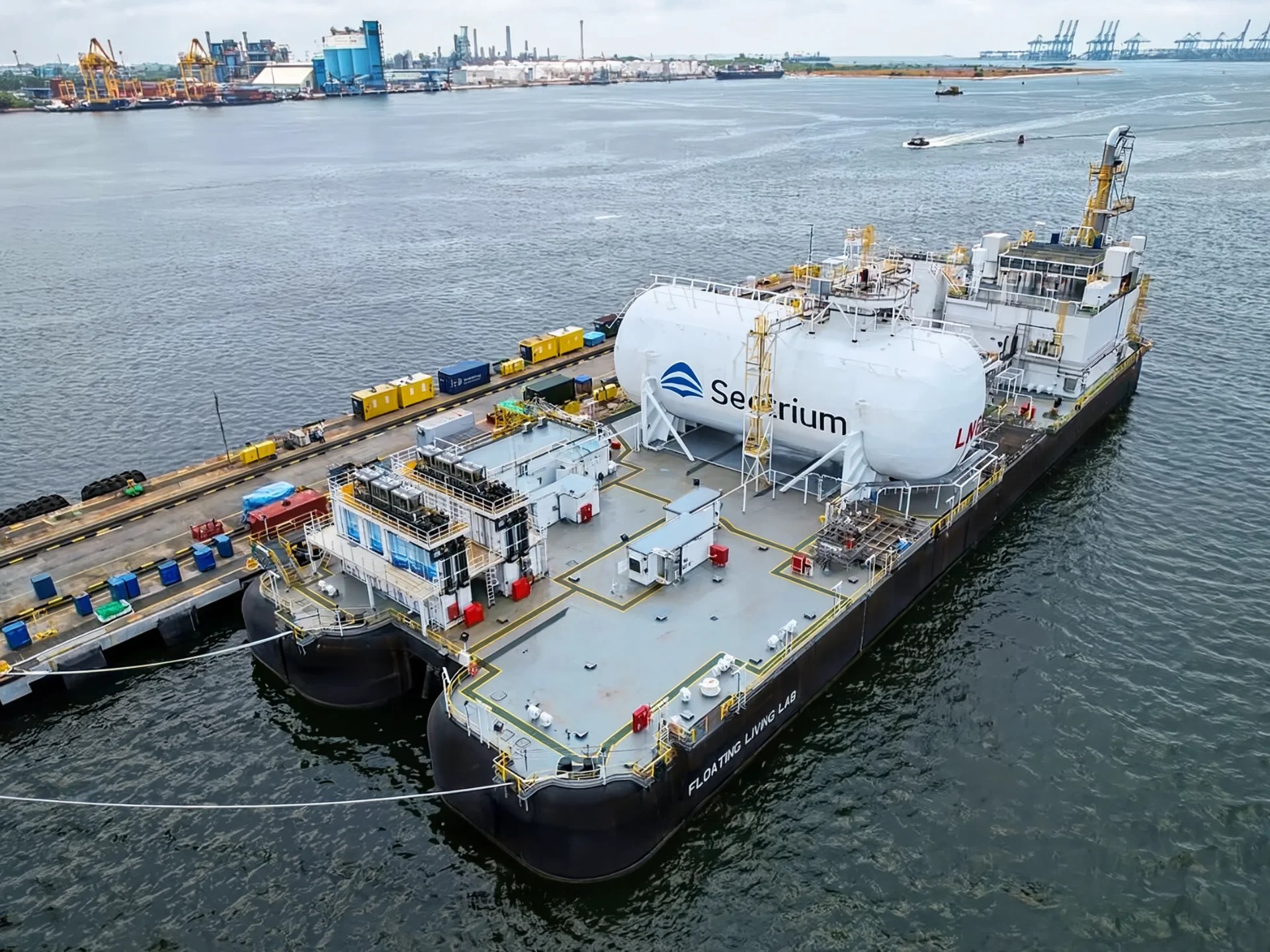
On 3 July 2026, Singapore's Seatrium delivered electricity to the country's grid for the first time from a floating facility controlled entirely remotely. According to the developers, the platform, called the Floating Living Lab (FLL), is the world's first able to generate, store and export power from a system that is independent of land, deployed near the shore and fully remotely controlled – which could open a new chapter in energy supply for densely populated areas with limited land.
A world first: a remotely controlled floating energy platform
The FLL is located at Seatrium's Pioneer yard, and the company describes it as a distributed energy resource (DER) platform.
The system is monitored and controlled from a remote operations centre (ROC) about 1 km away, significantly reducing the number of staff needed on site.
The milestone was witnessed by Tan See Leng, Singapore's Minister for Manpower and Minister-in-charge of Energy and Science & Technology. The platform has received the Remote-CON notation from the US classification society ABS, certifying that it can be operated safely from a shore-based control centre and meets strict automation, communication and operational safety requirements.
From LNG to batteries: how the FLL works
The platform runs on liquefied natural gas (LNG). The FLL received its first LNG delivery in March 2026 from a specialised vessel, via ship-to-ship transfer at sea – much like refuelling a ship on open water. Onboard gas engines convert this gas into electricity, supplemented by a layered battery energy storage system (ESS).
The power generated primarily covers the operational needs of the Pioneer yard, and the surplus is fed into the national grid. Seatrium estimates that the exported electricity can meet the energy needs of around 1,500 four-room HDB flats (Singapore public housing) a month.
Although LNG is not a renewable energy source, burning natural gas emits less carbon dioxide than other fossil fuels – which is why the company positions the system as a transitional solution towards lower emissions. According to Lee Wey Lii, senior vice-president of Seatrium Digital, the platform could also be used in the longer term to test lower-carbon energy mixes and, combined with renewable energy produced at the Pioneer yard, could eventually reduce the site's overall emission intensity.
Strict certification and cybersecurity
The remote operations centre (ROC) is built on DNV's assurance framework, which provides secure communication, data channels and human-supervised decision support for centralised oversight of the platform and related marine assets. The system is also supported by artificial intelligence and so-called AI-Ops tools that automate data processing, optimise energy use and speed up decision-making.
“Safety is fundamental to the successful deployment of new remotely operated and distributed energy technologies in nearshore and offshore environments.”
New business models and regional ambitions
According to Seatrium, the FLL sets a precedent not only technically but also commercially: the platform could support new models – such as Power-as-a-Service (PaaS) and new forms of energy infrastructure ownership – that have not been typical in the nearshore energy sector.
According to Violet Chen, director for solar and grid solutions at Singapore's Energy Market Authority (EMA), the project plays an important role in preparing Singapore's grid for a growing share of variable renewable generation.
“As Singapore's grid integrates more variable renewable energy, storage solutions like this will be key to maintaining grid stability and resilience.”
The company stresses that the project also proves a marine-classed floating platform can meet the strict regulatory and technical requirements for connecting to Singapore's grid. According to Lee Wey Lii, this could be especially significant in land-constrained areas like Singapore, as floating infrastructure can complement onshore energy systems and become exportable know-how for Singaporean companies.
Energy security has recently gained particular importance after the US–Iran conflict temporarily closed the Strait of Hormuz, one of the world's most important energy shipping routes – a development that has also drawn attention to flexible, decentralised solutions such as the FLL.
Summary
Seatrium's Floating Living Lab shows that a marine-classed platform combining LNG with battery storage can meet the strict connection requirements of a national grid. The project could also serve as a gateway to new business models – such as Power-as-a-Service – and in the longer term could provide Singaporean companies with exportable know-how for other similarly land-constrained markets in the region.
On 3 July 2026, Singapore's Seatrium delivered electricity to the national grid for the first time from the Floating Living Lab (FLL), a fully remotely controlled floating platform – a world first, according to the company. The system is controlled from a remote operations centre about 1 km away and has received the Remote-CON notation from the classification society ABS. The FLL converts liquefied natural gas (LNG) into electricity with onboard gas engines, supplemented by a battery energy storage system; surplus power is fed into the national grid, enough to supply around 1,500 Singapore households a month. Minister Tan See Leng attended the milestone. According to Seatrium, the platform could underpin new business models such as Power-as-a-Service (PaaS) and serve as a template for other regions with limited land.
On 3 July 2026, Singapore's Seatrium carried out the first export of electricity from its Floating Living Lab (FLL) platform to the national grid – according to the company, the world's first floating facility able to generate, store and export power entirely by remote control. The event was witnessed by Tan See Leng, Singapore's Minister for Manpower and Minister-in-charge of Energy and Science & Technology. The platform is controlled from a remote operations centre (ROC) about 1 km away. The system has received the Remote-CON notation from the US classification society ABS, certifying that it meets strict automation and operational safety requirements.
The FLL converts liquefied natural gas (LNG) into electricity using onboard gas engines, supplemented by a layered battery energy storage system. The platform received its first LNG delivery in March 2026 via ship-to-ship transfer. The power generated mainly covers the operational needs of Seatrium's Pioneer yard, with the surplus fed into the national grid – estimated to be enough to supply around 1,500 four-room HDB flats a month.
According to the company, the project could open the way to new business models such as Power-as-a-Service (PaaS) and new forms of energy infrastructure ownership, and could serve as a template for other land-constrained areas in the region.


The IEA expects the first annual fall in renewable additions in 21 years, the biggest six-year expansion on record, and a grid that is now the main thing standing in the way.


A new report projects data centres' water footprint reaching 9.32 trillion litres by 2030, but the number is only meaningful once you know what it counts, and who is making the case.

From 4 November, companies that want to buy biomethane can post their demand on the European Commission's platform and producers can bid from January. Here is what to do now and what the scheme will not give you.
The Dutch Authority for Digital Infrastructure warns that the shared cloud back ends behind home batteries, inverters and heat pumps could threaten grid stability, a risk EU rules only partly address.