The Ocean's Hidden Energies
Offshore wind has become a commercially proven, rapidly scaling industry – as we described in detail in an earlier article. Global capacity of 83 GW and projects such as Dogger Bank and Hywind all show that harnessing wind over the sea is no longer in question; it is an engineering and financing task. But the motion of the oceans offers humanity further sources of energy. Waves and currents have been rolling for millions of years – and technically we have reached the point where we can generate electricity from them.
This article explains where these two technologies stand today, how they differ from each other and from wind, which projects have already been built, and what is still missing for wider adoption.
Two resources, two kinds of physics
Wave energy and tidal stream energy both draw on the movement of the ocean, but their physical origins – and therefore the logic of harnessing them – are fundamentally different.
The energy of waves ultimately comes from the sun: the sun heats the atmosphere, temperature differences create wind, and the wind raises waves on the water's surface. This energy then travels thousands of kilometres across the ocean, accumulating in the waves with almost no losses. According to an analysis by Konispoliatis (2024) in the Journal of Energy and Power Technology, the theoretical global potential of wave energy is 29,500 TWh a year – roughly equal to the world's entire current electricity consumption.
The techno-economic assessment by Satymov et al. (2024) in Applied Energy is even more specific: by 2050, 29,000 TWh of wave energy could be extracted at a unit cost below €50/MWh a year if the technology matures as expected.
Tidal stream turbines
Tidal stream turbines, which harness current energy, draw on a different source. Ocean currents are driven partly by the Moon's gravity (the tidal cycle) and partly by thermohaline circulation – the global exchange of water driven by differences in ocean temperature and salinity. Where these currents are forced through narrow channels, headlands or straits, water velocity multiplies and the density of kinetic energy reaches exceptional levels. One fundamental physical fact: water is about 800 times denser than air – which means an underwater turbine with a similar rotor area can extract far more energy than a wind turbine at the same flow speed.
These two characteristics – the unpredictable but continuous energy of waves and the almost clockwork predictability of tides – together make these technologies valuable complements to offshore wind. Wind depends on the weather; the tide can be planned.
Technologies and efficiencies
Wave and tidal stream energy are harnessed with different technological solutions, which achieve different efficiencies.
Wave energy converters: three routes to electricity
There are three main technical approaches to extracting wave energy today, at different levels of maturity and for different applications. A comprehensive comparison by Abbasi and Ghassemi (2026) evaluates all three classes in detail.
The oscillating water column (OWC) is the most studied solution, with the most prototypes. The structure is a partly submerged, hollow chamber: incoming waves move the column of water inside the chamber up and down, creating an air flow that drives a generator through a turbine. The advantage of the OWC is its relative simplicity – few moving parts, and it can be built into existing seawalls and breakwaters. According to Konispoliatis (2024), OWC devices currently represent the most mature stage of development among open-sea wave energy converters.
A point absorber is a floating or submerged buoy that extracts energy from the up-and-down motion of waves. The buoy's motion is converted into electricity mechanically or electromagnetically. This approach is compact and modular, with relatively low installation costs – which is why most new market entrants are developing in this direction. Ocean Power Technologies' PB3 PowerBuoy achieved 95% availability over an 18-month test period in the North Sea, a significant result for durability.
An overtopping device is essentially a floating reservoir into which waves spill over; the raised water flows back out through turbines – a marine adaptation of the hydropower principle. This solution requires larger structures but provides more continuous output.
In terms of efficiency, the sector still lags far behind offshore wind: the best prototypes convert energy with 20–40% efficiency, compared with capacity factors of 45–55% for modern offshore wind turbines.
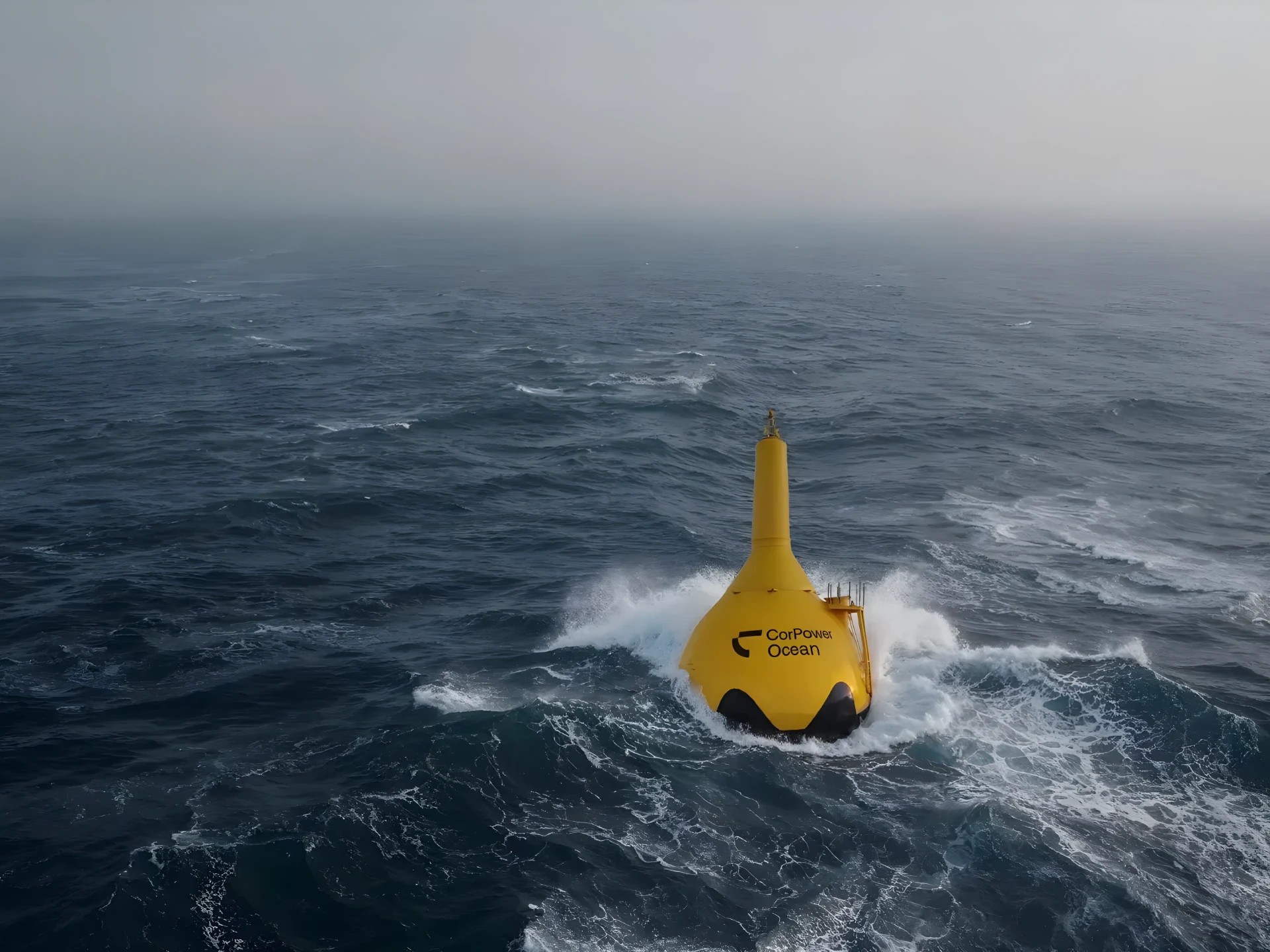
CorPower Ocean's WaveSpring technology – which delivers five times the energy yield of conventional point absorbers – shows where development is focused.
Tidal stream turbines: underwater wind farms
The dominant approach to extracting tidal stream energy is the tidal stream generator (TSG), which works in principle like a wind turbine – the only difference is the medium. Horizontal-axis turbines (like conventional wind turbines) are the industry standard: the MeyGen project's Andritz Hydro Hammerfest and AR1500 turbines and the Orbital O2 all use this principle. Vertical-axis designs are considered for sites with slower currents or for river applications.
Floating turbines – of which the Orbital O2 is the prototype – differ from conventional seabed-mounted solutions: the structure sits on a floating platform moored with anchor lines. This allows the turbine to be towed to port for maintenance, avoiding offshore interventions by divers or ROVs. According to Orbital Marine Power, the O2 is 74 m long and rated at 2 MW, with 20 m diameter rotors giving a combined swept area of 600 m² – twelve times that of the first Orbital prototype.
The tidal kite developed by Minesto works on a completely different principle: the kite-shaped device "flies" along a controlled path underwater and converts its kinetic energy into electricity with a small generator. This approach also works in slower currents, which greatly expands the range of usable sites.
The market today
The numbers reflect where the industry stands: according to Ocean Energy Europe's 2024 statistics report, a total of 32 MW of ocean energy capacity has been installed in Europe since 2010 – of which 12.7 MW is currently generating (Ocean Energy Europe, 2025). Offshore wind, by contrast, added 8 GW of new grid-connected capacity in a single year. The difference in scale is around 600-fold.
This does not mean the technology is a dead end – it means it is exactly where offshore wind stood 10–15 years ago: on the threshold between the demonstration phase and industrial-scale deployment.
The global wave and tidal stream energy market was worth $983 million in 2024 and is forecast to grow to $1.85 billion by 2032. The annual growth rate (~8%) is modest but steady – and the number of investments is growing faster than installed capacity, typical of a development phase. According to a 2025 market report by Astute Analytica, the US Department of Energy (DOE) spent $141 million on ocean energy development in 2024 and a total of $591 million over the past five years – its largest commitment to date.
The REN21 Global Status Report 2025 records that 165 MW of publicly funded projects are awaiting deployment in Europe over the next five years – 152 MW of tidal stream and 13 MW of wave energy (REN21, 2025). These figures are concrete evidence that the industry is moving from the demonstration phase to commercial preparation.
Europe's ocean energy projects over the next five years
MW
Source: REN21 Global Status Report 2025
| Tidal stream | 152 |
|---|---|
| Wave | 13 |
Flagship projects
MeyGen – Pentland Firth, Scotland. Operated by Ampeak Energy (formerly SIMEC Atlantis Energy), the project is the world's largest operating tidal stream array. Phase 1 consists of four 1.5 MW seabed-mounted horizontal-axis turbines, generating since 2018. According to PNNL's Tethys project database, the project had generated a cumulative 51 GWh by February 2023 – more than all the world's other tidal energy devices combined at that time (Pacific Northwest National Laboratory, n.d.). According to the latest REN21 GSR 2025 data, this exceeded 70 GWh by 2024, and total cumulative generation rose above 84 GWh by mid-2025 (REN21, 2025). The project's most important achievement is reliability.
One of the MeyGen turbines ran for 6.5 years without planned maintenance at one of the harshest sites in the Pentland Firth – the kind of result that once proved offshore wind too.
The project's consented expansion potential is 398 MW – the current phase is only the beginning.
Orbital O2 – Orkney, Scotland. Developed by Orbital Marine Power, it is the world's most powerful floating tidal turbine. It has operated at the EMEC (European Marine Energy Centre) test site since 2021, supplying electricity to the Orkney grid (EMEC, n.d.). According to the company, the O2 can meet the annual electricity needs of 2,000 UK households and displaces around 2,200 tonnes of CO₂ a year. Six units of the next-generation O2-X (2.4 MW) will be deployed in Orkney in 2026–2028, and talks are under way in Canada's Bay of Fundy to prepare a 16.5 MW project with a long-term power purchase agreement from Nova Scotia Power.
CorPower Ocean C4 – Aguçadoura, Portugal. Swedish company CorPower Ocean's HiWave-5 project is the most advanced commercial-scale wave energy demonstration. The C4 device – a 300 kW, 9 m diameter, 60-tonne point absorber buoy – has been generating in the Atlantic since 2023, exporting power to the grid.
According to measurement data published on CorPower Ocean's website, the device kept operating in 18.5-metre waves, proving its storm survivability – until now one of the sector's most critical challenges.
Under the EU POWER-Farm project, a 5 MW farm is also being built in Orkney with €30 million of Horizon Europe funding. In Portugal, the VianaWave project – supported by €40 million from the EU Innovation Fund – is planning a 10 MW wave farm expected to supply 7,500 homes.
Challenges and real obstacles
The levelised cost of energy (LCOE) of fixed-bottom offshore wind was around €40/MWh in 2024 – at the start of the decade it was three times as high. Wave and tidal stream energy, by contrast, typically cost €150–300/MWh today. That is not just a price difference – it is a difference in development maturity.
According to the techno-economic analysis by Satymov et al. (2024), an LCOE below €50/MWh for wave energy is realistically achievable only by 2050, and only if capacity is built out at the expected pace. For tidal stream energy, the planned CfD (Contracts for Difference) strike price for MeyGen's second phase is €204/MWh – high compared with offshore wind, but industry players expect drastic reductions within a decade, similar to the learning curve seen in wind power.
The extremes of the marine environment
The ocean is not a forgiving place. For wave energy converters, storm survivability was long the sector's number one unsolved problem – most prototypes were damaged or destroyed at sea in severe weather.
That is why the CorPower C4's documented operation in 18.5-metre waves is not just a statistic but proof of a technological turning point.
For seabed-mounted tidal turbines, installation requires specialised vessels and narrow windows between tides. Orbital's floating approach answers exactly this: the turbine can be towed and maintained in port on land, reducing both operating costs and risk.
Grid connection and permitting
For both technologies, grid integration is a major obstacle. For nearshore or offshore systems, laying subsea cables and building onshore connection points cost billions on their own. Ocean Energy Europe's 2024 data point out that one reason for slower progress in Europe's 165 MW project pipeline is precisely the drawn-out permitting and grid procedures (Ocean Energy Europe, 2025).
Regulatory frameworks are not equally developed either: in the United Kingdom the CfD scheme already includes a dedicated ring-fence for tidal stream energy (28 MW won contracts in 2024), but in most markets there is still no similar targeted revenue support mechanism for wave energy.
The question of ecological impact
Ecological studies are still under way for both technologies. According to OES-Environmental's 2024 report, 86 projects are under active environmental assessment – 40 tidal and 39 wave energy projects.
Data so far show that the life-cycle emissions of tidal stream energy stay below 22 g CO₂/kWh, one of the lowest values of any power generation technology.
Underwater turbines in places create an artificial reef effect, which even leads to growing fish populations – an unexpected positive side effect for the industry.
On the threshold of success
Wave and tidal stream energy will not replace offshore wind – nor should that be their aim. What they offer is different: the predictability of tides, the continuity of waves, and in both cases a generation profile independent of wind and sun. In a well-designed renewable energy mix, all three technologies complement each other.
The industry today is roughly where offshore wind stood around 2008–2012: the first commercial-scale projects are successful and public funding is growing, but the learning curve needed for industrial-scale growth still lies ahead.
MeyGen's reliability data, the CorPower C4's storm survivability and the maintainability of the Orbital O2's floating platform all show that answers have been found to the fundamental technological questions.
What comes next is cost reduction and building regulatory frameworks.
Ocean Energy Europe's 165 MW European project pipeline, the US DOE's $591 million five-year investment programme and the arrival of CfD contracts in the tidal stream market all suggest that this decade could be the decade of technological maturity. The question is no longer whether these technologies can work – but whether they can scale fast enough.
Offshore wind farms are now a proven industrial reality – but the oceans' energy potential goes much further. Wave and tidal stream energy are two emerging technologies just now leaving the demonstration phase. The global theoretical potential of wave energy is 29,500 TWh a year, while tidal stream energy has the advantage of near-perfect predictability: the tide does not depend on the weather. The global market was worth $983 million in 2024 and is set to grow to $1.85 billion by 2032. Scotland's MeyGen project has generated 84 GWh in total with four 1.5 MW turbines, and the CorPower C4 wave energy converter has operated in 18.5-metre waves off Portugal. Europe's project pipeline is 165 MW, and the US Department of Energy has invested $591 million over five years. The question is no longer whether it works, but how fast it can scale.
Offshore wind has become a commercially proven, rapidly scaling industry – but the oceans offer further sources of energy. Harnessing wave and tidal stream energy are two emerging technologies that naturally complement offshore wind: the former offers continuous output, the latter an almost perfectly predictable generation profile. The global theoretical potential of wave energy is 29,500 TWh a year, and according to the techno-economic analysis by Ruhnau et al. (2024), 29,000 TWh could be achieved by 2050 at a unit cost below €50/MWh. For tidal stream energy, a key factor is that water is 800 times denser than air, allowing much higher energy yields for the same rotor size.
The global wave and tidal stream energy market was worth $983 million in 2024 and is forecast to grow to $1.85 billion by 2032. In Europe, 165 MW of publicly funded projects are awaiting deployment within five years. The US Department of Energy (DOE) has invested $591 million in the sector over the past five years.
Among the flagship projects, Scotland's MeyGen has generated 84 GWh in total, and one of its turbines ran for 6.5 years without planned maintenance. The CorPower C4 wave energy converter has proven itself in 18.5-metre waves off Portugal. The 2 MW Orbital O2 floating turbine has been supplying the Orkney grid since 2021, and six units of its successor, the O2-X, will be deployed in 2026–2028.
The main challenges – high LCOE, extreme marine conditions, grid connection – are real but familiar: offshore wind struggled with the same problems a decade ago. The turning point now is that the fundamental technical questions have been answered. What comes next is scaling – and that requires regulatory commitment, long-term contractual frameworks and an industrial-scale supply chain.


The IEA expects the first annual fall in renewable additions in 21 years, the biggest six-year expansion on record, and a grid that is now the main thing standing in the way.


A new report projects data centres' water footprint reaching 9.32 trillion litres by 2030, but the number is only meaningful once you know what it counts, and who is making the case.

From 4 November, companies that want to buy biomethane can post their demand on the European Commission's platform and producers can bid from January. Here is what to do now and what the scheme will not give you.

The Dutch Authority for Digital Infrastructure warns that the shared cloud back ends behind home batteries, inverters and heat pumps could threaten grid stability, a risk EU rules only partly address.