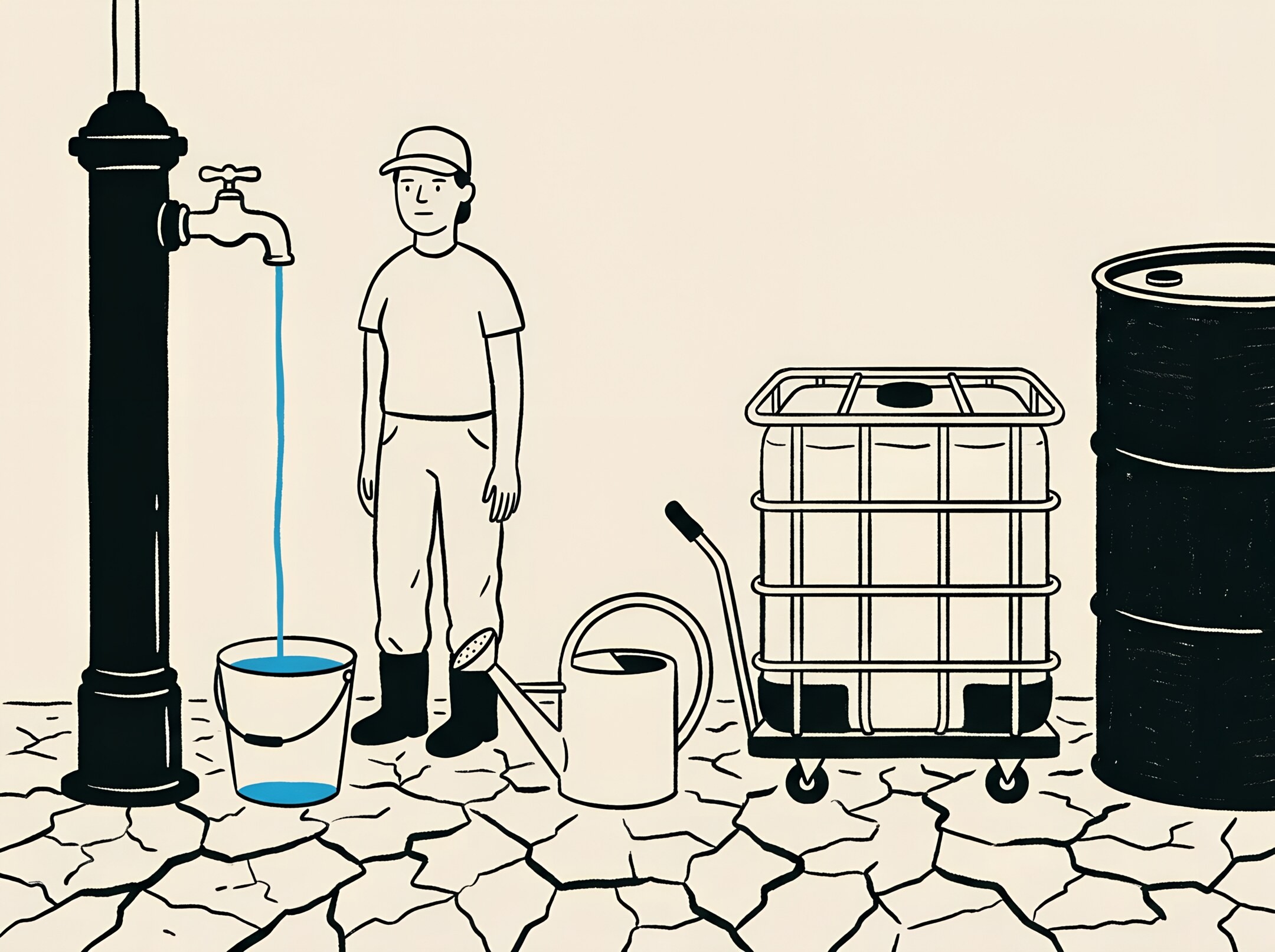
Where Centralised Wastewater Treatment Stops Paying

For half a century, the standard answer to dirty water has been a longer sewer and a larger plant. China has followed that model at a vast scale, and a study in Nature Water now uses that experience to ask where it stops making sense (Shen et al., 2026).
Using an inventory of 10,826 treatment plants, the researchers connect wastewater generation, collection, treatment, reuse and economic return in one national model. They conclude that the centralised system is approaching two limits: how far it can ease water scarcity, and how far it can recover its own costs. The findings are about China, but the question will be familiar to anyone planning sewers for small towns elsewhere.
The water isn't where it is needed
Treated wastewater looks like an obvious new source for dry regions. The study shows why the reality is narrower. Under actual reuse conditions in 2020, areas where the water scarcity index improved by more than 10% covered about 88.5 million people, roughly 6% of the population, and about 1% of the land. These benefits were concentrated in the Yellow and Haihe river basins. Even if all treated wastewater were reused, the population with substantial relief would rise only to 513.4 million.
The reason is a double mismatch.
- Wastewater and scarcity don't coincide. Only 38% of the areas assessed showed wastewater generation in line with the severity of scarcity, while it aligned with non-agricultural water demand in 87%. Much of the worst stress is in farming regions, which produce too little wastewater to support large-scale reclamation.
- Capacity reflects the past. Treatment capacity matched industrial output with 75% concordance, but population only 37% and total wastewater generation 55%. In other words, the plants are where industry used to grow, not where wastewater now arises.
The source has changed too. By 2020, domestic wastewater made up 84% of the total, while the most attractive buyers remain industrial. Power generation alone accounted for about half of potentially substitutable demand, almost all of it for cooling. Homes can use reclaimed water only for non-potable purposes such as toilet flushing, and these substitutable domestic uses amount to just 20–33% of non-agricultural demand. The water, in other words, comes from households and is wanted by power stations.
Plants were built where industry grew. Wastewater now arises where people live, and scarcity is often somewhere else.
All this adds up to a system that is less fully used than its size suggests. National capacity reached about 98 billion m³ a year in 2020, yet actual treatment was below two-thirds of that. About a quarter of urban plants and nearly half of rural ones ran at low load. Meanwhile, about 15% of wastewater went through overloaded facilities, and around 63% of rural wastewater was discharged without adequate treatment, according to the study's summary.
The size at which a plant pays
The second limit is financial. At a tariff of CNY 0.8/m³, centralised plants generally can't recover their costs under the conditions examined. At the prevailing CNY 0.9–1.1/m³, they break even only at about 6,793–49,744 m³ a day, depending on the cost scenario. The authors say this is a modelled range and not a design standard.
The scale problem in China's wastewater system
Modelled across cost and revenue scenarios
| Measure | Result |
|---|---|
| Plants in the inventory | 10,826 |
| Break-even size at prevailing tariffs | 6,793–49,744 m³/day |
| Existing plants at risk of not recovering costs | 70–93% |
| Their share of design capacity | 8–39% |
| Prospective plants in unserved areas below the threshold | 95–99% |
| People where reuse can both pay and bring substantial relief | about 450 million |
Source: Shen et al. (2026), Nature Water, via research summary
Those ranges tell a clear story. Financial weakness is concentrated among a very large number of small plants, which together hold a small share of capacity. And the next wave of building would be almost entirely below the viable size.
The cost driver changes with density. In cities, investment depends mainly on the plant's scale. In rural areas it depends on the sewer, since long pipelines are needed to collect small flows. The treatment process is rarely what makes a village scheme expensive. The pipe is.
This doesn't mean those places should go without treatment, and the authors are careful about that. Pollution control and public health may justify investment and public support even where a plant can't pay for itself. What the threshold does is identify where a centralised plant suits the place and where it doesn't.
The hybrid alternative
The study compares two pathways to meet China's national treatment and reuse targets by 2035 and hold them until 2050. Expanding centralised systems alone would need about CNY 4.0–5.0 trillion of additional investment, of which CNY 1.9–2.2 trillion is for areas now unserved. A hybrid pathway keeps or expands centralised plants where wastewater is concentrated, and uses decentralised systems, including constructed wetlands and stabilisation ponds, where sewers are expensive.
The hybrid route meets the same goals at 25–37% lower total cost, and could reduce net treatment cost by CNY 0.30–0.96/m³ by 2050. The saving comes mostly from sewers and small plants that are no longer needed, about CNY 1 trillion of avoided investment. Decentralised systems have shorter lives and would add about CNY 3.5 billion a year in renewal costs, but that is much less than what is saved.
Geography matters here too. In northern China, decentralised systems would make up more than 20% of annual investment in the years to 2027, while the south would rely more on expanding centralised capacity. It isn't a case against large plants, which remain the right choice where flows are big and reclaimed water has a reliable buyer.
How far this travels
Caveats apply. Costs depend on terrain, road networks, settlement patterns, construction prices and local management, and the authors say better spatial data would improve the estimates. Asset renewal, technology upgrades, energy use and emissions need fuller treatment too. Constructed wetlands bring their own needs, such as land and long-term maintenance, and these are often where small systems fail. Economic thresholds based on Chinese tariffs and costs can't be carried straight to another country.
The authors' own claim beyond China is modest: their findings support a transition towards coordinated hybrid systems in developing regions.
But the logic is general, and on our reading it applies in Europe too. The recast Urban Wastewater Treatment Directive extends collection and treatment obligations to smaller agglomerations of 1,000 person equivalents, and many of those are precisely the low-density places where the sewer dominates the bill. Whether an individual or decentralised system is an acceptable alternative is a matter of rules and evidence in each member state, and it deserves more attention than it gets. The sewer overflow and network failures we reported on recently are also a reminder that a long pipe is a long-term liability as well as an asset.
Questions for planners
Four questions follow from the study, wherever the plant is planned.
- Where is the reuse demand? Treated water without a stable buyer close by offers no relief, however good its quality. Power stations and industry may matter more than homes.
- What does the sewer cost per person? Compare the pipe with the plant before assuming a connection.
- Will the load still be there? Treatment assets outlast migration and industrial change. Phased and modular building reduces the risk of a plant left half-empty.
- Who pays if it doesn't recover its costs? A plant may well be justified without paying its way, but that should be a decision, with a named budget, and not something discovered later.
China's plants have achieved something remarkable in connecting cities. What this study adds is that the next phase, in sparser and drier places, won't be solved by more of the same.
China has built a vast wastewater system, but a new study in Nature Water says it is reaching its limits. Using data on 10,826 plants, researchers from the Chinese Academy of Sciences find that only about 450 million people live where reuse of treated water can both recover its costs and substantially ease local scarcity. At tariffs of CNY 0.9–1.1 per cubic metre, a plant must treat roughly 6,793–49,744 m³ a day to break even, and 95–99% of plants planned for unserved areas would fall short. A hybrid of centralised plants and local systems such as constructed wetlands could meet national targets for 25–37% less. The finding is about China, but the question applies to any country extending sewers to small settlements, including those covered by the EU's new wastewater rules.
For decades, the default answer to wastewater has been a bigger network and a bigger plant. A study in Nature Water by Shen and colleagues tests that assumption using an inventory of 10,826 treatment plants across China, and finds two limits: how far centralised systems can ease water scarcity, and how far they can pay for themselves.
The first limit is geographical. Wastewater arises where people and industry are, while scarcity is often in farming regions. Only 38% of the areas assessed showed wastewater generation aligned with the severity of scarcity. In 2020, reuse lifted local scarcity by more than 10% for only about 88.5 million people, and about 450 million live where it could both recover costs and bring substantial relief.
The second limit is scale. At prevailing tariffs of CNY 0.9–1.1 per cubic metre, plants break even only at about 6,793–49,744 m³ a day. Some 70–93% of existing plants risk failing to recover costs, though they hold only 8–39% of capacity, and 95–99% of prospective plants in unserved areas would fall below the threshold. Sewers are the reason: in low-density areas they, not the plant, dominate cost.
A hybrid pathway, with centralised plants where wastewater is concentrated and constructed wetlands or ponds in dispersed areas, could meet national targets at 25–37% lower cost, despite shorter asset lives. The authors stress that plants that can't pay may still be justified for public health. For Europe, where the recast directive reaches smaller agglomerations, the study is a reminder to test the sewer bill before assuming a connection.


Japanese researchers combined bacterial DNA from wastewater with pipe data and machine learning to flag the sewer sections most prone to corrosion – across the whole network, before the camera goes in.

Twelve years of Philadelphia data show that after combined sewer overflows, dissolved oxygen in smaller streams stays low for days, while the big river barely notices.

An English coalition has costed what it would take to keep every drop of wastewater out of England's largest lake, £3.6–3.7 billion, and its modelling says nothing less ends harmful algal blooms.

W4 relaunches with a new website, an English edition, dedicated series pages and a separate professional hub – the same coverage, with far better tools for reading and finding it.