Who Gets the Water? FAO's Draft Principles
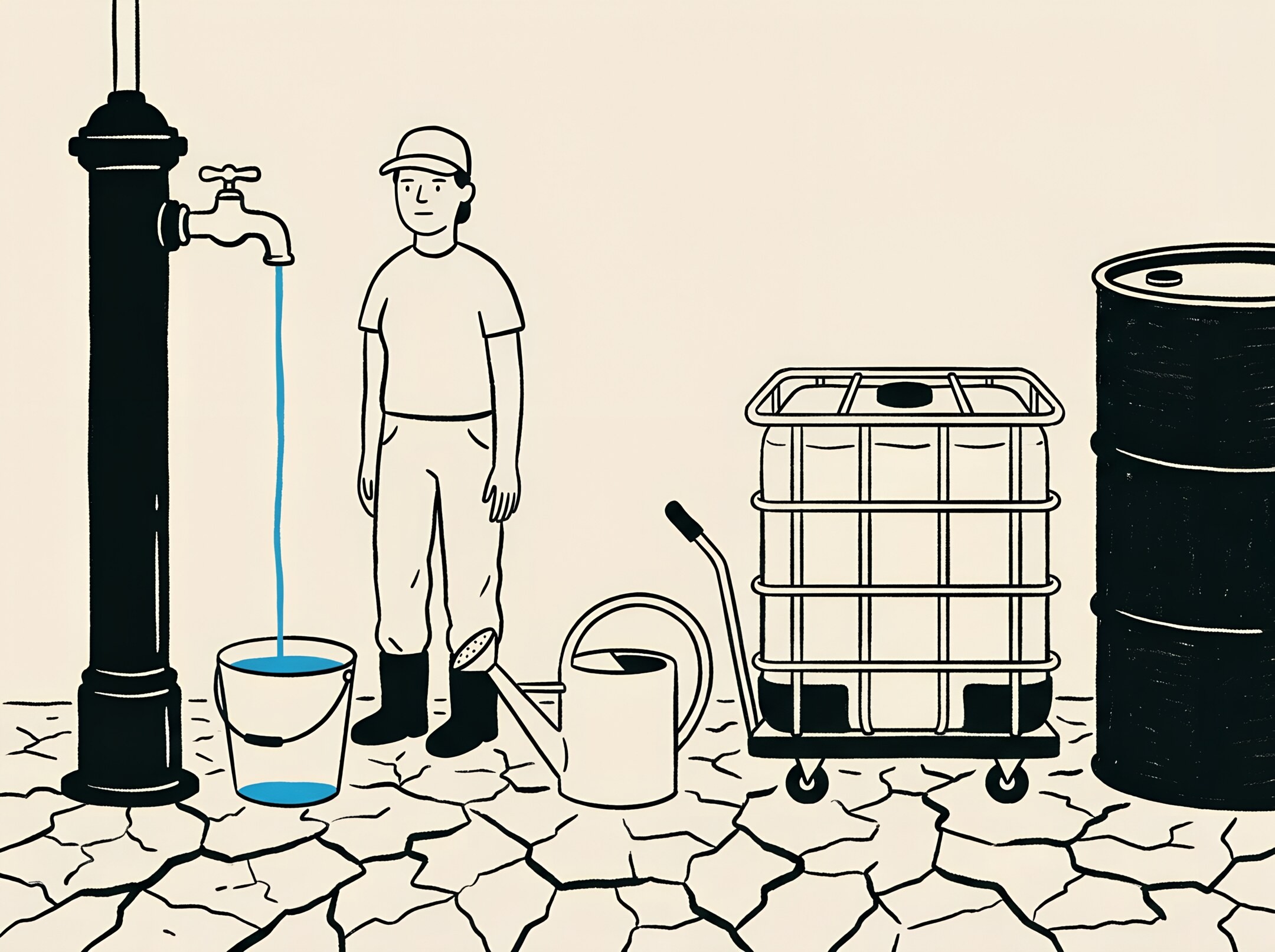
Every drought ends up asking the same question: who gets the water? Sometimes the answer is written down. Often it's scattered across old permits, local customs and whoever has the deepest well. And usually it's settled in a hurry, when the river is already low.
The Food and Agriculture Organization of the United Nations has spent several years trying to put the question on a firmer footing. In October, its draft principles on the responsible governance of water tenure were discussed at the Rome Water Dialogue (FAO, 2026a). It's a low-profile process with no binding force, but it speaks directly to the fights over allocation that have become common in dry summers.
What water tenure means
Water tenure describes the relationships between people and water, and in particular the arrangements that determine how people access and use it (FAO, 2026b). The term is wider than "water rights". Formal arrangements include permits, licences, concessions, court decisions and rights that arise through membership in a water user organisation. Others don't come from formal law at all. They rest on custom, local practice or informal arrangements.
That distinction can cause real harm. FAO notes that formally recognised arrangements typically trump those that aren't, and that recognition isn't enough on its own: duration, legal protection and, above all, measurement decide how secure a right is. A farmer whose family has irrigated from a stream for generations may have no paper at all. A newcomer with a licence, or a company with an investment contract, may have the stronger claim.
Cities are not exempt. For most of the world's people, who buy food and get water from a tap or a tanker, FAO says tenure matters only indirectly. But as more cities face shortages, including "zero day" events, and with food security in doubt, it adds, the issue matters to them no less. Urban suppliers are users too, and when farms and cities draw on the same river, a town's security depends on how well farm rights are defined.
The idea borrows from land. FAO's Voluntary Guidelines on the Responsible Governance of Tenure of Land, Fisheries and Forests have been an international reference for over a decade, and the water work draws lessons from them. But water behaves differently from land. It moves, it varies from year to year, and one user's take changes what's left for the next.
The 12 draft principles
FAO groups them in four clusters.
FAO's draft principles on water tenure
Draft, still being refined. Our short summaries of FAO's wording
| Cluster | Principle | In short |
|---|---|---|
| Foundations | Recognition and protection | All legitimate arrangements, including Indigenous and customary |
| Foundations | Security of tenure | Predictable allocation and reallocation, especially in scarcity |
| Foundations | Rights-based approaches | Protect the rights to water, food and a healthy environment |
| Governance | Evidence-based reform | Based on assessment, water accounting and monitoring |
| Governance | Policy and legal coherence | Aligned with land, farming, industry, mining and power |
| Governance | Accountability and transparency | Clear roles across local to national levels |
| Allocation | Fair and inclusive allocation | Non-discriminatory, with real participation |
| Allocation | Sustainability | Environmental flows and pollution control |
| Allocation | Resilience | Balance security with flexibility as water changes |
| Justice | Gender equality | Equal rights and a voice in decisions |
| Justice | Enforceability and accessibility | Adequate finance, and permits that aren't overly burdensome |
| Justice | Access to justice | Dispute resolution and recourse |
Source: FAO (2026a)
Three of these are worth stopping at, because they're where the text moves beyond good intentions.
Security against flexibility. The resilience principle admits a real tension: users need security in order to invest, and authorities need flexibility as water availability changes. A permit system that guarantees a fixed volume for 30 years fits badly with a river whose flow is falling.
Permits that can be used. The enforceability principle warns against overly burdensome requirements that block access to permit systems. It's a familiar paradox. Where licensing is slow and costly, small users tend not to apply, and they're then the ones treated as illegal.
Environmental flows. The sustainability principle treats water for ecosystems as part of allocation, not as what's left over. That is the same logic as the EU's Water Framework Directive, stated for a global audience.
The practical core: decide before the drought
The most useful line comes from FAO's explanatory text. Responsible governance includes "the predictable and fair re-allocation of water in times of drought and water shortage", which depends on "setting priorities between uses and the advanced definition of allocation reductions rather than ad hoc decision making".
Who gets cut first is a decision best made in a wet year.
FAO's Director-General Qu Dongyu made the broader case at the high-level session on 14 October, naming fair and reliable access as one of four linked priorities, along with efficiency, preparedness and healthy ecosystems (FAO, 2026d).
“Efficiency without inclusion deepens inequality. And resilience cannot last without healthy ecosystems or viable livelihoods.”
Qu's list also shows how the debate is shifting. For a long time, water scarcity was treated mainly as an engineering or a farming problem. Fair access is now being discussed in the same sentence as efficiency, and that puts allocation rules on the same agenda as drip irrigation.
The dialogue also took up pricing and allocation, saying that suitable pricing and incentives can encourage efficiency while protecting basic needs and vulnerable communities. It's a cautious formula, and it leaves the difficult decisions to governments.
Who has been asked, and what happens next
The Global Dialogue on Water Tenure began in 2023, as FAO's commitment to the Water Action Agenda at the UN Water Conference, after recommendations from its Committee on Agriculture and the Committee on World Food Security (FAO, 2026c). An expert group met in Rome in May 2025. National dialogues followed in Colombia, Senegal and Thailand, and regional ones in Latin America and the Caribbean, Asia-Pacific and West Africa. FAO says more than 700 people from 92 countries took part, 45% of them women.
Country assessments of water tenure have been carried out in 8 countries: Cambodia, Colombia, Indonesia, Rwanda, Senegal, Sri Lanka, Thailand and Vietnam. No European country is on the list.
The limits should be clear. The principles are non-binding, and FAO itself calls them a precursor to possible principles, to be adopted "at an appropriate forum", with no date. The Committee on World Food Security, the Rome Water Dialogue and the World Water Forum are named as platforms for review. FAO also stresses that water tenure is essentially a national matter and doesn't determine negotiations over shared rivers, though an assessment can inform them. No country positions have been published.
Why this matters beyond the eight countries
It's easy to read this as a text for developing countries with customary water use. That would be a mistake, because the same issues are surfacing in rich countries, usually in a different vocabulary.
Unlicensed abstraction is one. Drought shows quickly who can pump, who is measured and who isn't. Priorities are another: temporary use bans restricted more than 30 million people in England this year, and such tools embody a choice about who gets cut first. Data centres now compete for local supply, and, as our report on AI's water use shows, several disputes have turned on exactly who was consulted. And water conflicts, already at a record level, are in large part disputes over access.
For a water authority or a large user, the draft offers a usable checklist even without legal force:
- Is every significant use on record, measured and known? FAO stresses that measurement is at the heart of tenure security.
- Are priorities between uses written down? If so, they can be debated in advance. If not, they'll be settled under pressure.
- Can a small user actually get a permit? A system that shuts them out creates illegal use and undermines itself.
- Is there a real way to challenge a decision? Disputes that can't be heard somewhere tend to escalate.
- Does the permit system allow for less water? Long, fixed entitlements are a bet on a stable climate.
None of this will fill a reservoir. But the underlying point, that much of a water crisis comes down to governance, is one of the few that costs little to act on. When the next drought comes, the question won't be whether someone gets cut. It will be whether the rules for that were agreed beforehand.
When water runs short, someone has to decide who gets it, and in many places the rules are unclear or unfair. FAO has published draft principles on the responsible governance of water tenure, the arrangements that determine how people access and use water. The 12 principles, grouped in four clusters, cover legal recognition, including customary rights, security, fair allocation, environmental flows, and access to justice. They ask governments to set priorities and cuts in advance rather than improvising in a drought. The text is non-binding and has no adoption date. Assessments have been carried out in eight countries, none in Europe, but the questions apply everywhere. Europe's own disputes over unlicensed wells, bans and irrigation charges show why a clear system for allocating water matters most before the river drops.
Every drought eventually raises one question: who gets the water? FAO's work on water tenure tries to answer it in general terms. Water tenure means the arrangements that determine how people access and use water: permits and licences, but also custom, local practice and informal use. In October FAO discussed draft principles at the Rome Water Dialogue, after consultations it says involved more than 700 people from 92 countries.
There are 12 draft principles in four clusters. Foundational ones recognise all legitimate arrangements, including customary and Indigenous ones, and promote tenure security and rights-based approaches. Governance principles call for evidence-based reform, coherence with other sectors and accountability. Allocation principles cover fair sharing, environmental flows and resilience. The last group covers gender equality, enforceability and access to justice.
The most practical idea is advance planning. FAO argues that reallocation in a drought should be predictable and fair, which depends on setting priorities between uses and defining reductions ahead of time rather than deciding ad hoc. It also warns that burdensome permit systems can shut out small users.
The text is non-binding, and FAO stresses that water tenure remains a national matter and doesn't determine transboundary negotiations. There is no adoption date, only a reference to an appropriate forum, with the Committee on World Food Security, the Rome Water Dialogue and the World Water Forum named as platforms. Eight countries have been assessed: Cambodia, Colombia, Indonesia, Rwanda, Senegal, Sri Lanka, Thailand and Vietnam. Europe wasn't among them, but its water disputes raise the same questions.



A study of 10,826 Chinese treatment plants finds that big centralised systems are reaching two limits at once, on easing water scarcity and on paying their way, and that a hybrid model could do the job for up to 37% less.
A new report projects data centres' water footprint reaching 9.32 trillion litres by 2030, but the number is only meaningful once you know what it counts, and who is making the case.
An English coalition has costed what it would take to keep every drop of wastewater out of England's largest lake, £3.6–3.7 billion, and its modelling says nothing less ends harmful algal blooms.

The Joint Research Centre mapped 1,300 hydrogen plants against local water resources and found the EU's targets reachable without a water crisis, though southern Europe and parts of central Europe will need careful planning.