From Wastewater to Fertiliser: a $12 Billion Turn
The global market for nutrient recovery systems was worth $5.11 billion in 2024 and is expected to reach $12.2 billion by 2032, according to market research published by DataM Intelligence in May 2026. That corresponds to an average annual growth rate of 11.5% – almost 2.4-fold expansion in eight years. Growth is driven by an increasingly decisive shift among municipal wastewater treatment plants, farmers and industrial operators: instead of removing nutrients, the focus is on recovering and using them.
This change represents a shift in what we regard as waste and what we regard as a raw material.
The turning point: removal vs. reuse
For decades, wastewater treatment was built on the logic of removal. Keeping nitrogen and phosphorus out of effluent was mandatory, because in receiving waters these substances cause eutrophication – massive algal growth, oxygen depletion and ecosystem collapse. But the precipitated substances had to be treated and disposed of at great cost. The nitrogen and phosphorus extracted were lost, even though they are mineral resources of strategic value.
For nitrogen the link is particularly striking: conventional nitrogen fertiliser production relies on the Haber–Bosch process, which accounts for around 1–2% of global energy use. Nitrogen recovered from wastewater therefore also means direct energy savings.
For phosphorus, the supply security question is even sharper. Phosphorus is on the EU's list of critical raw materials: the continent depends almost entirely on imports, since there is no significant phosphate mining in Europe. Supply dependence on the Middle East, Africa and China poses a serious risk to the European food system, because phosphorus is indispensable for crops and has no substitute. According to the register of the European Sustainable Phosphorus Platform (ESPP, n.d.), more than 40 commercially available or developing technologies now exist for recovering phosphorus from wastewater – from simple filtration to electrodialysis and struvite precipitation.
Rescuing value
A typical tool for recovering phosphorus is struvite (magnesium ammonium phosphate): a crystalline, slow-release fertiliser that reduces leaching losses and improves uptake by plants. Ostara's European sites – in Amersfoort in the Netherlands, Madrid in Spain and Slough in the UK – recover it from wastewater to produce the struvite-based fertiliser Crystal Green®, sold directly to farmers. The market price of phosphate rock was around $170 per tonne at the end of 2024, a level at which the economic competitiveness of recovered struvite is increasingly well founded.
Nitrogen is recovered mainly by ammonia stripping, especially from the liquid residue after anaerobic digestion. Struvite precipitation and ammonia stripping achieve 80–90% recovery efficiency at full scale for both nitrogen and phosphorus.
Potassium can also be recovered, to a lesser extent, mainly from agricultural waste and digestate. Technology development here still lags behind the other two elements – although potassium is not a critical raw material, and its recovery efficiency is also lower.
Biogas as the link
One of the less visible but crucial drivers of the nutrient recovery market's growth is the spread of anaerobic digestion. An anaerobic digester – whether at a wastewater treatment plant, an agricultural biogas plant or an industrial facility – produces two products in parallel: biogas for energy, and digestate.
Digestate is extremely rich in nitrogen and phosphorus, yet it is rarely suitable for direct application to land, because its nutrient concentration is usually not high enough and it does not meet discharge requirements. Nutrient recovery technologies remedy exactly this. Around 180 million tonnes of digestate are produced in the EU each year, with the liquid fraction containing 2–5 g of nitrogen and 0.5–1.5 g of phosphorus per litre. According to a systematic review published in Environmental Evidence, combining anaerobic digestion with nutrient recovery technologies achieves energy and nutrient recovery at the same time (Lorick et al., 2020).
Anaerobic digestion is thus not just an energy solution but also one of the most promising core processes of the nutrient recovery industry. Its potential is still far from fully exploited.
The European picture
Europe is at the regulatory and technological forefront of nutrient recovery. The EU's recast Urban Wastewater Treatment Directive (EU 2024/3019) entered into force on 1 January 2025 and fundamentally reshapes the conditions for nutrient management on the continent. Plants above 150,000 population equivalent (PE) must introduce tertiary treatment. At medium-sized plants of 10,000–150,000 PE, the discharge limit for phosphorus falls from 2 g/m³ to 0.7 g/m³ and for nitrogen from 15 g/m³ to 10 g/m³ – creating de facto pressure to invest in more advanced recovery systems. According to the ESPP, around 50 permanent phosphorus recovery sites currently operate on the continent, most of them in the Netherlands, Belgium, Germany and the UK.
The Netherlands has gone furthest: in 2014 it set a national target that 25% of fertilisers used should come from recovered phosphorus – mainly struvite. Although no binding deadline was attached, the framework clearly steers investment and market demand.
Two industry giants also took notable steps in 2025. In July, Veolia launched an advanced nutrient recovery system for municipal wastewater treatment plants, focused on efficient recovery of nitrogen and phosphorus. In March, SUEZ unveiled its new-generation platform, backed by an $11 million R&D investment and combining real-time monitoring with automation.
Regions and market players
North America is currently the largest market – thanks to advanced infrastructure and decades of experience with nutrient regulation. Asia-Pacific is the fastest-growing region: Japan stands out as a strategic market, where fertiliser security and sewage sludge use are becoming increasingly important political issues.
The main active market players include Lenntech, Ostara Nutrient Recovery Technologies, Xylem, Trident Process Inc, DVO Inc, Clearas Water Recovery, Belgium's NuReSys NV and GSR Solutions. One of the most characteristic trends of recent years is the arrival of more and more specialised companies in this segment, breaking into a market dominated by Veolia, SUEZ and Xylem – increasing competition and accelerating price reductions.
Ammonia stripping and struvite precipitation can now be carried out at a cost of €2–7 per kilogram of recovered nutrient. This range is getting ever closer to the threshold at which recovery pays for itself – especially given rising disposal costs, which push up the real price of simple removal.
A fast-growing market
The expected growth of the nutrient recovery market from $5.11 billion to $12.2 billion is the financial footprint of a strategic transformation. Behind the 11.5% annual growth rate lie mutually reinforcing drivers: tighter EU wastewater rules, the classification of phosphorus as a critical raw material, the untapped potential of the 180 million tonnes of European digestate from anaerobic digestion, and ever cheaper recovery technologies. Nutrient recovery is becoming a defining pillar of circular wastewater management – especially in Europe, where regulation and raw material dependence together create a framework in which recovery is not just an opportunity but a necessity.
According to market research by DataM Intelligence, the global market for nutrient recovery systems was worth $5.11 billion in 2024 and could reach $12.2 billion by 2032, growing at 11.5% a year. The driver of the sector's transformation is recovering nitrogen, phosphorus and potassium from wastewater – a shift from removal to reuse. Anaerobic digestion creates a direct link between the biogas and nutrient recovery industries: from the 180 million tonnes of digestate produced in the EU each year, struvite precipitation and ammonia stripping can recover nitrogen and phosphorus with 80–90% efficiency. The tightening limits of the EU's Directive 2024/3019 create pressure to invest. The Netherlands, Spain and the United Kingdom already produce struvite-based fertiliser from wastewater at commercial-scale sites. Veolia and SUEZ made further developments in the segment in 2025, the latter with an $11 million R&D investment.
According to market research published by DataM Intelligence in May 2026, the global market for nutrient recovery systems could grow from $5.11 billion to $12.2 billion by 2032, at an average annual growth rate of 11.5%. Behind the expansion lies a change of mindset among municipal wastewater treatment plants, farmers and industrial operators: recovering nutrients is replacing removing them.
Recovery concerns three main elements: nitrogen, phosphorus and potassium. Phosphorus is especially critical: Europe depends entirely on imports, and phosphorus is on the EU's list of critical raw materials. According to the European Sustainable Phosphorus Platform (ESPP), more than 40 technologies are available for recovery, and around 50 permanent sites currently operate on the continent.
Anaerobic digestion plays a key role in market growth. The roughly 180 million tonnes of digestate produced in the EU each year contain 2–5 g of nitrogen and 0.5–1.5 g of phosphorus per litre. Struvite precipitation and ammonia stripping achieve 80–90% recovery efficiency at full scale, at a cost of €2–7 per kilogram. Anaerobic digestion is thus not only an energy solution: it is also one of the most promising core processes of the nutrient recovery market.
In Europe, the regulatory framework is a strong driver. Under the EU's Directive 2024/3019, tertiary treatment is mandatory at larger plants and discharge limits are tightening. The Netherlands set a target for the share of recovered phosphorus back in 2014. Ostara produces struvite at commercial scale at sites in the Netherlands, Spain and the UK. Veolia and SUEZ each made major developments in 2025, the latter with an $11 million R&D investment.



A study of 10,826 Chinese treatment plants finds that big centralised systems are reaching two limits at once, on easing water scarcity and on paying their way, and that a hybrid model could do the job for up to 37% less.
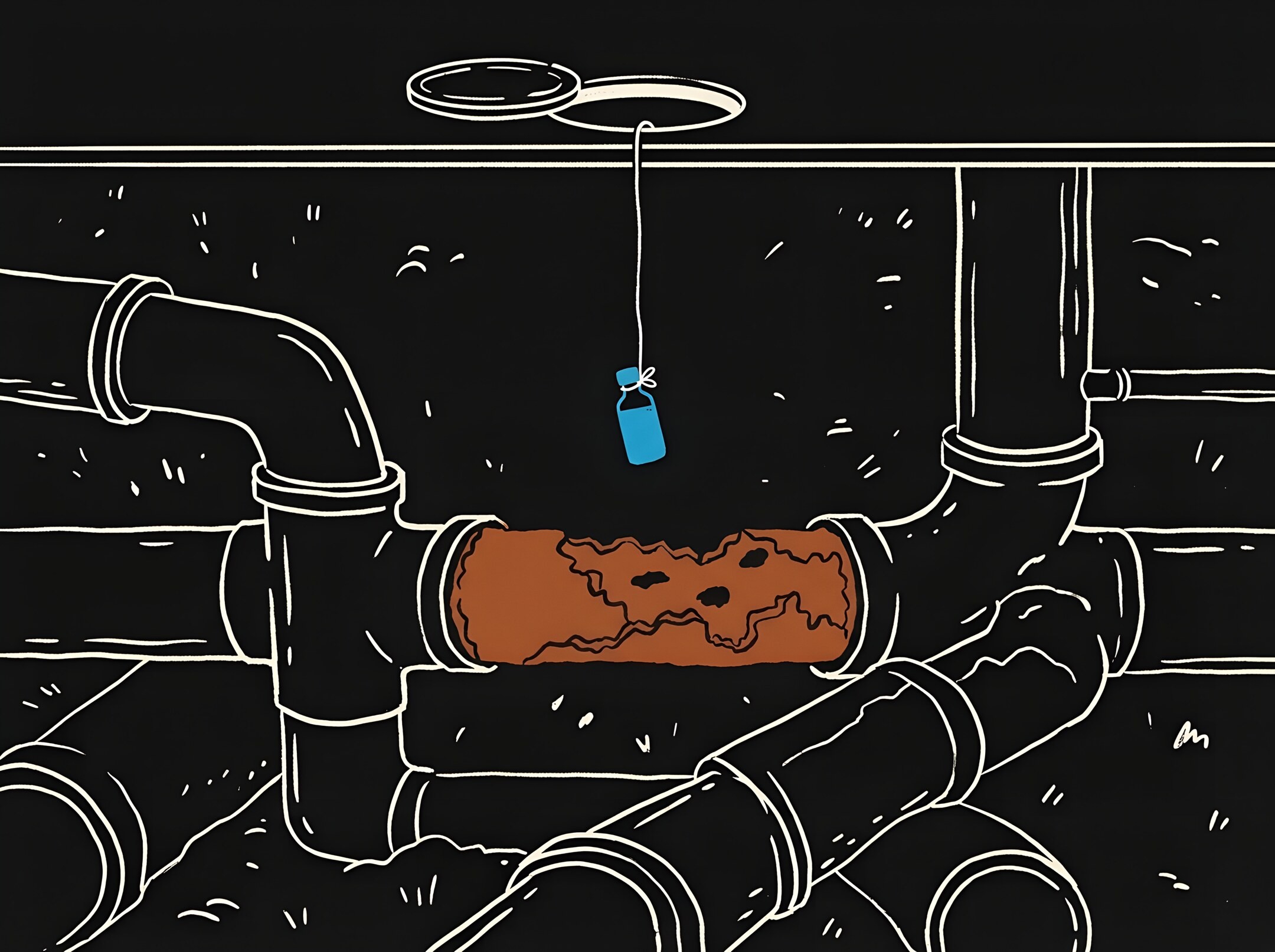
Japanese researchers combined bacterial DNA from wastewater with pipe data and machine learning to flag the sewer sections most prone to corrosion – across the whole network, before the camera goes in.

Twelve years of Philadelphia data show that after combined sewer overflows, dissolved oxygen in smaller streams stays low for days, while the big river barely notices.

An English coalition has costed what it would take to keep every drop of wastewater out of England's largest lake, £3.6–3.7 billion, and its modelling says nothing less ends harmful algal blooms.