What a Sewer Overflow Does to a Stream
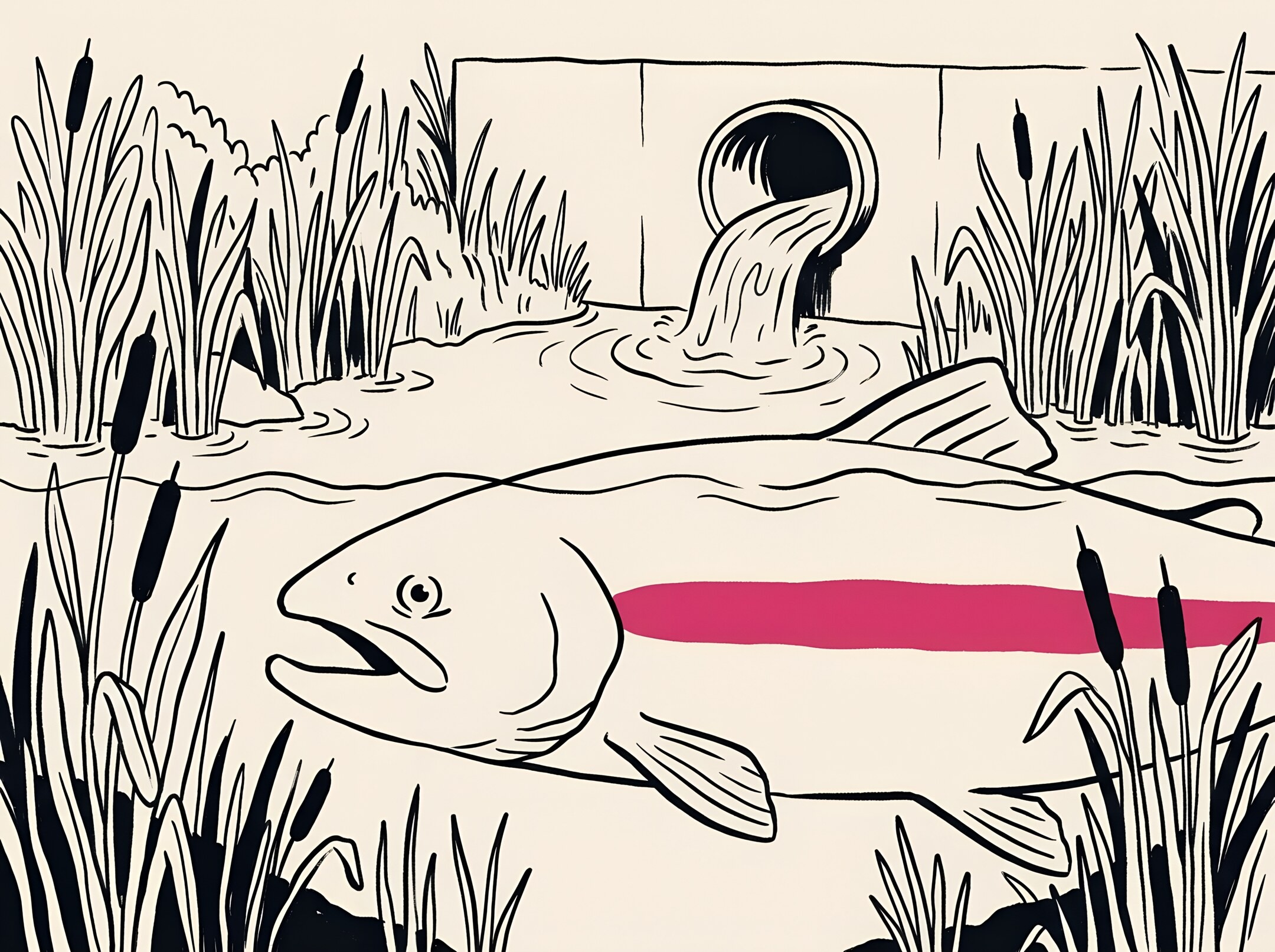
When a combined sewer – one pipe carrying both wastewater and rainwater – receives more than it can carry, the excess spills through overflows into the nearest stream or river. What that does to the waterway is rarely measured over the long term. A Philadelphia study has now used 12 years of data to show that in small streams the effect lasts for days, while in a large river it barely registers (Black et al., 2026).
Four watersheds, above and below the outfall
Researchers at Drexel University worked with the Philadelphia Water Department, with support from the US Geological Survey (USGS). They combined USGS water quality monitoring from 2013 to 2024 with NOAA rainfall data and the utility's overflow records across four watersheds: Darby-Cobbs, Pennypack and Tacony-Frankford creeks, and the stretch of the Delaware River bordering Philadelphia. Each has at least one overflow, with monitoring stations both upstream and downstream.
The measure they tracked was dissolved oxygen. It shows whether fish and other aquatic life can survive, and because breaking down the organic matter in overflowing sewage consumes oxygen, it reflects the load directly.
Days of low oxygen
Across all four watersheds, overflows and wet weather lowered daily minimum oxygen compared with dry days. In the smaller streams the drop exceeded 1 mg/l and lasted for days (Drexel University, 2026).
Tacony-Frankford Creek fared worst. There, 40% of July readings fell below the minimum set by the US Environmental Protection Agency (EPA) for fish growth and reproduction, and low levels persisted into September. Pennypack and Darby-Cobbs creeks rarely fell below the threshold at any point in the year.
A small stream carries the mark of an overflow for days; a large river barely notices.
The Delaware River showed very little change in oxygen after overflows. According to the researchers, its sheer volume and flow dilute the organic matter in the sewage.
Temperature sets the baseline, overflows the swings
One of the study's main contributions is separating the effects. In every watershed, oxygen followed the same seasonal cycle: warm summer water holds less oxygen, and biological activity uses more of it. Temperature therefore sets the baseline. Overflows and changes in flow cause the short-term drops on top of that, and determine how long they last (Black et al., 2026).
How long they last varies by watershed. Where water is exchanged quickly, oxygen recovers fast; where water lingers and is flushed less, it stays low for days.
Amanda Carneiro Marques, who led the research, said this shows that the impact of overflows is far from uniform across watersheds.
What the researchers recommend
The researchers say that before a city invests in cutting overflows, it should understand how vulnerable each watershed is. Stormwater should be held back where it falls, through retention areas, permeable surfaces and household rainwater tanks. Next, the team plans to study what overflows contain and how the built environment shapes resilience.
In Philadelphia this is no abstract question. More than 30 billion litres (8 billion gallons) of combined sewage and stormwater reach the county's rivers and streams each year during high flows. Combined sewers serve about 60% of the city. Under Green City, Clean Waters, the 25-year green infrastructure programme the water department launched in 2011, the city must cut combined sewer pollution by at least 85% by 2036. The utility says more than 2,800 green features have been built at nearly 800 sites so far (Philadelphia Water Department, n.d.).
The lesson goes beyond Philadelphia. The EU's recast Urban Wastewater Treatment Directive (EU 2024/3019) requires integrated urban wastewater management plans that include tackling storm overflows. The Philadelphia data suggest those plans should look hardest at small receiving streams, where an overflow leaves its mark longest – especially in the warm summer months.
Researchers from Drexel University and the Philadelphia Water Department used data from 2013 to 2024 to examine how combined sewer overflows affect dissolved oxygen in four Philadelphia waterways. In smaller streams, oxygen fell by more than 1 mg/l after overflows and stayed low for days. In Tacony-Frankford Creek, 40% of July readings were below the level needed for fish growth and reproduction. The Delaware River, by contrast, showed little change, because its large flow dilutes the pollution. Temperature sets the baseline, while overflows drive short-term drops and how long they last. The researchers conclude that overflow impacts differ from one watershed to the next, so each stream's vulnerability should be assessed before cities choose how to tackle them.
Researchers from Drexel University and the Philadelphia Water Department, supported by the US Geological Survey, used data from 2013 to 2024 to examine how combined sewer overflows affect dissolved oxygen in four Philadelphia waterways. Each of the four watersheds has at least one overflow, with monitoring stations both upstream and downstream. In Philadelphia County, more than 30 billion litres of combined sewage and stormwater reach rivers and streams each year.
Across all watersheds, overflows and wet weather lowered daily minimum oxygen compared with dry days. In smaller streams the drop exceeded 1 mg/l and lasted for days. In Tacony-Frankford Creek, 40% of July readings were below the level needed for fish growth and reproduction, and oxygen stayed low into September. Pennypack and Darby-Cobbs creeks rarely fell below the threshold, and the Delaware River showed little change, because its large flow dilutes the pollution.
Temperature sets the baseline, while overflows and flow conditions drive short-term drops and how long they last. The researchers conclude that impacts differ from one watershed to the next, so each stream's vulnerability should be assessed before mitigation is chosen, and stormwater should be held back where it falls. Philadelphia has been cutting overflows since 2011 under a 25-year green infrastructure programme. Under the programme, combined sewer pollution must fall by at least 85% by 2036. The lesson also applies to European cities with combined sewers, which must prepare integrated plans under the EU's wastewater directive: small receiving streams are the most vulnerable.



A study of 10,826 Chinese treatment plants finds that big centralised systems are reaching two limits at once, on easing water scarcity and on paying their way, and that a hybrid model could do the job for up to 37% less.
Japanese researchers combined bacterial DNA from wastewater with pipe data and machine learning to flag the sewer sections most prone to corrosion – across the whole network, before the camera goes in.
An English coalition has costed what it would take to keep every drop of wastewater out of England's largest lake, £3.6–3.7 billion, and its modelling says nothing less ends harmful algal blooms.

W4 relaunches with a new website, an English edition, dedicated series pages and a separate professional hub – the same coverage, with far better tools for reading and finding it.