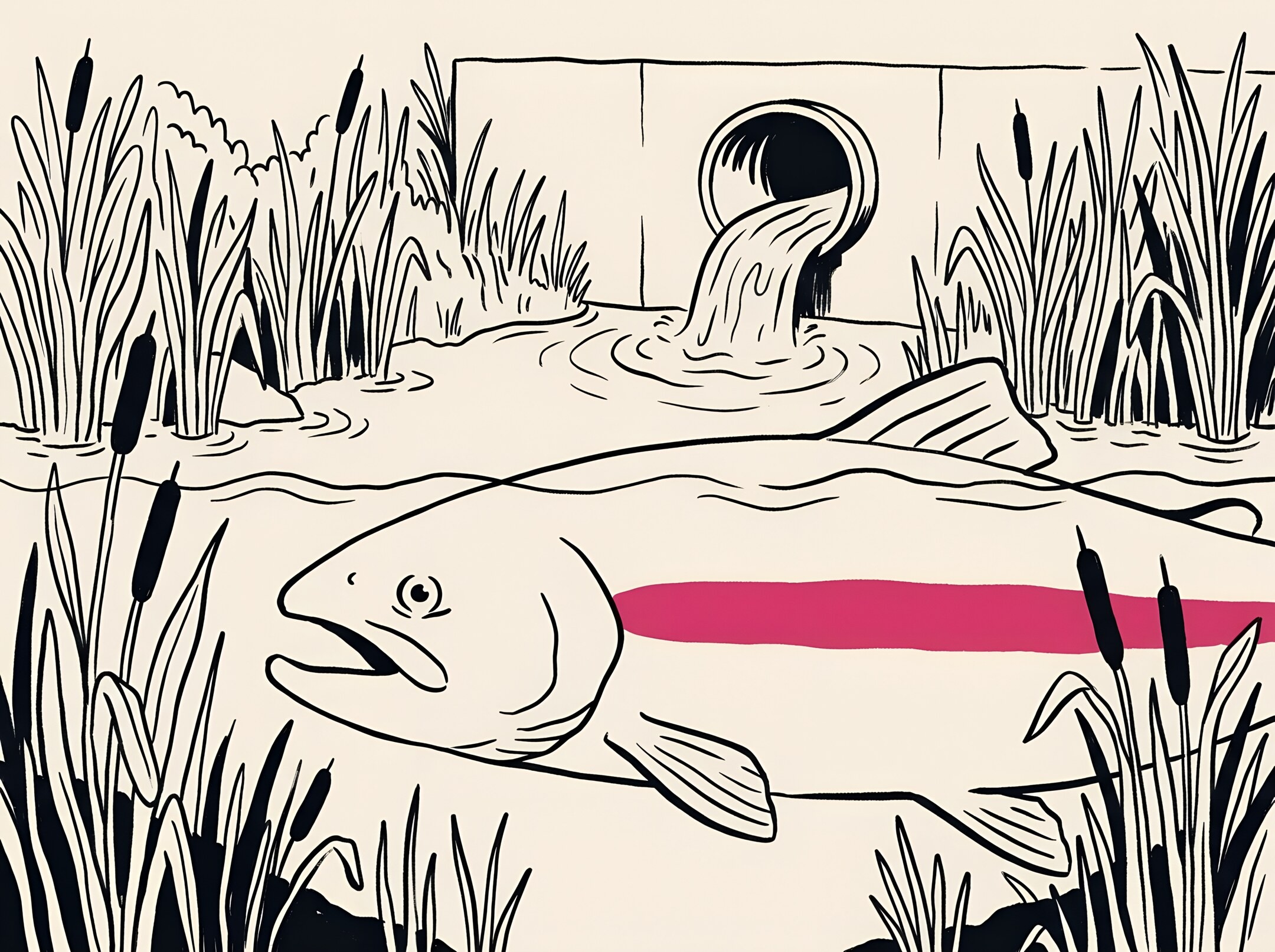
Wastewater DNA Shows Which Sewer Is Corroding
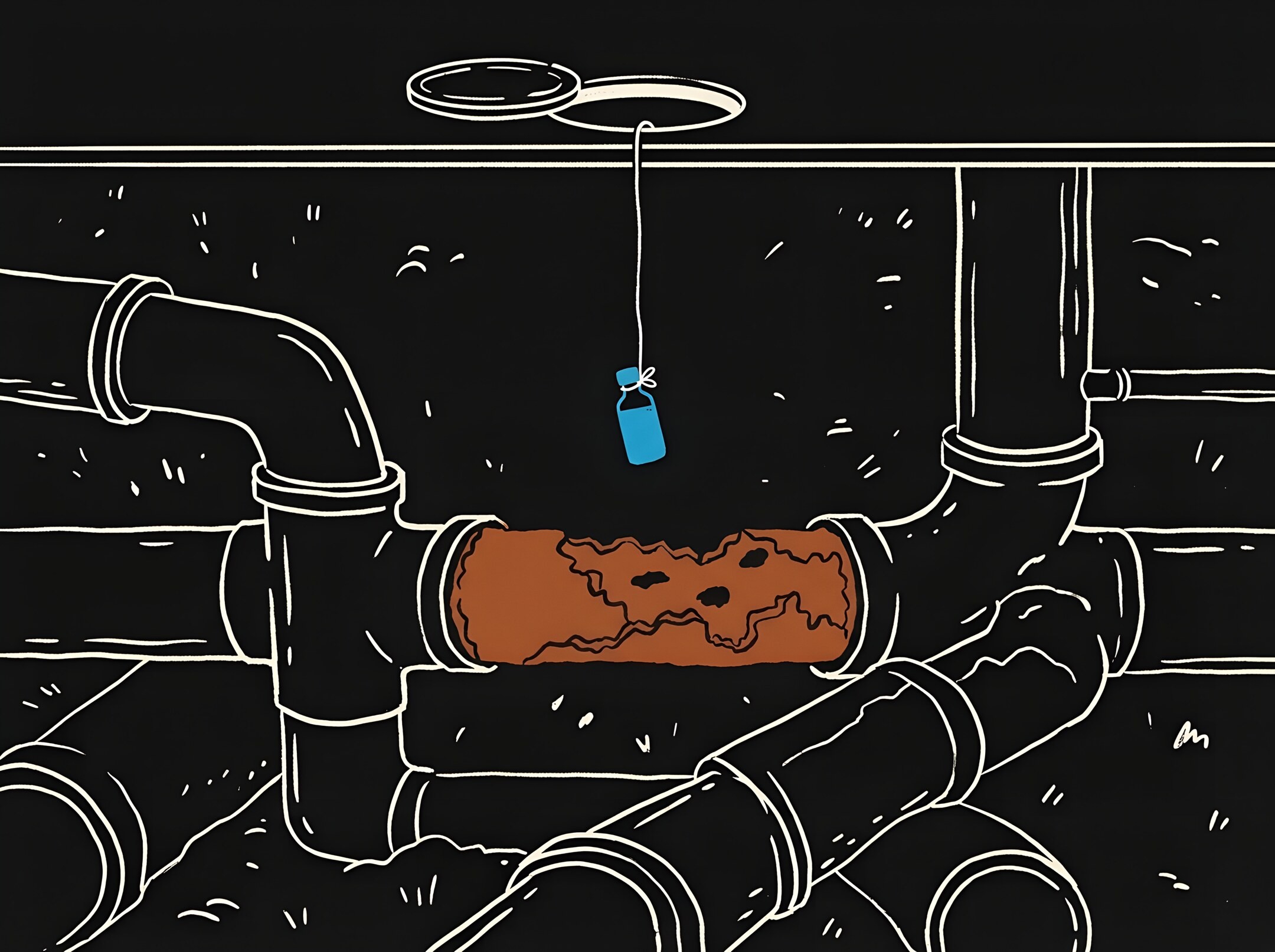
Sewer networks are ageing, and corrosion of concrete pipes is a major cause of their deterioration and premature collapse (Gomez-Alvarez et al., 2012). The standard check is camera inspection, which is hard to scale across a large network when resources are tight. Japanese researchers have now asked whether the wastewater itself can tell utilities where to look first (Zhang et al., 2026).
The bacteria behind corrosion
Bacteria play a central part in sewer corrosion. In oxygen-poor wastewater, sulphate-reducing bacteria produce hydrogen sulphide; the researchers describe their role in sewer sulphide production as well established. Bacteria that oxidise sulphur compounds settle on the upper part of the pipe: in one study of a corroded concrete sewer, the crown and the invert hosted different bacterial communities, partly because of the abundance of sulphide-oxidising and sulphate-reducing bacteria (Gomez-Alvarez et al., 2012).
So knowing where sulphate-reducers thrive in a network could point to where corrosion risk is higher.
DNA from the wastewater
Over two years, the researchers sampled wastewater at points across a predefined network and used environmental DNA to measure two genera of sulphate-reducing bacteria, Desulfovibrio and Desulfobulbus, along with dsrB, a gene involved in sulphate reduction.
From these results they estimated which sections of the network offer suitable habitat, using species distribution modelling, a standard ecological method. It was designed to predict where an animal or plant species can live; here, pipe sections became the habitat. The model performed best for Desulfobulbus, with a ROC-AUC – a measure of classification quality – of 0.925, where 1 is a perfect prediction.
Machine learning on camera results
In a second step, the bacteria's estimated habitat suitability was fed, together with pipe data, into a machine learning model known as a random forest. Its task was to predict the condition of the pipes as classified by the city's camera inspections.
The best model used the two-year average habitat suitability rather than individual sampling rounds, so the longer record gave a more reliable signal. On the test data it reached an area under the precision-recall curve (PR-AUC) of 0.670. This measure captures how well a model finds the rarer corroded pipes without flagging too many sound ones; it was the best result among the models tested on this network. Pipe age remained the most important predictor. Among the microbial inputs, Desulfobulbus and the dsrB gene carried similar weight, followed by Desulfovibrio.
Pipe age stays the best predictor – bacterial DNA adds to it rather than replacing it.
What it can and cannot do
The method's strength is that it scales to an entire network and produces estimates even for pipe sections where no samples were taken. The researchers therefore propose it for ranking inspections: deciding where to send the camera first.
The limits are clear too. The model was built on a single Japanese network, camera inspection still establishes the actual condition of a pipe, and pipe age mattered more than the bacteria. For a utility, what is new is not the sampling itself but linking wastewater samples to network condition assessment. If the approach holds up on other networks, a limited inspection budget could find more bad pipes in time. Most utilities rank pipes by age and material today; a wastewater sample adds a signal that reflects what is happening inside the pipe, not just how old it is.
Sewer networks are ageing, and camera inspection is slow and costly, so utilities cannot inspect every pipe regularly. Japanese researchers have tested whether bacterial DNA in wastewater can help decide where to look for corrosion first. They sampled a defined network over two years and used species distribution modelling to map where sulphate-reducing bacteria, which produce hydrogen sulphide, are likely to thrive. A machine learning model then combined these maps with pipe data and was checked against the city's camera inspection results. Pipe age remained the strongest predictor, but the microbial data added real information. The method does not replace the camera, but it can show where to send it first.
Sewer networks are ageing, and corrosion of concrete pipes is a major cause of their deterioration and premature collapse. Camera inspection is slow and costly, so utilities cannot inspect every pipe regularly, and deciding where to start is hard.
Japanese researchers have tested whether bacterial DNA in wastewater can help. Over two years they sampled wastewater across a defined network and measured two genera of sulphate-reducing bacteria, Desulfovibrio and Desulfobulbus, along with dsrB, a gene involved in sulphate reduction. Using species distribution modelling, a method borrowed from ecology, they estimated which sections of the network offer good habitat for the bacteria behind hydrogen sulphide production. For Desulfobulbus the model performed very well.
A machine learning model, a random forest, then combined this map with pipe data and learned to predict the corrosion status assigned by the city's camera inspections. Pipe age remained the most important predictor, but the microbial data, especially for Desulfobulbus and the dsrB gene, added real predictive value. The two-year averages worked better than single sampling rounds.
According to the researchers, the method can be scaled to a whole network and produces estimates even for pipe sections where no samples were taken. It does not replace camera inspection, but it can help utilities decide where to send the camera first. The model was built on a single network, so it still has to be shown to work in other cities.



A study of 10,826 Chinese treatment plants finds that big centralised systems are reaching two limits at once, on easing water scarcity and on paying their way, and that a hybrid model could do the job for up to 37% less.
Twelve years of Philadelphia data show that after combined sewer overflows, dissolved oxygen in smaller streams stays low for days, while the big river barely notices.

An English coalition has costed what it would take to keep every drop of wastewater out of England's largest lake, £3.6–3.7 billion, and its modelling says nothing less ends harmful algal blooms.

W4 relaunches with a new website, an English edition, dedicated series pages and a separate professional hub – the same coverage, with far better tools for reading and finding it.