The New Age of the Electric Motor
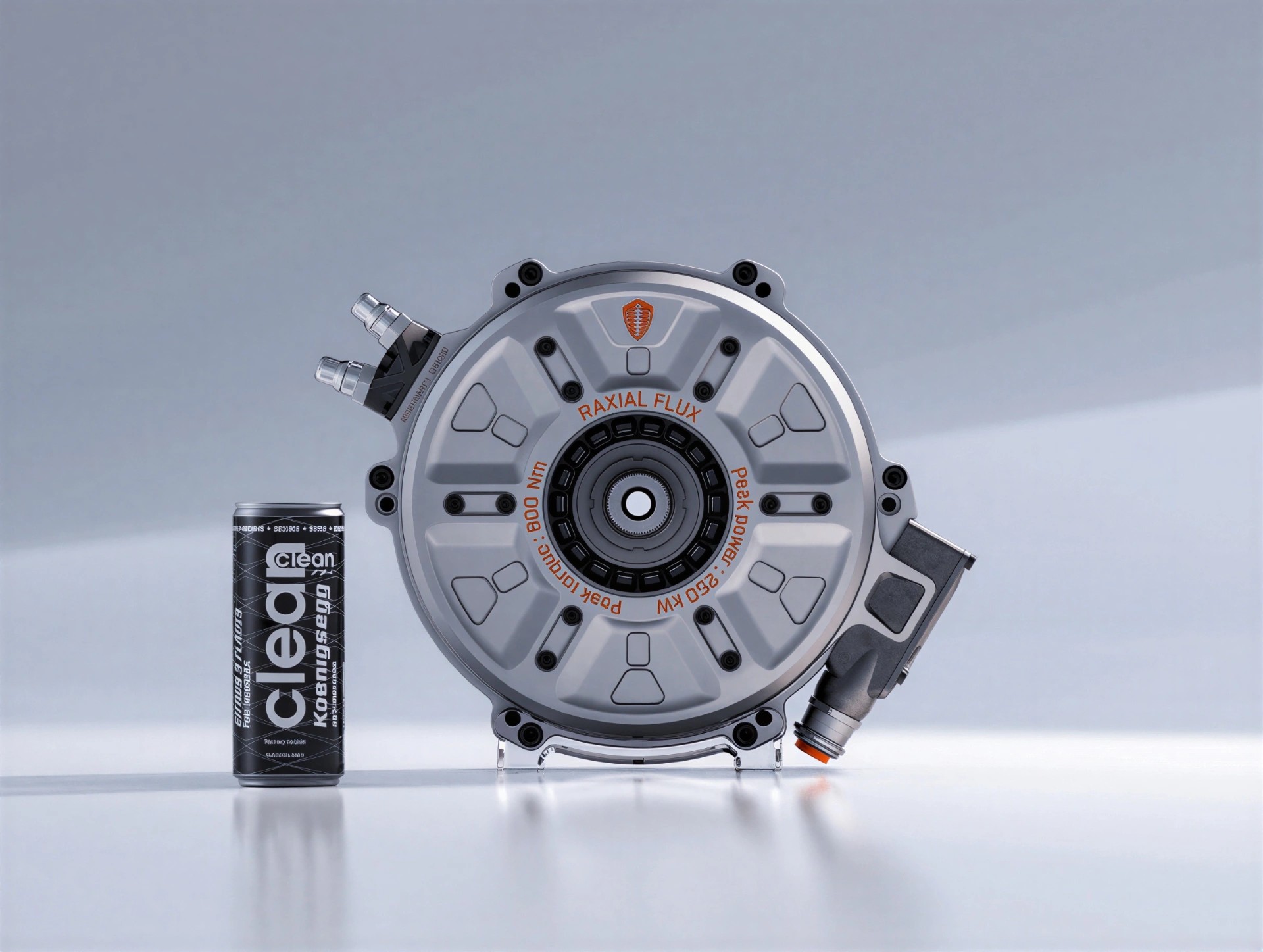
Electric motors are an integral part of modern life, so it is crucial that they work as efficiently as possible. Yet in essence they have barely changed since their invention – or what has changed amounts mostly to a facelift. Now that has changed, thanks to Koenigsegg, a Swedish carmaker known for its performance-focused sports cars.
Two centuries in three steps
According to a summary by Parvalux, the development of the electric motor began in 1821, when Michael Faraday discovered the principle of electromagnetic induction and built the first axial-type motor. Thirteen years later, in 1834, Thomas Davenport built the first working radial DC motor – the arrangement that became the basis of industrial electrification and defined the sector for more than 150 years.
The real breakthrough came in 1887–88 with Nikola Tesla's patents for the AC induction motor. According to Regal Rexnord's industrial history, this invention opened a new era of automation and industrial productivity: the AC system was more robust, reliable and efficient than the DC solutions before it.
The three-phase squirrel-cage induction motor – developed further by Dolivo-Dobrowolsky in 1889 – remains the most widespread type of machine in industry above 1 kW to this day.
The era of electric vehicles brought the rise of permanent magnet synchronous motors (PMSM). Following the development of neodymium–iron–boron magnets in the 1970s, a new dominant solution gradually emerged: a compact, efficient motor with high torque density that now forms the backbone of electric car drivetrains.
Who dominates the electric motor market?
According to IDTechEx's 2026 market analysis, permanent magnet solutions accounted for more than 75% of the EV motor market between 2015 and 2024 – and this share is not expected to fall below 70% in the next decade either.
PMSMs and axial flux motors together accounted for more than 86% of the EV motor market in 2024.
Four main types now compete in electric propulsion. The PMSM is the most widespread: Tesla, Toyota and Hyundai use it most, thanks to its outstanding efficiency and torque density. The AC induction motor (e.g. the Tesla Model S) is cheaper to make and needs no rare earths, but is less efficient at partial load. The electrically excited synchronous motor (EESM) is European manufacturers' (Renault, BMW) alternative for reducing rare earth dependence – it uses electromagnets instead of permanent magnets. The axial flux motor (e.g. YASA / Mercedes-AMG) offers outstanding torque and power density thanks to its disc design, but is more complex and expensive to manufacture.
The rare earth question
PMSM dominance comes at a price. According to S&P Global, demand for rare-earth-free motors will grow by 15% a year between 2025 and 2037 – driven by geopolitical tension. Rare earth demand linked to EV motors reached 37 kilotonnes in 2024 and rose further to 43 kt in 2025. IDTechEx's analysis of the rare earth market shows that China controls 85–90% of global rare earth magnet production.
The EU's position is well illustrated by the fact that it sources almost 98% of its roughly 16,000 tonnes of annual rare earth magnet imports from China.
Beijing actively uses this position as a strategic tool: in 2025 it introduced export restrictions on processed rare earth materials, causing production disruptions at Western EV makers and forcing Tesla, GM and others to develop alternative sourcing strategies. According to IDTechEx, despite the progress of rare-earth-free solutions, PM motors' market share will remain above 70% over the next decade – sustained by PMSM dominance in China's EV market.
Europe's response is twofold: on the one hand the spread of EESM (Renault, BMW, Volkswagen) and induction solutions (Tesla, GM, Audi), on the other investment in rare-earth-free magnet materials – such as Proterial's dysprosium- and terbium-free neodymium magnet announced in 2025.
Koenigsegg Quark: pushing the limits of physics
In 2022 the Swedish hypercar maker unveiled the Quark electric motor – a solution that fundamentally challenges previous design principles. Traditionally, axial flux motors are stronger in torque and radial ones in power density – but Koenigsegg's engineers did not want to sacrifice either.
Koenigsegg calls its solution raxial flux: a hybrid of radial and axial that achieves an industry-leading torque–power–weight ratio.
The first series-production version of the Quark delivers 600 Nm of torque and 250 kW of power at a weight of 28.5 kg – a remarkable figure in itself, and even more impressive given that the unit is barely bigger than an ordinary beer can.
To save weight, Koenigsegg used materials from aviation and motorsport: the shaft is made of 300M steel, and the rotor uses Aircore™ hollow carbon fibre technology – the same technology the brand uses in its wheels and steering wheels. Cooling is direct, which is better for compactness and efficiency than oil or water systems.
Combining two Quark motors with a single six-phase inverter called David produced the Terrier, a torque-vectoring EV drive unit for the four-seat Gemera hypercar. The system controls two motors with one inverter – reducing weight, complexity and part count.
The project was led by András Székely, head of electric motor development at Koenigsegg. According to Koenigsegg's press release, his team solved an engineering problem the traditional industry had found no answer to: how to make a motor small, light and extremely torque-rich at the same time. The manufacturer also envisions the Quark in aviation, VTOL and marine applications – direct drive allows it to reach the required speed and torque without a gearbox.
DeepDrive: the dual rotor and the in-wheel motor revolution
While Koenigsegg is reinventing motor design in the world of hypercars, Munich start-up DeepDrive offers a radically new solution for the mass market. In DeepDrive's dual-rotor motor, the stator drives an inner and an outer rotor at the same time – essentially packing two motors into one compact unit.
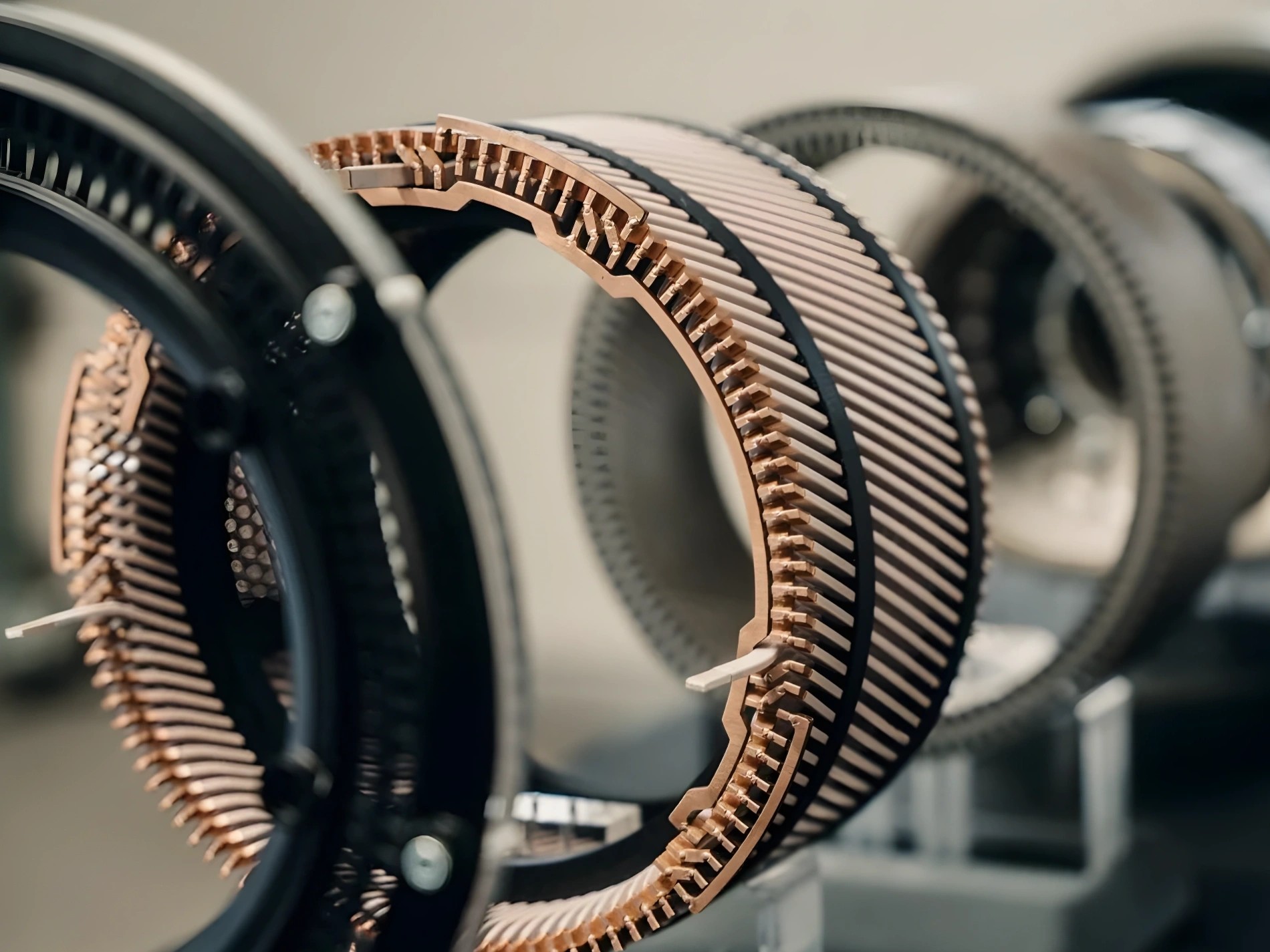
The RM 1250 in-wheel motor delivers 1,250 Nm of peak torque and 80 kW of peak power, with a built-in SiC MOSFET inverter and CAN interface.
The system promises a 20% efficiency gain over current EV drivetrains, allowing either a smaller battery or a longer range. According to DeepDrive, this would let electric cars travel more than 800 km on a single charge.
The company closed a €30 million Series B round in September 2024, led by BMW i Ventures, Continental's investment arm (co-pace) and other venture capital funds. Part of the investment will go into building production lines: DeepDrive plans small-series production for 2026, with large-scale series production scheduled for 2028–2029.
The collaboration with BMW entered the testing phase in summer 2024, with test drives of BMW models fitted with DeepDrive drive units. DeepDrive is working in parallel with eight of the world's ten largest carmakers – a remarkable achievement for a start-up founded only a few years ago.
The dual-rotor principle can be used flexibly in a centralised drivetrain paired with a gearbox, or as a direct in-wheel drive. The in-wheel version frees up the space between the wheels, opening entirely new possibilities in vehicle design.
The motors of the future
IDTechEx's 2026–2036 analysis identifies three defining trends. The first is the steep growth of axial flux and in-wheel motor applications, mainly in specialised vehicle categories where compact size and direct drive are decisive. According to QY Research, the in-wheel motor market could grow from $179 million in 2025 to $591 million by 2032, or 18.8% a year.
The second trend is software as a competitive advantage: torque-vectoring systems can control the torque of each wheel individually with millisecond precision, opening entirely new possibilities for stability and driving dynamics. The PACES platform presented by WATT EV and Donut Lab at CES 2026 is an early demonstration: in-wheel motors built into a light, modular chassis and controlled with millisecond precision allow unrivalled torque vectoring.
The third area – and one the industry is watching ever more closely – is eVTOL: electric vertical take-off and landing aircraft. According to a review (Zhao et al., 2025), eVTOL propulsion systems are developing towards high torque density and fault-tolerant operation – exactly the two characteristics the new generation of motors (Quark, DeepDrive) is optimised for.
The needs of the eVTOL market and automotive development thus reinforce each other: what is developed for hypercars and urban air mobility could find its way into ordinary cars within a few years.
One step up
All in all, the two-hundred-year history of the electric motor has reached a marked turning point. The current dominance of PMSMs is stable, but rare earth dependence on China puts lasting geopolitical pressure on the industry – and that pressure is accelerating alternative solutions. With its raxial flux topology, the Koenigsegg Quark has shown that the limits of physics can be pushed in reality, not just in computer simulations. DeepDrive's dual-rotor principle and the logic behind in-wheel motors suggest that the next big leap may come not so much in motor technology as in architecture: where, how and with what software the motor is integrated into the vehicle.
The future of electric propulsion will not be defined by a single breakthrough – but by when and how these mutually reinforcing developments meet mass production.
The electric motor is not a new invention: Faraday built the first axial-type motor in 1821, Davenport the radial one in 1834 and Tesla the AC induction version in 1888. In the 21st-century EV revolution, permanent magnet synchronous motors (PMSM) have become dominant, accounting for 86% of the EV motor market in 2024. But this comes with a serious dependence: China produces 85–90% of the world's rare earth magnets and supplies almost 98% of the EU's annual imports of 16,000 tonnes. The innovation race has brought revolutionary solutions on two fronts: Koenigsegg's 28.5 kg Quark motor, delivering 600 Nm of torque, pushes the limits of physics with its raxial flux design, while Munich-based DeepDrive's dual-rotor principle targets the mass market with a 20% efficiency gain and a potential range of 800 km.
The history of the electric motor began in 1821 with Faraday's axial motor and progressed through Davenport's radial DC motor of 1834 and Tesla's induction motor of 1888 to today's dominance of permanent magnet synchronous motors (PMSM). According to IDTechEx, more than 75% of the EV motor market between 2015 and 2024 used PM-based solutions, and in 2024 PMSMs and axial flux motors together accounted for 86% of the market.
This dominance, however, brings geopolitical vulnerability. China controls 85–90% of global rare earth magnet production and supplies almost 98% of the EU's annual imports of 16,000 tonnes. In 2025 Beijing introduced export restrictions, causing production disruptions and accelerating European manufacturers' (Renault, BMW) shift towards rare-earth-free EESM motors.
The innovation race has brought radical change in two areas. Koenigsegg's Quark motor delivers 600 Nm of torque and 250 kW of power at a weight of 28.5 kg – the industry's first raxial flux design, developed by the Swedish hypercar maker under the leadership of engineer András Székely. Munich start-up DeepDrive's dual-rotor in-wheel motor, by contrast, targets the mass market: it promises a 20% efficiency gain and a potential range of 800 km, began road tests with BMW in 2024 and is expanding production capacity with €30 million of funding. The in-wheel motor market is expected to reach $591 million by 2032.


The IEA expects the first annual fall in renewable additions in 21 years, the biggest six-year expansion on record, and a grid that is now the main thing standing in the way.

A new report projects data centres' water footprint reaching 9.32 trillion litres by 2030, but the number is only meaningful once you know what it counts, and who is making the case.

From 4 November, companies that want to buy biomethane can post their demand on the European Commission's platform and producers can bid from January. Here is what to do now and what the scheme will not give you.
The Dutch Authority for Digital Infrastructure warns that the shared cloud back ends behind home batteries, inverters and heat pumps could threaten grid stability, a risk EU rules only partly address.