AI's Thirst for Water: Data Centres and Public Water Systems
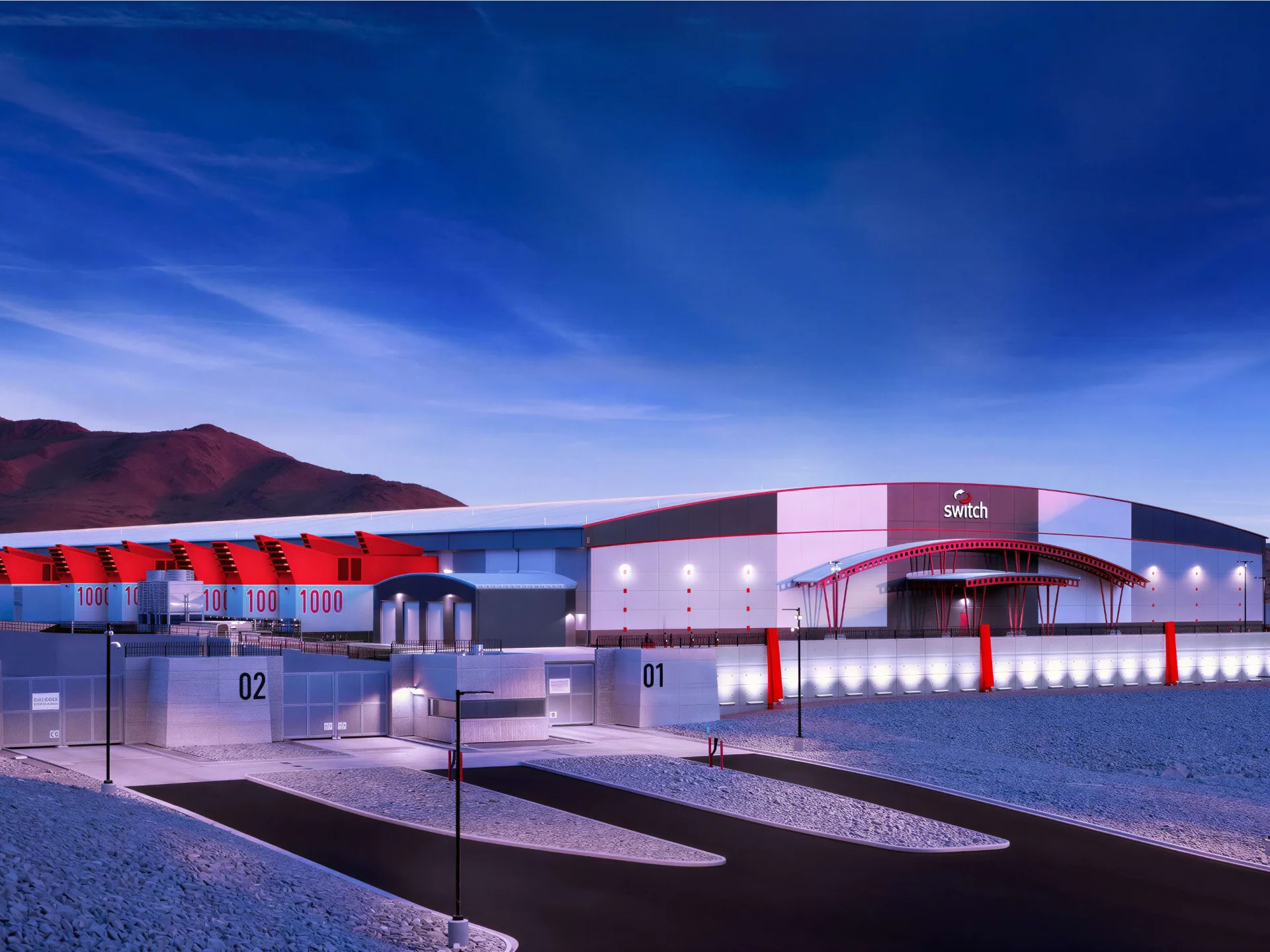
Over recent decades the internet has become indispensable infrastructure for modern society. As data traffic grows exponentially, so does the demand for data centres to store and process it. In these facilities, maintaining a stable temperature range of 18–27 °C is essential for servers and other IT systems to work reliably. High-performance hardware, however, generates large amounts of heat, creating extremely high cooling demand.
One of the most widespread and efficient ways to meet this demand is evaporative cooling. In cooling towers, heat is removed from the system by evaporating water. This consumes a great deal of water, which is expected to become a major water management, utility and urban development issue in the coming decades, reaching far beyond traditional data centre engineering.
A joint study by researchers at UC Riverside and Caltech (Han et al., 2026) has now quantified the problem at system level for the first time. It shows not only how much water American data centres consume, but also when and where that consumption becomes a real bottleneck for public drinking water networks. The study's conclusions apply not only to the United States – they are becoming increasingly relevant in Europe too.
The problem is not the annual average – it is the summer peak
One of the study's key findings is that the total annual water consumption of data centres is a misleading metric on its own. The annual total may look modest – but daily peak consumption paints a very different picture.
Data centres do not use water evenly: on the hottest summer days, daily peak consumption can be 6–30 times the annual daily average – and that is exactly when local public water systems are under the most strain and have the least spare capacity.
Water engineers call this ratio the peaking factor. An average household or office has a peaking factor of around 1.5–2.5. For a data centre with evaporative cooling it starts at 6 and, in cold climates – where cooling switches on for only a few hundred hours a year – can climb above 30.
Data measured in Iowa show that a large data centre's peak monthly water withdrawal was 4.3 times the monthly average; converted to a daily basis, the peaking factor is at least 6.45. This means that while the data centre barely draws any water from the network in January, on a scorching July day it may need 3,800–30,000 m³ of water. The entire daily capacity of many small and mid-sized water utilities is not much more than that.
The numbers: New York City's entire daily water supply
According to the study's projections, if water use intensity stays at 2024 levels (baseline), US data centres will need a total of 2.64–5.49 million m³ a day of new water capacity between 2024 and 2030. For comparison, New York City's entire daily water supply is about 3.79 million m³ a day, serving nearly 9 million people.
If the industry improves its water efficiency by 10% a year (best case), this falls to 0.86–2.29 million m³ a day – theoretically still enough to cover half a day of New York's water demand. The estimated cost of building the infrastructure is $7–58 billion in the baseline and $2–24 billion in the best case.
These sums are modest relative to the global AI industry as a whole – but for many local water utilities they are simply unaffordable. In response, Amazon, for example, has committed $400 million to upgrading local water infrastructure in Louisiana so that its data centres can use evaporative cooling without burdening existing customers.
Why do data centres become a water bottleneck?
The state of US drinking water networks explains why the issue is so sensitive. Of the country's roughly 50,000 community water systems, about 40,000 are small systems serving no more than 3,300 people. Their spare capacity is so small that the peak demand of a single mid-sized data centre could exhaust it entirely.
The case of Newton County, Georgia, shows how this plays out in reality, through two overlapping problems. In 2018 Meta began building a $750 million data centre on the county line. The finished facility uses about 10% of the county's total daily water consumption. The situation has become so serious that Newton County could face a water deficit by 2030 – and if the local water authority cannot expand its infrastructure, residents face water restrictions.
While this problem is already real and present, the county faces a second front. In recent months, nine more companies have applied to build in Newton County – some asking for 22,700 m³ of water a day, more than the county's entire current daily consumption. The director of the local water authority put it simply:
"What the data centers don't understand is that they're taking up the community wealth. We just don't have the water."
These applications have not been approved so far. Another problem is how long infrastructure development takes: exploring and commissioning a new water source can take up to 20 years. This makes planning especially urgent – data centres are built far faster than drinking water networks can expand.
Cooling technology as a decision point
Data centres can be cooled in two basic ways:
Dry cooling
It consumes no water at all, but in summer needs 10–35% more electricity than evaporative cooling. On summer days, when the power grid is under the heaviest load, this further worsens the energy balance.
Evaporative cooling
It removes heat efficiently by evaporating water and uses 25–35% less electricity in summer – but can need 1,000–8,000 m³ of water a day at peak load.
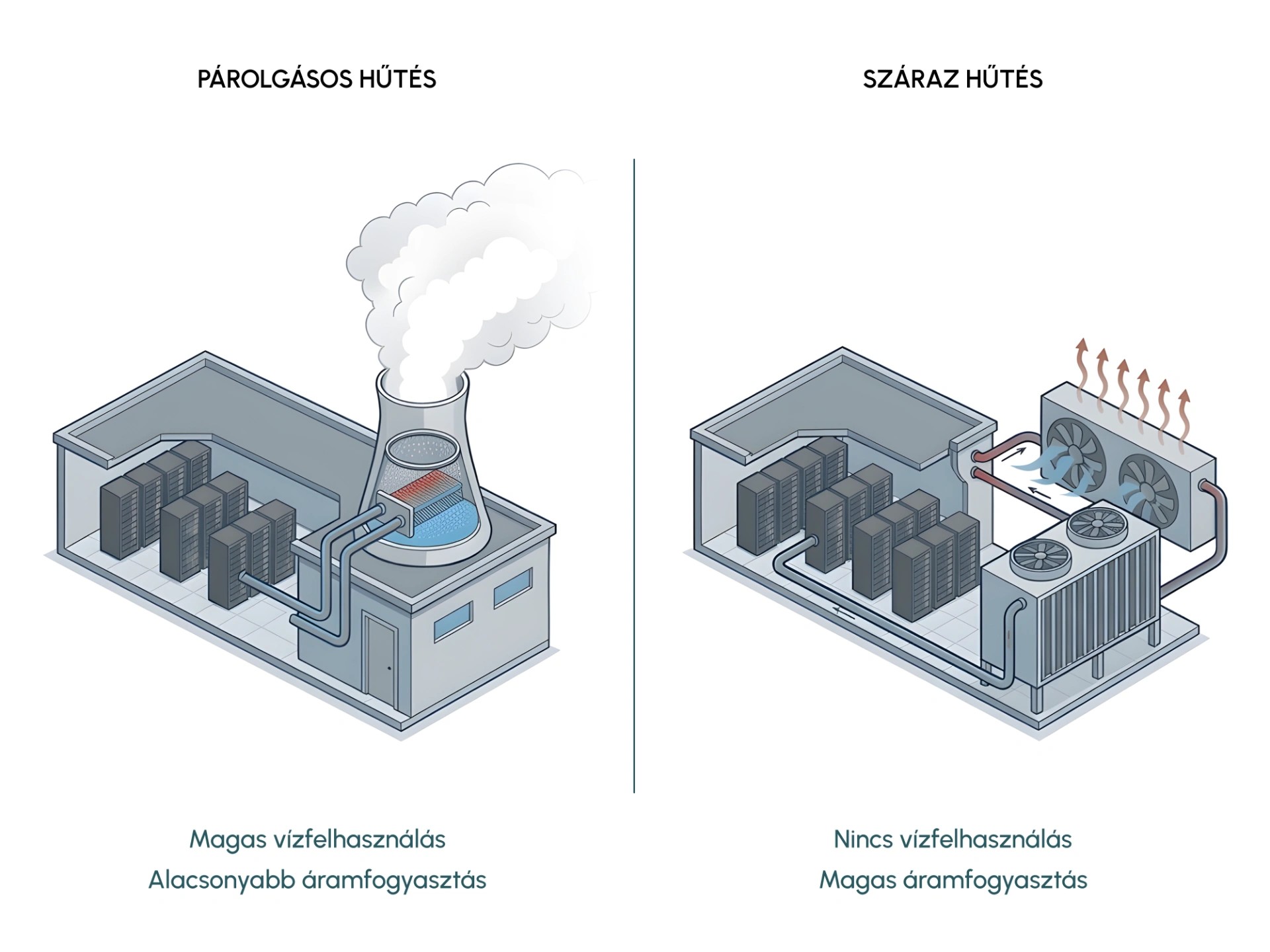
There is a fundamental trade-off between water and energy use – saving water puts more strain on the power grid, saving energy puts more strain on the water system. Without coordinated planning of the two resources, solving one problem makes the other worse.
The most advanced data centres increasingly use a hybrid solution: liquid-cooled AI servers with high temperature tolerance, handled by dry coolers all year round – but supplemented by evaporative cooling on the hottest summer days. This reduces annual water consumption but raises the peaking factor further, as water use becomes even more concentrated on a few critical days.
Since August 2024, for example, Microsoft has designed all new data centres with systems that lose no water to evaporation, and plans to bring the first such sites online in 2027. It is a significant shift for the industry – but changing existing facilities, designed for decades of operation, will be a slower process.
Water as a resource that cannot be redistributed
Unlike electricity, water cannot be moved over long-distance networks. What is scarce in Arizona or Georgia cannot be made up from Oregon. Drinking water is a local and seasonal resource: legislation, water rights, geology and climate together determine how much of it is available.
For data centres, this means that choosing the site of a large data centre is also a water decision – not merely a question of energy or real estate. More and more water utilities are setting conditions as a result: West Des Moines Water Works, a utility in Iowa, has since 2022 only signed contracts with new data centres that can show they can effectively reduce their peak water demand.
This approach – planning water capacity in advance – will become one of the defining norms of data centre development in the coming decade.
The European context
Europe's data centre industry is expanding rapidly on the back of the AI boom. Ireland, the Netherlands and the Nordic countries are the biggest hosts – but Central and Eastern Europe is playing a growing role in regional diversification, with Poland, the Czech Republic and Hungary all among the targets.
This expansion is happening just as summer heatwaves in southern and central Europe are becoming more intense and longer-lasting. Water stress – a worsening ratio between available and demanded water – is not a future scenario; it is already here.
In parts of Europe, groundwater abstraction already outpaces natural recharge – and every new large water user competes for the same limited reserves.
In this context, the water demand of data centre projects cannot be treated as a technical detail to be dealt with later. The question of peak water capacity must be built into permitting, site selection and investment conditions, just as it already is for energy infrastructure.
When the energy debate hides the water question
Across Europe, governments are competing for AI infrastructure. Hyperscale campuses with power demands of around 100 MW – roughly the output of a nuclear reactor unit – are being planned in several countries, often presented as major industrial investments.
Public debate around these projects has so far revolved almost exclusively around energy – understandably, since 100 MW of continuous power demand really is a system-level challenge. Questions about whether national power mixes, industrial electricity prices and import dependence make a country competitive for data centres dominate the discussion.
What this debate has almost entirely ignored is water use. According to the study, a data centre with evaporative cooling and an IT load of 100 MW could need 1,900–9,500 m³ of water capacity a day at peak times. Not every host town is Tokyo or Los Angeles: the spare capacity of local water systems is often limited. Proximity to a large river is an asset, but expanding public water infrastructure and obtaining water permits are lengthy processes.
According to a study published in early 2026, the AI industry's global water demand will grow by 129% by 2050. While many European countries are actively trying to attract data centre investment, it remains unclear how much attention the water consequences receive in strategic planning.
The EU's new water resilience strategy explicitly names the cooling water demand of data centres as an emerging challenge that, alongside digital development, could further increase demand for high-quality drinking water in Europe.
This is the question that must be asked of every data centre project: where will the water come from, and what will the impact be on the local public water system on the hottest days of summer?
The study's four recommendations – and what they mean for Europe
The Han et al. (2026) study makes four concrete recommendations:
- Disclose peak water use. Today data centres report only their total annual water consumption. The authors propose a new metric: pWUE (peak Water Usage Effectiveness), which relates water consumption on the most intensive day to IT energy use. For Europe: countries that want to host data centres should make this figure a mandatory element of their permitting systems.
- Corporate–community partnerships. Data centres should be not only consumers but also active developers of local water infrastructure. In the US, proportional contributions can be required by law. In Europe this is not yet regulated – but the logic is the same: part of the profit should be reinvested in community infrastructure.
- A "Pipe Neutral" commitment. Just as tech companies make "Water Positive" pledges for their total water consumption, the researchers propose a new concept: Pipe Neutral. This means a data centre funds as much new water capacity as it reserves – without reducing the reserves available to the host community.
- Joint water–energy planning. Evaporative cooling relieves the power grid during summer peaks – but only if water is available. The researchers call this a "water battery". Exploiting it requires coordinated energy and water planning, which is a serious coordination challenge wherever energy policy and water management are separate policy areas – as they are in most European countries.
In short, data centre water use looks like a technological problem but actually has resource management, utility and spatial planning dimensions. The problem lies not in total annual consumption but in the summer peak that local public water systems have to absorb – and for which many small and mid-sized water utilities are not prepared.
The biggest question is whether water infrastructure can keep pace with the growth of AI infrastructure over the next decade. It is a strategic question, not just an engineering one.
Did you know? The world's biggest data centres
The AI-driven expansion of data centres is straining not only power grids but, increasingly, drinking water networks too. A 2026 US study found that American data centres could need new water capacity equal to New York City's entire daily supply by 2030. The root of the problem is not total annual consumption but summer peak demand: on the hottest days, the daily water demand of evaporatively cooled data centres can be up to thirty times the annual daily average. In Europe, where data centre capacity is growing fast, public debate still focuses almost exclusively on energy, while the water implications receive little attention in strategic planning.
Water use by data centres is one of the least discussed yet most critical resource management issues of the coming decade. According to a joint study by researchers at UC Riverside and Caltech published in March 2026, US data centres will need 2.64–5.49 million m³ a day of new water capacity between 2024 and 2030 – comparable to New York City's entire daily water supply. The estimated cost of building the infrastructure is $7–58 billion.
The crux of the problem is that data centres' water demand is not steady. On the hottest summer days, daily peak demand can be six to thirty times the annual daily average. It therefore strains local public water systems exactly when their own spare capacity is tightest.
The choice of cooling technology rests on a fundamental trade-off: evaporative cooling needs 25–35% less electricity in summer but comes with a heavy water demand; dry cooling consumes no water but worsens the energy balance.
Europe's data centre industry is expanding rapidly, with Central and Eastern Europe also competing for AI investment – at a time when summer heatwaves in southern and central Europe are growing longer and more intense. Public debate has so far focused mainly on energy: whether national power mixes can serve such demand. The water dimension has been largely missing from strategic thinking, even though the spare capacity of local water systems, peak water demand and investment in the host community's infrastructure matter at least as much as the power supply.


A study of 10,826 Chinese treatment plants finds that big centralised systems are reaching two limits at once, on easing water scarcity and on paying their way, and that a hybrid model could do the job for up to 37% less.
FAO has published draft principles on who may use water and on what terms, a quiet piece of international work that speaks directly to this year's fights over drought, wells and free irrigation.

A new report projects data centres' water footprint reaching 9.32 trillion litres by 2030, but the number is only meaningful once you know what it counts, and who is making the case.
An English coalition has costed what it would take to keep every drop of wastewater out of England's largest lake, £3.6–3.7 billion, and its modelling says nothing less ends harmful algal blooms.