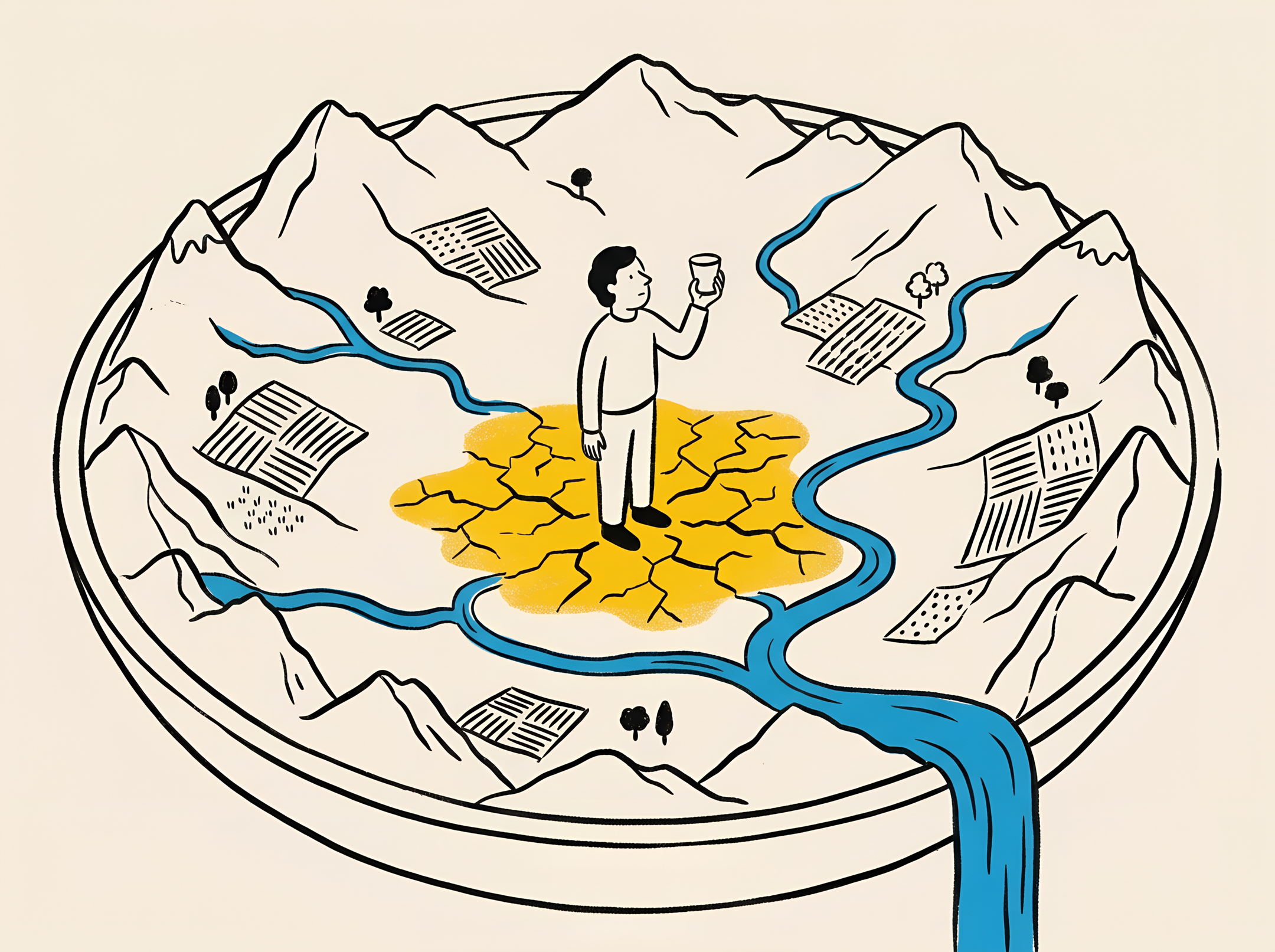
Europe's Water Systems on the Brink of Change
Our World Water Day series continues with a look at Europe's water systems.
Europe's water towers
For a long time Europe was considered an exception to the global water crisis. Its temperate climate, extensive river network and long regulatory tradition ensured a reliable water supply for hundreds of millions of people. Today, however, that picture is changing fast. Alpine glaciers are losing mass, Mediterranean droughts are deeper and longer, floods are increasingly destructive – and scientists are already warning that Europe has crossed the planetary boundary for freshwater, the threshold within which the continent's water systems still function stably.
Together, the UN's 2026 World Water Development Report (UN-Water, 2026) and its previous, glacier-focused 2025 edition (UN-Water, 2025) give a comprehensive picture of where Europe stands today – and what it risks if it fails to act in time.
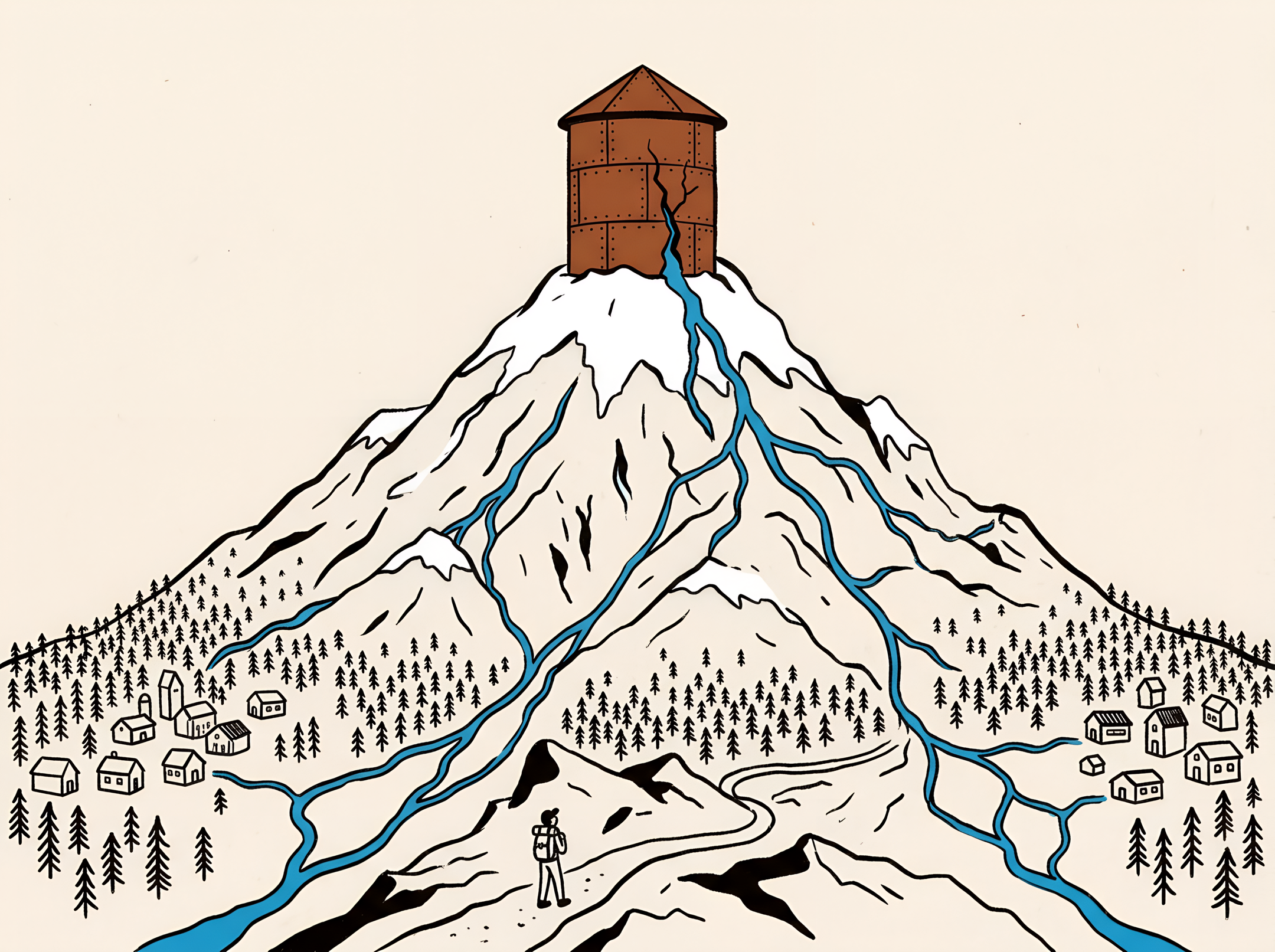
Europe's water tower is cracking
If one image had to capture Europe's water crisis, it would be the sight of retreating Alpine glaciers. The UN's 2025 WWDR documents in detail how Alpine snow and ice melt has for centuries provided a steady water supply to Europe's major rivers – including the Rhine, the Rhône and the Po. This natural regulating system is now changing fundamentally.
As a result of climate change, spring snowmelt is coming ever earlier, while in summer and autumn – when water demand is highest – less and less water flows down from the mountains. Glaciers are losing mass and their function as natural reservoirs is weakening. Temperatures on Alpine peaks have risen faster than the European average in recent decades, and some projections suggest that European Alpine glaciers face unavoidable ice loss until 2050 – meaning the effects of processes already under way could not be stopped even if emissions fell to zero immediately.
In areas that depend on Alpine water – from northern Italy through southern Germany to Austria – water supply security is still guaranteed by glaciers and snowmelt today. But that guarantee is becoming ever more fragile.
The Carpathians are no exception: according to the UN report, they are home to nearly 30% of Europe's plant species, and as a catchment area they are a vital source of water for Central Europe's river systems. The link between the health of mountain ecosystems and lowland water supply is direct and irreversible – when mountain systems weaken, the effect shows up immediately in river flows.
Droughts and floods: both extremes at once
Europe's water problems are not only visible in slow, decades-long changes – extreme weather events are signalling ever more dramatically that something has fundamentally changed. Paradoxically, a region that suffers months of drought one year may face catastrophic floods the next.
This is not random fluctuation but one of the most characteristic consequences of climate change: an intensified water cycle that brings both extremely high and extremely low rainfall. Italy's Po Valley has experienced both extremes in recent years: the river fell to historic lows during a severe drought, and months later devastating floods hit Lombardy. A similar pattern can be seen in Spain, Greece and Germany, where recent catastrophic floods have claimed lives and caused huge material damage.
In the Mediterranean, water stress has become a chronic problem. In parts of Spain and Cyprus, summer water shortages are no longer exceptional events but a standard part of annual planning. Meanwhile in Flanders – a traditionally water-rich region – groundwater levels have remained persistently low after successive dry years.
Europe's water crisis has many faces – drought and flood, chronic shortage and sudden abundance. The common denominator: the predictability of water systems has been shaken.
The development of groundwater levels in Central Europe is particularly worrying. After several consecutive drier-than-average years, groundwater reserves have not been able to recharge fully. This threatens not only drinking water sources but also agriculture, ecosystems and – through groundwater feeding rivers – surface water systems.
Water quality in Europe: much progress, but not enough
Europe has made real progress on water quality in recent decades – partly thanks to a strong legal framework. The 2020 recast of the EU Drinking Water Directive, which entered into force in 2021, set new standards in many areas: it updated water quality limits, introduced monitoring of endocrine disruptors and PFAS (so-called "forever chemicals"), and from 12 January 2026 made compliance with PFAS limits mandatory for member states.
The latter is particularly important: PFAS are extremely persistent in the environment, accumulate in living organisms, and research links their presence in drinking water to a growing number of health risks. An EU methodology for measuring microplastics also gained a legal basis in 2024, enabling member states to collect comparable data on this increasingly scrutinised pollutant.
The directive also obliges member states to reduce network water losses and increase transparency, and actively encourages drinking tap water instead of bottled water – an objective that also matters for the environment.
Despite all this, according to the UN WWDR, water quality monitoring is still incomplete in some member states, and diffuse agricultural pollution – from nitrates and pesticides to pharmaceuticals – places a heavy burden on rivers, lakes and groundwater.
The cornerstone of European water policy
In 2000 the European Union adopted the Water Framework Directive (WFD), which has since been the cornerstone of EU water policy. The directive manages water quality and quantity at river basin level, involving the relevant authorities, scientists and civil society. It laid the foundations for large-scale programmes such as the Dutch Room for the River initiative, which improved flood protection by restoring floodplains and natural water systems.
The directive's fitness check, completed in 2020, concluded that the WFD is up to date and necessary for achieving good ecological and chemical status in Europe's rivers, lakes and groundwater. Yet the European Commission is now considering amending some of its provisions. History offers a warning: in the 2000 Baia Mare mining disaster in Romania, cyanide-laden pollution entered the Tisza and then the Danube, causing one of Europe's worst environmental disasters. The case is still a reminder of what can happen when protective thresholds give way.
What works – and must be protected
Europe's water situation presents a mixed picture. On the one hand, the continent has largely solved the question of basic access: access to drinking water and sanitation in EU member states is almost universal. That alone is a huge achievement, built on decades of infrastructure development and strong regulatory frameworks.
On the other hand, climate change, glacier melt, extreme weather and pollution together put Europe's water systems under a pressure that existing infrastructure and regulation were not fully prepared for. Nature-based solutions – restoring floodplains, protecting peatlands, afforesting catchments – have proved effective, but their use is still patchy and their funding unpredictable.
The UN WWDR is clear: healthy rivers, lakes and wetlands are not obstacles to economic development – on the contrary, they are core infrastructure for a climate-resilient economy. Where floodplains are given back their natural place, flood damage falls. Where wetlands are preserved, water quality improves and the cost of wastewater treatment falls. Where groundwater is managed sustainably, agriculture and drinking water supply rest on safer foundations.
Managing Europe's water systems is not enough – they must be protected, restored and governed sustainably. This is not idealism but the cheapest long-term investment.
Looking ahead: what is Europe doing, and what should it do?
EU water legislation is world-leading by global standards. The recast Drinking Water Directive, the introduction of PFAS and microplastics limits and the preservation of the Water Framework Directive all point in the right direction. The EU's Zero Pollution Action Plan and Circular Economy Action Plan also contain water-related elements.
Experts and scientists nonetheless warn with one voice that weakening existing protective frameworks – whatever economic arguments are used to justify it – could cause irreversible damage. Repairing damage to water systems can take decades and cost billions. Cleaning up contaminated groundwater is sometimes impossible altogether – the damage is permanent.
World Water Day is a reminder that Europe's water future hangs in the balance. In the long run, the principles enshrined in the directives will only be upheld if economic and political decisions are based on science, precaution and long-term thinking – rather than on short-term competitiveness concerns or under pressure from global private equity funds and other economic lobbies.
Europe's water systems are under increasing pressure. Alpine glaciers are retreating, the Mediterranean faces chronic water stress, groundwater levels in Central Europe remain persistently low, and extreme weather – floods and droughts – is becoming ever more destructive. At the same time, the EU has built a strong legal framework: the Drinking Water Directive has introduced binding PFAS limits from 2026, and the Water Framework Directive has protected European rivers and lakes for decades. On World Water Day Europe's task is clear: preserve and strengthen what works, and speed up the use of nature-based solutions.
The state of Europe's water systems presents a mixed picture. On the one hand, the continent has achieved near-universal drinking water and sanitation coverage, and the EU has created world-leading water legislation – the Drinking Water Directive, recast in 2020, introduces binding PFAS limits from 2026, and the Water Framework Directive (WFD) has protected European waters through a river basin approach since 2000. On the other hand, climate change is fundamentally reshaping the continent's water resources.
Alpine glaciers are retreating, threatening the summer flow of many major rivers from the Rhine to the Po. In the Mediterranean – from Spain to Cyprus – water stress has become a chronic problem, while groundwater levels in Flanders and Central Europe remain persistently low after successive dry years. The catastrophic floods of recent years in Italy, Germany, Greece and Spain show that extremes in both directions are intensifying. Scientists conclude that Europe has crossed the planetary boundary for freshwater – the threshold within which water systems still function stably.
The UN WWDR is clear: healthy floodplains, wetlands and sustainable groundwater management are not a luxury but core infrastructure. Nature-based solutions – restoring floodplains, protecting peatlands, afforestation – have been shown to reduce flood damage and improve water quality. On World Water Day the task facing Europe is to defend existing protective frameworks, accelerate nature-based investment and treat water not as an economic burden but as our most fundamental shared treasure.


A study of 10,826 Chinese treatment plants finds that big centralised systems are reaching two limits at once, on easing water scarcity and on paying their way, and that a hybrid model could do the job for up to 37% less.
FAO has published draft principles on who may use water and on what terms, a quiet piece of international work that speaks directly to this year's fights over drought, wells and free irrigation.
A new report projects data centres' water footprint reaching 9.32 trillion litres by 2030, but the number is only meaningful once you know what it counts, and who is making the case.
An English coalition has costed what it would take to keep every drop of wastewater out of England's largest lake, £3.6–3.7 billion, and its modelling says nothing less ends harmful algal blooms.