What Is Hydrogen Good For? – Industry, Energy, Transport
This is the third article in our four-part series on hydrogen. In the first part we introduced the basics of hydrogen and mapped the global race; in the second we examined production technologies. This part looks at what hydrogen is really good for – where it is already present today and where it awaits a real breakthrough. The fourth part will examine the obstacles to the transition.
Hydrogen leads a double life. One life is invisible: it quietly sustains the material foundations of modern civilisation. The other is just being born: in Swedish steelworks, next to Patagonian wind farms, at Norwegian airports. To understand hydrogen's real role in the energy system, we need to know both.
Industry's invisible friend
Nearly 95% of global hydrogen use today is not in energy but in industry. Most of the nearly 100 million tonnes of global demand in 2024 comes from two sectors: refining with 41 million tonnes, and industry – including ammonia and methanol production – with 53 million tonnes (IEA, 2025).
Ammonia is produced from hydrogen and atmospheric nitrogen using the Haber–Bosch process. 60% of industrial hydrogen use goes into ammonia – most of which ultimately becomes fertiliser. Methanol accounts for a further 30%: it is a raw material for paints, plastics, adhesives and synthetic fibres. Refining needs hydrogen for desulphurisation processes without which today's fuel standards could not be met.
None of this is spectacular or makes headlines – but it is indispensable. What is spectacular is the next wave.
Green steel: the HYBRIT paradigm shift
Iron and steel production accounts for almost 7% of global carbon dioxide emissions. Conventional blast furnaces burn coking coal to reduce iron ore – a process that cannot, even in theory, be decarbonised without eliminating carbon emissions entirely. Hydrogen, however, can replace coal: in direct reduction, iron ore reacts with hydrogen, and the by-product is water instead of carbon dioxide.
Sweden's HYBRIT consortium – steelmaker SSAB, mining company LKAB and energy company Vattenfall – has been developing this technology since 2016.
The 2024 results are convincing: the pilot plant in Luleå produced 5,000 tonnes of zero-emission iron with a metallisation degree of 99% – and the quality of the product exceeds that of conventional blast furnace iron.
Hydrogen storage has also seen a breakthrough: a steel-lined rock cavern store has proved workable at industrial scale, and smart optimisation against fluctuating energy prices can cut operating costs by 26–31%.
The next step is a commercial plant with a capacity of 1.2 million tonnes a year in Gällivare, due to start operating in 2026. Volvo, Epiroc and Peab are already buying HYBRIT steel – hydrogen-based steelmaking is no longer an experiment.
Fuel cell vehicles: where is the market really moving?
The principle of a fuel cell vehicle is simple: hydrogen reacts with oxygen in the fuel cell, generating electricity, with water as the by-product. The global FCEV (hydrogen vehicle) fleet exceeds 80,000 – tiny compared with the number of combustion-engine vehicles, but the direction of growth is promising (Hydrogen Council & McKinsey & Company, 2025).
In passenger cars, the Toyota Mirai and Hyundai Nexo lead – but the lack of infrastructure is seriously holding back their market success. Only 1,100 refuelling stations operate worldwide, and in the passenger car market hydrogen is for now at a disadvantage compared with large battery electric fleets. According to the IEA's 2025 report, heavy trucks are the only fast-growing segment of the FCEV market.
The Hyundai XCIENT fuel cell truck is already in commercial operation in Switzerland and South Korea. Seoul's bus network aims to replace 1,300 diesel buses by 2026, with 2,000 new hydrogen buses a year to be put into service nationwide. Hydrogen's advantages in heavy transport are real: refuelling measured in minutes, ranges of over a thousand kilometres, and no loss of payload to battery weight.
A race car won on synthetic fuel
Synthetic fuel – also called e-fuel – is made by combining hydrogen with captured carbon dioxide. The result cannot be distinguished from conventional petrol in its combustion properties – but life-cycle calculations show it can emit up to 90% less carbon dioxide.
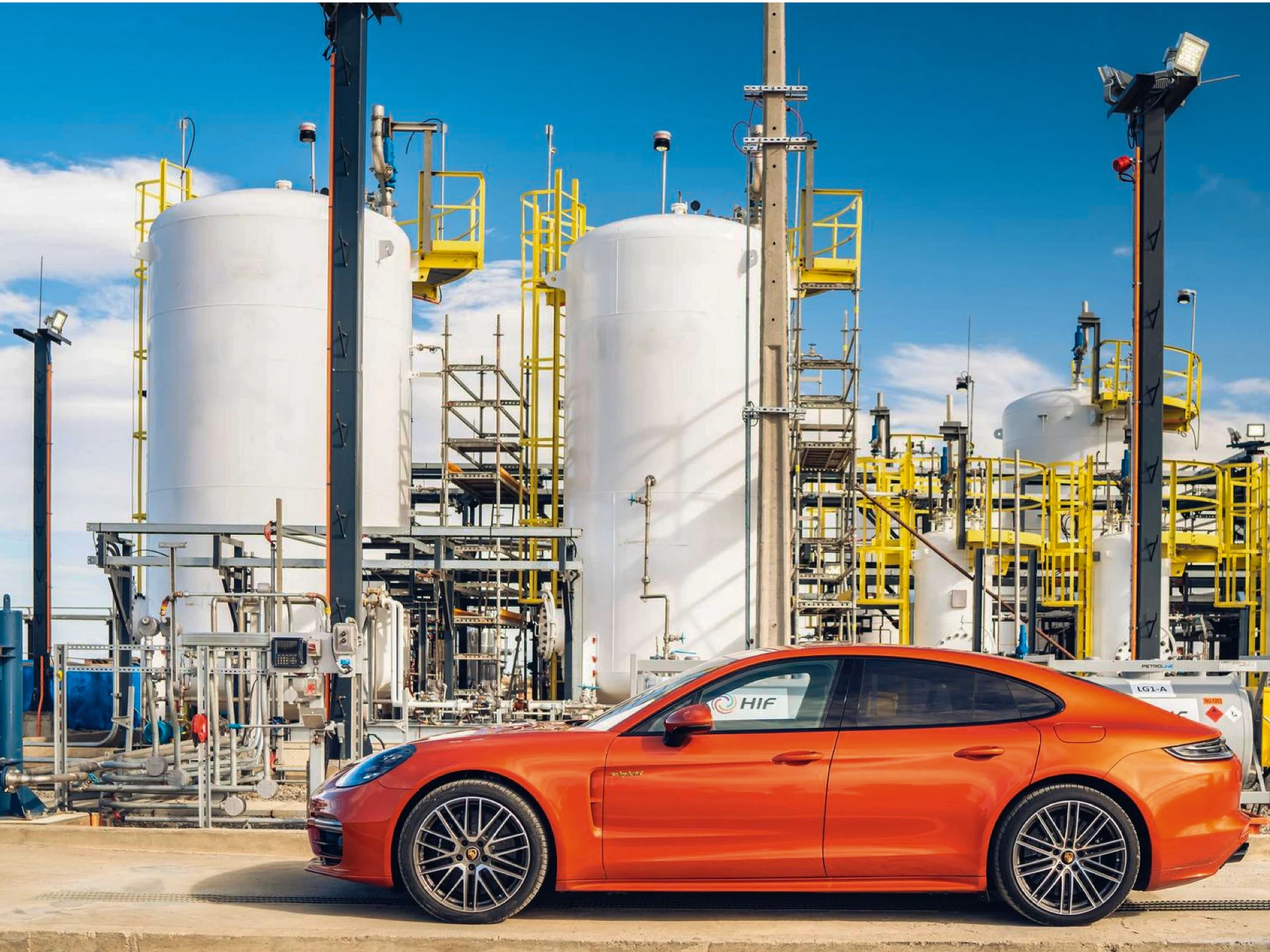
Porsche and HIF Global's Haru Oni project in Chile opened the world's first integrated, commercial-scale e-fuel plant in 2022. Patagonian wind power drives the electrolyser, and green hydrogen and captured carbon dioxide are turned into synthetic methanol and then synthetic petrol.
Current capacity is 130,000 litres a year. In 2024 Porsche ran all European rounds of the Mobil 1 Supercup on this fuel. The plant also holds ISCC RFNBO certification, meaning it meets the EU's renewable fuel standards.
The situation, however, is more nuanced than press releases suggest. Construction of the direct air capture (DAC) unit – which extracts carbon dioxide from the atmosphere – only began in December 2024, and its commissioning was still under way at the time of writing. Large-scale expansion – originally 55 million litres in the near term, then 550 million litres by 2026 – has slipped seriously. This does not show the failure of the e-fuel concept, but that industrial scaling is slower and more expensive than planned.
Hydrogen propulsion in the air and at sea
Aviation and shipping are the toughest areas of the energy transition: they need high energy density, have to be designed for long service lives, and battery solutions (with current technology) are physically impossible for larger vessels and aircraft.
In September 2025, British–American company ZeroAvia successfully simulated the full flight profile of its ZA600 fuel cell engine in a ground test – the system delivered power equivalent to an aircraft with up to 20 seats over a simulated 2 hour 38 minute route.
The EU is funding ZeroAvia's Norwegian project with a €21.4 million innovation grant: fitting 15 Cessna Caravan aircraft with fuel cell engines, building hydrogen infrastructure at 15 airports and starting commercial operations from 2028. In 2025 Airbus confirmed that it will base the next phase of its ZEROe programme on fuel cell technology, and it plans to launch the first hydrogen-powered commercial aircraft by 2035.
In shipping, more than 60 methanol-powered ships were in service by June 2025, with nearly 300 on order – one of the fastest-growing market segments for hydrogen-based fuels (synthetic methanol, green ammonia), according to IEA data.
Where hydrogen is used
| Application (example) | Maturity | H₂ type today | Main challenge |
|---|---|---|---|
| Traditional industry | |||
| Ammonia production (Haber–Bosch, global) | mature | grey | Meets the world's fertiliser demand – decarbonising it is industry's biggest emission-reduction opportunity |
| Methanol production (chemicals, global) | mature | grey | Raw material for plastics, adhesives and synthetic fibres – the switch to green methanol is slow |
| Oil refining (desulphurisation, global) | mature | grey | Indispensable for meeting fuel standards; switching H₂ source requires infrastructure |
| Industrial decarbonisation | |||
| Steelmaking (HYBRIT, Sweden) | pilot | green | Capital-intensive industrial scale-up; commercial plant starts in Gällivare from 2026 |
| Cement production (pilot projects, EU) | early | green/blue | High temperature demand; technology still at laboratory and pilot stage |
| Transport | |||
| Heavy trucks, buses (Hyundai XCIENT, Seoul bus fleet, Switzerland, South Korea) | commercial | green/blue | Lack of refuelling infrastructure; fuel price not yet competitive with diesel |
| Passenger cars (Toyota Mirai, Hyundai Nexo, global) | limited | green/grey | Only ~1,100 refuelling stations worldwide; economically disadvantaged against battery cars |
| Aviation (ZeroAvia, Airbus ZEROe, EU, USA) | early | green | Certification, safety, infrastructure; commercial operations expected between 2028 and 2035 |
| Shipping (green ammonia, synthetic methanol, global) | growing | green | 60+ methanol-powered ships in service, ~300 on order; fuel standardisation under way |
| Synthetic fuels | |||
| E-fuel (synthetic petrol), Haru Oni / HIF Global (Chile) | pilot | green | Industrial scale-up delayed; DAC unit under construction; current capacity 130,000 l/year |
| Energy system | |||
| Seasonal energy storage (Power-to-Gas projects, EU) | developing | green | Round-trip losses (efficiency ~30–40%); economical only at large, seasonal scale |
| Grid balancing (HYBRIT store, rock cavern, Sweden) | pilot | green | Storage proven at industrial scale; scaling up is capital-intensive |
As an energy carrier: grid balancing and seasonal storage
Hydrogen also plays a third, less spectacular role in the energy system: it can act as a "buffer" for renewable energy. When wind or solar power produces a surplus – at night, at weekends, in summer – the excess can be converted into hydrogen by electrolysis, stored and converted back into electricity when needed.
This Power-to-Gas logic enables seasonal energy storage – something batteries cannot do economically.
HYBRIT's hydrogen storage results are relevant here too: rock cavern storage has been proven under real industrial conditions and offers significant operating advantages through price optimisation against the grid. Hydrogen storage is gaining an increasingly important role in the EU's energy strategy for grid stability and long-term energy security.
Hydrogen's real place in the energy system
Hydrogen is not the opponent of electricity – nor is it a universal solution for everything. The real question is where a hydrogen-based solution beats direct electrification (Eszes, 2024).
According to the IEA and industry consensus, hydrogen performs best where direct electrification runs into physical or economic limits: in heavy industry, where high temperatures or chemical feedstocks are needed; in long-distance heavy transport; as a feedstock for synthetic fuels; and in seasonal energy storage. For passenger cars and short-distance transport, battery solutions are more efficient and economical.
This is not a downgrade. Deep cuts in carbon dioxide emissions from global heavy industry are impossible without hydrogen, and aviation and shipping will hardly become carbon-neutral without synthetic fuels. Hydrogen is the key to the part of the energy transition that the electric cable cannot reach.
Parallel realities
Hydrogen exists in two parallel realities at once. The first is invisible: for decades it has supplied fertilisers, plastics and refined fuels, quietly and indispensably. The second is just being born: Swedish steelworks are producing fossil-free iron, racing petrol is being distilled from wind power in Patagonia, fuel cell trucks are running on Swiss motorways, and hydrogen tanks are being built at Norwegian airports. According to 2024 data, new applications still account for less than 1% of global demand – but HYBRIT's 5,000 tonnes of zero-emission iron, ZeroAvia's €21.4 million EU grant and Haru Oni's ISCC-certified synthetic petrol cannot be dismissed as mere experiments. Hydrogen is not just a promise – in some industries it is already a decision.
Next part: why isn't the world running on hydrogen? The real obstacles to the transition
In this third part we went through the areas where hydrogen has already proved itself – and where its real potential lies. In the fourth and final part we examine why the transition is moving so slowly, even though the technology is available in many places. We will discuss the fragile points of the supply chain, the lack of infrastructure, the real costs of transport and storage, the chicken-and-egg market paradox – and how oil companies finance hydrogen projects while slowing down the real energy transition.
95% of global hydrogen demand today answers a single question: how to make ammonia, methanol and refined fuels. This industrial base is quiet but indispensable – food, plastics and steel all depend on it. The real change is happening at the margins: the HYBRIT project makes iron with hydrogen, Porsche makes synthetic fuel from Patagonian wind, and ZeroAvia is developing fuel cell engines for aircraft. Hydrogen's real strength comes into play where electric solutions are not enough – in heavy industry, long-distance transport and seasonal energy storage.
Hydrogen is one of the world's most important industrial raw materials today – and one of the least visible. Global demand was close to 100 million tonnes in 2024, of which refining used 41 million tonnes and ammonia and methanol production 53 million tonnes. These applications are not trends: hydrogen is a raw material for modern agriculture's fertilisers, for plastics and for pharmaceuticals – something most people do not know. Less than 1% of current demand comes from new applications, but that figure is growing fast.
At the forefront of industrial decarbonisation, the HYBRIT project has already proved itself: in 2024 the Swedish consortium produced 5,000 tonnes of zero-emission iron with a hydrogen-based process, at a metallisation degree of 99%. The next step is a plant with a capacity of 1.2 million tonnes a year in Gällivare, due to start operating in 2026.
In transport, trucks and buses are growing dynamically – progress in the passenger car market is much slower. The Haru Oni project in Chile produces 130,000 litres of synthetic fuel a year, enough for all races of the 2024 Porsche Mobil 1 Supercup – but large-scale expansion has slipped. In aviation, ZeroAvia's fuel cell engine (with €21.4 million of EU support) is aiming for commercial operating approval in Norway by 2028. Hydrogen also has a place in energy where electricity is not enough – and that field is huge.


The IEA expects the first annual fall in renewable additions in 21 years, the biggest six-year expansion on record, and a grid that is now the main thing standing in the way.


A new report projects data centres' water footprint reaching 9.32 trillion litres by 2030, but the number is only meaningful once you know what it counts, and who is making the case.
From 4 November, companies that want to buy biomethane can post their demand on the European Commission's platform and producers can bid from January. Here is what to do now and what the scheme will not give you.

The Dutch Authority for Digital Infrastructure warns that the shared cloud back ends behind home batteries, inverters and heat pumps could threaten grid stability, a risk EU rules only partly address.