The Po on the Brink of Drying Up, the Iberian Peninsula in Flames
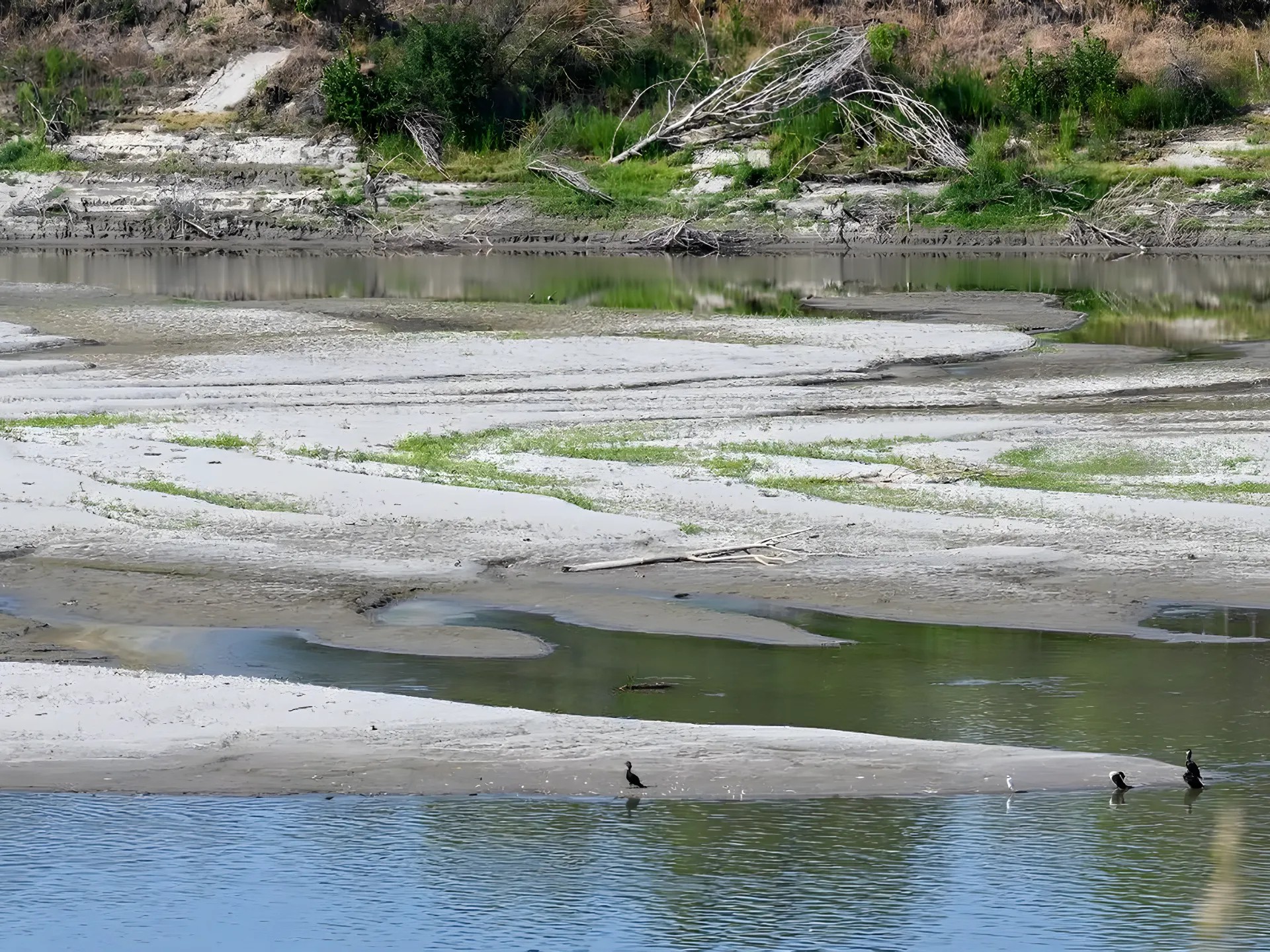
In recent days, the authority responsible for the basin of the Po in northern Italy (ADBPO) has described the situation as extremely critical: at the current rate of irrigation, the river's water reserves will last only 10 days unless significant rain falls in the region soon. Since the Po Valley is one of Italy's most important agricultural areas, farmers urgently need to look for alternative water sources – and the situation is not an isolated phenomenon but one of the most serious symptoms of a much wider drought crisis affecting the whole of southern Europe.
The death throes of the Po
Because of the reduced flow, salt water from the Adriatic has pushed 20–25 kilometres up the riverbed, which partly makes it impossible to irrigate fields – and according to the authority, the ecosystem as a whole may also be at risk.
The region's lakes are also shrinking fast: Lake Maggiore lost 17% of its volume – 33 centimetres – in just one week, and the level of Lake Como fell by 15%. The north-eastern Veneto region, where the Po flows into the Adriatic, declared a state of emergency at the beginning of the month, and an emergency meeting was convened in Piedmont, at the river's source, to deal with the situation.
The phenomenon is not new, and according to science it is getting worse. According to a study by Montanari and colleagues in Science Advances, droughts in the Po basin are among the most severe of the past two hundred years, caused by unusually persistent anticyclonic conditions over the region – which bring lack of rain and high temperatures at the same time, reinforcing each other (Montanari et al., 2023).
Iberia, France and Greece in flames
While rivers shrink in Italy, on the western and southern edges of the continent the drought is already wreaking havoc in the form of wildfires. On the first weekend of July 2026, a total of around 190 square kilometres – twice the size of Manhattan – burned in Portugal, Spain, France and Greece. In France, around Perpignan at the foot of the Pyrenees near the Spanish border, 700 firefighters battled a rapidly spreading fire while 10,000 people had to be evacuated. Organisers closed part of the third stage of the Tour de France to spectators, and the European Union sent firefighting aircraft from Cyprus and Sweden to help the French firefighters.
One of the fires in northern Portugal destroyed around 13,000 hectares of forest and scrub before the authorities managed to bring 80% of the flames under control. In Greece, fires broke out around both Thessaloniki and Athens, and the authorities warned residents of toxic smoke.
In total, in Spain alone 14 major fires have destroyed around 50,000 hectares so far this summer, and in Portugal the burned area has reached 30,000 hectares. The fires have claimed at least 14 lives so far, and according to the World Weather Attribution group, the June heatwave alone caused more than 5,600 excess deaths in European cities.
The severity of the situation is shown by the fact that the European Union has deployed a record number of firefighters and 22 firefighting aircraft in the region, while in France the burned area is already almost double that of the same period last year. The persistent heat also threatens energy supply: because of low and warming water in the Rhine basin and other rivers, the French power company has warned of output restrictions at several nuclear plants – including Chooz, Blayais, Bugey and Golfech.
Warming on a continental scale
Behind the local crises lies a much broader climate trend. According to the European State of the Climate 2025 report, published this spring by the Copernicus Climate Change Service (C3S) and the World Meteorological Organization (WMO), Europe has been warming twice as fast as the global average since the 1980s, making it the fastest-warming continent on Earth (C3S & WMO, 2026).
In 2025, at least 95% of the continent was warmer than average, and in terms of soil moisture it was one of the three driest years in Europe since 1992. Flows were below average in 70% of rivers, and in May 53% of the continent was affected by some degree of drought.
As a result, a record area of more than 1 million hectares (exactly 1,034,550 hectares) burned in Europe in 2025 – more than ever before – almost half of it in Spain. According to the report's authors, the combined effect of heat and drought increasingly determines the course of the fire season: not only persistent heat but also its intensity is becoming an ever more important factor in how fires behave.
The situation demands action in water management
The emergency on the Po is a warning sign in itself, but it takes on its real weight when seen as part of the southern European drought crisis as a whole. The drying of the Italian river, the burning forests of the Iberian Peninsula, France and Greece, and the record figures in the Copernicus report are all faces of the same process – a Europe warming twice as fast as the global average. While the ADBPO counts the Po's remaining water in days, the continent's decision-makers must find answers for water management, fire protection and food security looking decades ahead.
According to the Po River Basin District Authority (ADBPO), the river's water reserves will last only 10 days if no rain falls. Because of the falling flow, salt water from the Adriatic has pushed 20–25 kilometres inland from the mouth, and the levels of Lake Como and Lake Maggiore fell by 15% and 17% in a single week. According to a 2023 study in Science Advances, the Po drought is among the most severe in two hundred years. The water crisis is not an isolated phenomenon: in July, a total of 190 square kilometres burned in Portugal, Spain, France and Greece, and in Spain 14 major fires destroyed 50,000 hectares. According to the EU's Copernicus climate service, Europe is warming twice as fast as the global average; in terms of soil moisture, 2025 was one of the three driest years since 1992, and a record area of more than 1 million hectares burned across the continent.
According to the Po River Basin District Authority (ADBPO), at the current rate of irrigation the river's water reserves will last only 10 days unless significant rain falls. Because of the falling flow, salt water from the Adriatic has pushed 20–25 kilometres inland from the mouth, endangering irrigation and the ecosystem. The region's lakes are also shrinking: Lake Como fell by 15% and Lake Maggiore by 17% (33 centimetres) in a single week. According to a study by Montanari and colleagues in Science Advances, the drought affecting the Po is among the most severe of the past two hundred years, caused by persistent anticyclonic conditions.
The Po crisis, however, is only one part of a much wider southern European drought. In July 2026, around 190 square kilometres burned in Portugal, Spain, France and Greece in a single weekend, and in France 10,000 people had to be evacuated around Perpignan. In Spain, 14 major fires destroyed a total of 50,000 hectares, in Portugal 30,000 hectares burned, and the fires have claimed at least 14 lives so far. The European Union deployed a record number of firefighters and 22 firefighting aircraft in the region. According to the latest report of the EU's Copernicus Climate Change Service (C3S), Europe has been warming twice as fast as the global average since the 1980s; in terms of soil moisture 2025 was one of the three driest years since 1992, flows were below average in 70% of rivers, and a record area of more than 1 million hectares burned across the continent – almost half of it in Spain.



A study of 10,826 Chinese treatment plants finds that big centralised systems are reaching two limits at once, on easing water scarcity and on paying their way, and that a hybrid model could do the job for up to 37% less.
FAO has published draft principles on who may use water and on what terms, a quiet piece of international work that speaks directly to this year's fights over drought, wells and free irrigation.

A new report projects data centres' water footprint reaching 9.32 trillion litres by 2030, but the number is only meaningful once you know what it counts, and who is making the case.
An English coalition has costed what it would take to keep every drop of wastewater out of England's largest lake, £3.6–3.7 billion, and its modelling says nothing less ends harmful algal blooms.